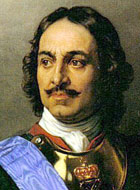

Reforms of Peter I - transformations in state and public life , carried out during the reign of Peter I in Russia .
All the reforming activities of Peter I can conditionally be divided into two periods ( stages ): 1696 - 1715 and 1715 - 1725 .
The peculiarity of the first stage was the rush and not always thought out character, which was explained by the conduct of the Northern War . Reforms were aimed primarily at raising funds for the war, carried out by force and often did not lead to the desired result. In addition to state reforms, at the first stage, extensive reforms were carried out with the aim of modernizing the way of life. In the second period, reforms were more systematic.
A number of historians, for example V.O. Klyuchevsky , pointed out that the Petrine reforms were only a natural continuation of the changes that took place during the 17th century. Other historians (for example, Sergey Solovyov ), on the contrary, emphasized the revolutionary nature of Peter's transformations.
Historians who analyzed Peter's reforms hold different views on his personal participation in them. One group believes that both in drawing up the reform program and in the process of their implementation, Peter did not play the main role (which was attributed to him as the king). Another group of historians, on the contrary, writes about the great personal role of Peter I in carrying out various reforms.
Public Administration Reforms
Having been in the West, Peter I finally became convinced of the need for Europeanization of the country. This verdict, handed down by Peter, can be called the main result of all trips to European countries. Upon arrival in Moscow, Peter began to introduce "foreign customs", that is what their people called them. As it seemed to ordinary citizens, Peter himself did not fully understand the essence of the reforms introduced by him. The main part of the indignation was caused by reforms related to clothing, and appearance in general, which was only worth the tax on wearing a beard. As Peter himself will later explain, he was motivated by a great desire to quickly make Russia at least outwardly similar to Europe, but because of the chaos many did not share this idea, fortunately, there were faithful people who, despite not understanding Peter's actions, remained with him in every way supported him.
Peter I initially did not have a clear reform program in government . The emergence of a new state institution or a change in the administrative-territorial government of the country was dictated by the conduct of wars, which required significant financial resources and mobilization of the population. The system of power inherited by Peter I did not allow collecting enough funds for the reorganization and expansion of the army, the construction of the fleet , and the construction of fortresses in St. Petersburg .
From the first years in Peter's policy, there was a tendency to reduce the role of the ineffective Boyar Duma in government. In 1699, the Near Chancellery was organized at the Tsar ’s [1] , and later Consuls (Council) of ministers gathered in its premises, which included up to 15 proxies who controlled individual orders . It was a prototype of the future Governing Senate , formed on February 22 ( March 5 ), 1711 . The last mention of the Boyar Duma (more precisely, “congresses of the boyars”) dates back to 1708: at that time, participants in meetings of the “consiliums” could be called both “boyars” and “ministers” [2] . Since 1708, a certain mode of work has been established in the Consilia: each minister had special powers, reports and minutes of meetings appear.
In 1711, instead of the Boyar Duma and the Consulate that replaced it, the Senate was established. Peter formulated the main task of the Senate: “ Watch expenditures throughout the state, and unnecessary, and especially vain, set aside. It’s possible to take away money, as long as money is the artery of war. "
Created by Peter for the current government during the absence of the king (at that time the king went on a Prut campaign ), the Senate, consisting of 9 people (presidents of the collegiums), gradually turned from a temporary to a permanent higher government institution, which was enshrined in Decree 1722 . He controlled justice, was in charge of trade, fees and expenses of the state, monitored the serviceability of serving military service by the nobles, he was transferred to the functions of the Rank and Ambassadorial orders .
Decisions in the Senate were taken collectively at a general meeting, and supported by the signatures of all members of the highest state body. Thus, Peter I delegated part of his authority to the Senate, but at the same time entrusted its members with personal responsibility.
Simultaneously with the Senate, the post of fiscals appeared. The duty of the chief fiscal under the Senate and the fiscals in the provinces consisted of secret supervision of the institutions: they revealed cases of violation of decrees and abuses and reported to the Senate and the king. Since 1715, the work of the Senate was monitored by the auditor general , from 1718 renamed the chief secretary . Since 1722, control over the Senate has been carried out by the prosecutor general and chief prosecutor , to whom the prosecutors of all other institutions were subordinate. No Senate decision was valid without the consent and signature of the Attorney General. The prosecutor general and his deputy chief prosecutor were directly subordinate to the sovereign.
The Senate, as a government, could make decisions, but they needed an administrative apparatus to execute them. In 1717 - 1721, a reform of the executive governing bodies was carried out, as a result of which 13 colleges , the forerunners of future ministries, were created along with the Swedish system of orders [3] with their vague functions. Unlike orders, the functions and fields of activity of each college were strictly delimited, and relations in the college itself were built on the principle of collegiality of decisions. Were introduced:
- The college of foreign (foreign) affairs - replaced the Ambassadorial order , that is, was in charge of foreign policy.
- Military Collegium (Military) - manning , armament , equipment and training of the army.
- Admiralty College - naval affairs, navy.
- The patrimonial board replaced the Local Order , that is, was in charge of noble land tenure (land lawsuits, transactions for the purchase and sale of land and peasants, the search for the fugitives were considered). It was founded in 1721.
- Chamber Collegium - collection of state revenues.
- Staff-office-board - was in charge of government spending.
- Revision board - control over the collection and expenditure of public funds.
- Commerce Collegium - shipping, customs and foreign trade.
- Berg-collegium - mining and metallurgy (mining industry).
- Manufactory College - light industry (manufactories, that is, enterprises based on the division of manual labor).
- The justice collegium was in charge of civil proceedings (the Serfdom operated under it: it registered various acts - merchants, on the sale of estates, spiritual wills, and debt obligations). Engaged in civil and criminal courts.
- The Ecclesiastical Collegium , since 1721 the Most Holy Governing Synod , managed church affairs, replaced the patriarch and Councils of the Russian Orthodox Church. The composition of this board included representatives of the higher clergy. Since their appointment was carried out by the tsar, and decisions were approved by him, we can say that the Russian emperor became the de facto head of the Russian Orthodox Church. The actions of the Synod on behalf of the highest secular authorities were controlled by the Chief Prosecutor , a civil servant appointed by the tsar. By a special decree, Peter I ordered the priests to carry out an educational mission among the peasants: to read sermons, instructions, teach children prayers, and cultivate respect for the king and the church with them.
- Little Russian Collegium - exercised control over the actions of the hetman , who owned power in Ukraine, because there was a special local government regime. After the death of Hetman I.I. Skoropadsky in 1722, new hetman elections were banned, and the hetman was first appointed by royal decree. The college was headed by the tsarist officer .
Since February 28 ( March 10 ), 1720 , the General Rules introduced a uniform system for the entire country in the state administration. According to the regulations , the board consisted of the president , 4-5 advisers and 4 assessors .
The central place in the control system was occupied by the secret police : the Preobrazhensky order (in charge of state crimes cases) and the Secret Chancellery . These institutions were run by the emperor himself.
In addition, the Salt Office , the Copper Department , and the Land Survey Office operated.
The “first” colleges were called Military, Admiralty and Foreign Affairs.
The collegiums were two institutions: the Synod and the Main Magistrate .
The collegiums were subordinate to the Senate , and to them - the provincial, provincial and district administration .
The results of the management reform of Peter I are controversially examined by historians.
Regional Reform
In 1708 - 1711, a regional reform was carried out with the aim of strengthening the vertical of local power and better providing the army with supplies and recruits. In 1708, the country was divided into 8 provinces, headed by governors , vested with the entirety of judicial and administrative power: Moscow , Ingermanland (later St. Petersburg), Kiev , Smolensk , Azov , Kazan , Arkhangelogorodsky and Siberian . The Moscow province gave more than a third of the revenue to the treasury, followed by the Kazan province.
The governors also knew the troops located in the province. In 1710, new administrative units appeared - shares , uniting 5536 households. The first regional reform did not solve the tasks, but only significantly increased the number of civil servants and the cost of their maintenance.
In 1719 - 1720, the second regional reform was carried out, which liquidated the shares . Provinces began to be divided into 50 provinces led by governors , and provinces into districts led by zemstvo commissars appointed by the Chamber College . The governor was left with only military and judicial matters.
Judicial Reform
Under Peter I, the judicial system underwent radical changes. The functions of the supreme court were received by the Senate and the Justic College. Below them were: in the provinces - gofgericht , or court of appeal courts in large cities, and provincial collegiate lower courts. Provincial courts conducted civil and criminal cases of all categories of peasants, except for the monastery, as well as the townspeople not included in the settlement. The court cases of the townspeople included in the Posad have been led by a magistrate since 1721. In other cases, the so-called sole court acted (cases were decided solely by the zemstvo or city judge). However, in 1722, the lower courts were replaced by provincial courts, headed by the governor [4] [5] . Judges were also separated from the administration.
Control over the activities of public servants
To control the implementation of decisions on the ground and reduce rampant corruption, the post of fiscals was established in 1711 , which was supposed to "secretly conduct, report and denounce" all abuses, both of high and lower officials, prosecute embezzlement, bribery, and accept denunciations from private individuals . At the head of the fiscals was the chief fiscal , appointed by the emperor and subordinate to him. The ober-fiscal was part of the Senate and maintained contact with subordinate fiscals through the fiscal table of the office of the Senate. The denunciation chamber was examined and monthly reported to the Senate by the Reprimanding Chamber - a special judicial presence of four judges and two senators (existed in 1712-1719) [6] [7] .
In the years 1719-1723. the fiscals were subordinate to the Justits College, with the establishment in January 1722 of the position of Attorney General were supervised by him. Since 1723, the main fiscal was the fiscal general appointed by the sovereign; his assistant was the chief fiscal appointed by the Senate. In this regard, the fiscal service withdrew from the jurisdiction of the Justitz College and regained departmental independence. The vertical fiscal control was brought to the level of the city [6] [7] .
Military Reform
Army reform: in particular, the introduction of regiments of the new system , reformed according to a foreign model, was begun long before Peter I, even under Alexei Mikhailovich . However, the combat effectiveness of this army was low [8] . The reform of the army and the creation of the fleet became necessary conditions for victory in the Northern War of 1700-1721 . In preparation for the war with Sweden , Peter ordered in 1699 to make a general recruitment and begin training military personnel ( soldiers , dragoons , reytar and so on) according to the model instituted by the Preobrazhentsev and Semenovtsev. This first recruitment recruitment gave 29 infantry regiments and two dragoons. In 1705, every 20 yards were supposed to put up one recruit for life. Subsequently, recruits began to be taken from a certain number of male souls among the peasants. Recruitment into the fleet , as well as into the army, was carried out from recruits.
In addition to the organizational structure, Peter changed the system of material supply of the army and did much to provide the army with domestic weapons. Already in the midst of the Northern War of 1700-1721, Peter opened many weapons factories, the most famous of which were the Tula Arms Plant and the Olonets Artillery Plant . In terms of material support, Peter Alekseevich introduced uniform uniforms in the Russian army for the ground (green caftans and black hats) and cavalry troops (blue caftans and black hats). According to the military charter [ to which? ] In 1716, food was also standardized, grocery stores were opened throughout the country.
If at first among the officers there were mainly foreign specialists, then after the beginning of the work of the navigation, artillery, and engineering schools , the growth of the army was satisfied by Russian officers from the nobility . In 1715, the Maritime Academy was opened in St. Petersburg . In 1716, the Military Charter was issued, which strictly defined the service, rights and obligations of military personnel.
As a result of the reforms, a strong regular army and a powerful navy were created, which Russia simply did not have before. By the end of the reign of Peter, the number of regular ground forces reached 210 thousand (of which 2600 were in the guard , 41 560 in the cavalry, 75 thousand in the infantry , 14 thousand in the garrisons ) and up to 110 thousand irregular troops . The fleet consisted of 48 battleships, 787 galleys and other ships; there were almost 30 thousand people on all ships [9]
Church Reform
One of the reforms of Peter I was the reform of church governance that he carried out, aimed at the elimination of church jurisdiction autonomous from the state and the subordination of the Russian church hierarchy to the Emperor. In 1700 , after the death of Patriarch Hadrian , Peter I instead of convening a council for the election of a new patriarch temporarily placed the clergy of Ryazan Stefan Yavorsky at the head of the clergy, who received the new title of Overseer of the Patriarchal Throne or “Exarch”.
To manage the property of the patriarchal and bishop’s houses, as well as monasteries, including the peasants belonging to them (approximately 795 thousand), the Monastery order was restored, headed by I. A. Musin-Pushkin , who again began to judge the monastery peasants and to control the income from church-monastic land tenure. In 1701, a series of decrees was issued to reform the management of church and monastery possessions and the organization of monastic life; the most important were the decrees of January 24 and 31 ( February 11 ), 1701 .
In 1721, Peter approved the Spiritual Rules , the compilation of which was entrusted to the Pskov bishop, an approximate king of Little Russia Feofan Prokopovich . As a result, a fundamental reform of the church took place, eliminating the autonomy of the clergy and completely subordinating it to the state. The patriarchate and collegiality of the Russian Orthodox Church was abolished in Russia . The Ecclesiastical Collegium was established at the first meeting, in 1721, renamed the Holy Synod , which was recognized by the Eastern patriarchs as equal to the patriarch. All members of the Synod were appointed by the Emperor and brought him a loyal oath of office upon assuming office. St. Synod was the highest public authority in its power equal to the Senate. On the spiritual side, he gave instructions to all the lower institutions of the empire. The Holy Synod and the Senate were communicated with "witches." Under Peter I, these bodies held joint conferences. Wartime stimulated the seizure of valuables from the monastery vaults. Peter did not go to the full secularization of church and monastery possessions, which was carried out much later, at the beginning of the reign of Catherine II .
Religious Policy
The era of Peter was marked by a tendency toward greater religious tolerance. Peter terminated the "12 articles" adopted by Sophia, according to which the Old Believers , who refused to renounce the "split", were to be burned at the stake . The "schismatics" were allowed to practice their faith, subject to the recognition of the existing state order and payment of taxes in double amount [10] . Full freedom of faith was granted to foreigners who came to Russia, restrictions on communication between Orthodox Christians and Christians of other faiths were removed (in particular, interfaith marriages were allowed).
Nevertheless, after an armed skirmish with a monastic brotherhood in the Polotsk Basilian monastery on the territory of the Polish-Lithuanian Commonwealth, which occurred during Vespers on July 11, 1705 and in which four Uniates were mortally wounded, Peter ordered one of the monks exposing him to be hanged [11] .
Financial Reform
The Azov campaigns , the Northern War of 1700-1721 , and the maintenance of the permanent recruiting army created by Peter the Great required enormous funds, and financial reforms were sent to collect them.
At the first stage, it all came down to finding new sources of funds. The traditional customs and tavern taxes were supplemented by fees and benefits from monopolizing the sale of certain goods (salt, alcohol, tar, bristles, etc.), indirect taxes (bath, fish, horse taxes, tax on oak coffins, etc.) , mandatory use of stamp paper, minting of coins of less weight (deterioration).
In 1704, Peter carried out a monetary reform, as a result of which the main monetary unit was not money, but a penny. From now on, it began to equal not ½ money, but 2 money, and this word first appeared on coins. At that time, the non-exchangeable ruble was also canceled, which since the 15th century was a conventional monetary unit, equivalent to 68 grams of pure silver and used as a standard in exchange operations. The most important measure in the course of the financial reform was the introduction of a poll tax instead of the prior taxation. In 1710, a “home” census was carried out, showing a decrease in the number of yards . One of the reasons for this decrease was that in order to reduce taxes, several yards were surrounded with one fence, and they made one gate (this was considered one census during the census). Due to these shortcomings, it was decided to switch to a poll tax. In 1718 - 1724, a second census was carried out in parallel with the revision of the population (revision of the census), which began in 1722 . According to this revision, the taxable status turned out to be 5 967 313 people.
Based on the data received, the government divided by the population the amount of money needed to maintain the army and navy.
As a result, the size of the poll tax was determined: serfs of the landowners paid the state 74 kopecks, state peasants - 1 ruble 14 kopecks (since they did not pay rent), the urban population - 1 ruble 20 kopecks. Only men were taxed, regardless of age. The nobility, the clergy, as well as soldiers and Cossacks, were exempted from the poll tax. The soul was countable - between revisions, the dead were not excluded from tax lists, newborns were not included, as a result, the tax burden was distributed unevenly.
As a result of tax reform, the size of the treasury was significantly increased. If in 1710 the income extended to 3,134,000 rubles; then in 1725 there were 10,186,707 rubles. (according to foreign information - up to 7 859 833 rubles).
Transformations in Industry and Trade
Realizing during the Great Embassy the technical backwardness of Russia , Peter could not ignore the problem of reforming Russian industry . In addition, the creation of its own industry was dictated by military needs, as indicated by a number of historians [12] . Starting the Northern War with Sweden to gain access to the sea and proclaiming the construction of a modern fleet in the Baltic (and even earlier in the Azov) as a task, Peter was forced to build manufactories designed to meet the sharply increased needs of the army and navy.
One of the main problems was the lack of qualified craftsmen. The tsar solved this problem by attracting foreigners to the Russian service on favorable terms, sending Russian nobles to study in Western Europe . The manufacturers received great privileges: they were exempted from military service with children and craftsmen, they were only subject to the court of the College of Manufacturing , they got rid of taxes and internal duties, they could duty-free bring the necessary tools and materials from abroad, their houses were exempted from military duty.
Near Nerchinsk in Siberia in 1704 the first silver-smelting plant in Russia was built. The following year he gave the first silver.
Significant measures have been taken for the exploration of minerals in Russia. Earlier, the Russian state in terms of raw materials completely depended on foreign countries, primarily Sweden (from there they brought iron ), but after the discovery of deposits of iron ore and other minerals in the Urals, the need for iron purchases disappeared. In the Urals in 1723 the largest ironworks in Russia was founded, from which the city of Yekaterinburg developed. Under Peter, Nevyansk , Kamensk-Uralsky , Nizhny Tagil were founded. Arms factories (cannon yards, arsenals) appear in the Olonets region, Sestroretsk and Tula, gunpowder factories - in St. Petersburg and near Moscow, the leather and textile industries - in Moscow, Yaroslavl, Kazan and Left-Bank Ukraine are developing, which was caused by the need to produce equipment and uniforms for Russian troops, silk spinning, paper, cement, sugar factory and trellis factory appear.
In 1719, the Berg-Privilege was published, according to which everyone was given the right to search, smelter, cook and clean metals and minerals everywhere, subject to payment of the "mountain tax" in 1/10 of the cost of mining and 32 shares in favor of the owner of that land where ore deposits are found. The owner of the ore was threatened with land confiscation, corporal punishment, and even the death penalty “due to fault” for the concealment of ore and an attempt to hinder mining.
The main problem at Russian factories of that time was the lack of labor . The problem was solved by violent measures: whole villages and villages were attributed to manufactories , whose peasants worked out their taxes to the state at manufactories (such peasants would be called ascribed), criminals and beggars were sent to factories. In 1721, a decree followed that allowed "merchant people" to buy villages, the peasants of which could be relocated to manufactories (such peasants would be called missionaries).
Further development was given to trade. With the construction of St. Petersburg, the role of the main port of the country passed from Arkhangelsk to the future capital. River canals were built.
In particular, the Vyshnevolotsky ( Vyshnevolotsky water system ) and Obvodny canals were built. At the same time, two attempts to build the Volga-Don Canal ended in failure (although 24 locks were built), while tens of thousands of people worked on its construction, working conditions were difficult, and mortality was very high [13] .
Some historians characterize Peter's trade policy as a protectionism policy, which consists in supporting domestic production and setting higher duties on imported products (this corresponded to the idea of mercantilism ). So, in 1724, a protective customs tariff was introduced - high duties on foreign goods that domestic enterprises could manufacture or already produced.
The number of factories and plants at the end of the reign of Peter extended to 233 [14] , of which about 90 were large manufactories [15] .
Under Peter I, there were transformations in the food industry and agriculture. While in Holland, the ruler appreciated the production of cheese and brought to Russia cheese makers. He also sent the seeds of new crops from Europe. Thanks to the efforts of Peter the Great, Savoy cabbage and kohlrabi, parsley, celery, sugar beets, fennel, spinach, sunflower, grapes and other overseas species appeared on Russian tables. Он сам лично следил, хорошо ли культуры приживаются в опытном саду под Воронежем, "дабы усмотреть, могут ли произрастать в земле нашей полезные плоды, растения, виноград и другие травы". Особенно успешным оказался его эксперимент с виноградниками в Воронежской и Харьковской губерниях, откуда вскоре к царскому столу стали поставлять знаменитое цимлянское вино. Петр I начал приучать народ к картофелю, чаю, кофе. О макаронах на Руси тоже узнали во времена царствования Петра. [sixteen]
В Петровскую эпоху народ получил возможность постоянно употреблять морскую рыбу. Этому способствовало то, что монарх повелел отдать северные рыбные промыслы купечеству в вольное производство. Сам Петр рыбу не ел, так как считал ее вредной пищей. [sixteen]
Указ о престолонаследии
До Петра I порядок престолонаследия в России никак не регулировался законом, и целиком определялся традицией. Пётр I ввел указ в 1722 году о престолонаследии, согласно которому царствующий монарх при жизни назначает себе преемника, причём император может сделать своим наследником кого угодно (предполагалось, что царь назначит своим преемником «самого достойного»). Этот закон действовал до царствования Павла I. Сам Пётр не успел воспользоваться законом [17] [18] .
Сословная политика
Основная цель, преследуемая Петром I в социальной политике, — юридическое оформление сословных прав и обязанностей каждой категории населения России . В результате сложилась новая структура общества, в которой более отчётливо сформировался сословный характер. Были расширены права и определены обязанности дворянства, и, в то же время, усилен крепостной гнёт крестьян.
Дворянство
Основные вехи:
- Указ об образовании 1706 года: боярские дети в обязательном порядке должны получить либо начальное школьное, либо домашнее образование.
- Указ о вотчинах 1704 года: дворянская и боярская вотчины не делятся и приравниваются друг к другу.
- Указ о единонаследии 1714 года : землевладелец, имеющий сыновей, мог завещать всё своё недвижимое имущество только одному из них по своему выбору. Остальные были обязаны нести службу. Указ знаменовал окончательное слияние дворянского поместья и боярской вотчины , тем самым, окончательно стерев различия между ними.
- Разделение военной, гражданской и придворной службы на 14 рангов. При достижении восьмого класса любой чиновник или военный мог получить статус личного дворянина. Тем самым карьера человека зависела прежде всего не от его происхождения, но от достижений на государственной службе.
Место прежнего боярства занял «генералитет», состоящий из чинов первых четырёх классов « Табели о рангах ». Личная выслуга перемешала представителей прежней родовой знати с людьми, поднятыми службой. Законодательные меры Петра, не расширяя существенно сословных прав дворянства, существенно изменили его обязанности. Военное дело, бывшее в московские времена повинностью узкого класса служилых людей, становится теперь повинностью всех слоёв населения. Дворянин петровских времён по-прежнему обладает исключительным правом землевладения, но вследствие указов о единонаследии и о ревизии на него возлагается ответственность перед государством за податную исправность своих крестьян . Дворянство обязано для подготовки к службе учиться. Пётр разрушил прежнюю замкнутость служилого класса, открыв путём выслуги через Табель о рангах доступ в среду шляхетства людям других сословий. С другой стороны, законом о единонаследии он открыл выход из дворянства в купцы и духовенство тем, которые хотели этого. Дворянство России становится сословием военно-бюрократическим, права которого создаёт и наследственно определяет государственная служба, а не рождение.
Крестьянство
Реформы Петра изменили положение крестьян. Из разных категорий крестьян, не находившихся в крепостной зависимости от помещиков или церкви (черносошные крестьяне севера, нерусские народности и т. п.), была сформирована новая единая категория государственных крестьян — лично свободных, но плативших оброк государству. Мнение, что данная мера «уничтожила остатки свободного крестьянства» неверно, так как группы населения, составившие государственных крестьян, в допетровский период не рассматривались как свободные — они были прикреплены к земле ( Соборное уложение 1649 года ) и могли быть пожалованы царём частным лицам и церкви в качестве крепостных. Gos. крестьяне в XVIII веке обладали правами лично свободных людей (могли владеть собственностью, выступать в суде в качестве одной из сторон, выбирать представителей в сословные органы и т. п.), но были ограничены в передвижении и могли быть (до начала XIX века, когда данная категория окончательно утверждается в качестве свободных людей) переведены монархом в разряд крепостных. Законодательные акты, касавшиеся собственно крепостного крестьянства, носили противоречивый характер. Так, было ограничено вмешательство помещиков в заключение браков крепостных (указ 1724 года ), запрещено выставлять крепостных вместо себя ответчиками на суде и держать их на правеже за долги владельца [19] . Также была подтверждена норма о передаче в опеку имений помещиков, разорявших своих крестьян [19] , а холопам предоставлена возможность записываться в солдаты, что освобождало их от крепостной зависимости [20] (указом имп. Елизаветы 2 ( 13 ) июля 1742 года крепостные лишились этой возможности).
Указом 1699 г. и приговором Ратуши 1700 г крестьянам, занимающимся торговлей или ремеслом, было предоставлено право переходить в посады, освобождаясь от крепостной зависимости (если крестьянин в таковой находился) [21] . В то же время были значительно ужесточены меры против беглых крестьян, большие массы дворцовых крестьян розданы частным лицам, помещикам было разрешено отдавать крепостных в рекруты. Указом 7 ( 17 ) апреля 1690 г. (по юлианскому календарю) было разрешено уступать, за неоплаченные долги «поместных» крепостных, что фактически было формой торговли крепостными [21] . Обложение холопов (то есть личной прислуги без земли) подушной податью привело к слиянию холопов с крепостными крестьянами. Церковные крестьяне были подчинены монастырскому приказу и выведены из-под власти монастырей.
При Петре создалась новая категория зависимых земледельцев — крестьян, приписанных к мануфактурам . Эти крестьяне в XVIII веке получили название посессионных . Указом 1721 года было разрешено дворянам и купцам-фабрикантам покупать крестьян к мануфактурам для работы на них. Купленные к фабрике крестьяне не считались собственностью её владельцев, а были прикреплены к производству, так что владелец фабрики не мог ни продавать, ни закладывать крестьян отдельно от мануфактуры. Посессионные крестьяне получали фиксированное жалование и выполняли фиксированный объём работ [22] .
Городское население
Городское население в эпоху Петра I было очень невелико: около 3 % населения страны [23] . Единственным крупным городом была Москва, которая до царствования Петра являлась столицей. Хотя по уровню развития городов и промышленности Россия сильно уступала Западной Европе, но в течение XVII в. происходил их постепенный рост. Социальная политика Петра Великого, касавшаяся городского населения, преследовала обеспечение уплаты подушной подати. Для этого население делилось на две категории: регулярных (промышленники, купцы, ремесленники цехов) и нерегулярных граждан (всех остальных). Отличие городского регулярного обывателя конца царствования Петра от нерегулярного заключалось в том, что регулярный гражданин участвовал в городском управлении путём избрания членов магистрата, был записан в гильдию и цех или нёс денежную повинность в доле, падавшей на него по общественной раскладке.
В 1722 году появились ремесленные цехи по западноевропейскому образцу. Основной целью их создания стало объединение разрозненных ремесленных мастеров для производства продукции, необходимой армии. Однако цеховая структура на Руси не прижилась. В период правления Петра изменилась система управления городами. Назначаемые царём воеводы были заменены выборными Городскими магистратами , подчинённые Главному магистрату. Магистраты обеспечивали сбор налогов и выполняли судебные функции. Эти меры означали развитие городского самоуправления [24] .
Преобразования в сфере культуры
Пётр изменил начало летоисчисления от Сотворения Мира на от Рождества Христова . 7208 год по византийской эре стал 1700 годом от Рождества Христова, а Новый год стал праздноваться 1 января . Кроме того, при Петре было введено единообразное применение юлианского календаря .
После возвращения из Великого посольства Пётр I повёл борьбу с внешними проявлениями «устаревшего» образа жизни (наиболее известен запрет на бороды ), но не менее обращал внимание на приобщение дворянства к образованию и светской европеизированной культуре. Стали появляться светские учебные заведения, основана первая русская газета, которая получила название « Ведомости » [25] , появляются переводы многих книг на русский. Успех по службе Пётр поставил для дворян в зависимость от образования.
При Петре в 1703 появилась первая книга на русском языке с арабскими цифрами («Арифметика» Леонтия Магницкого). До того числа обозначались буквами с титлами (волнообразными линиями). В 1708 Пётр утвердил новый алфавит с упрощённым начертанием букв (церковнославянский шрифт остался для печатания церковной литературы), две буквы «кси» и «пси» были исключены.
Петром были созданы новые типографии, в которых за 1700—1725 годы напечатано 1312 наименований книг (в два раза больше, чем за всю предыдущую историю русского книгопечатания). Благодаря подъёму книгопечатания потребление бумаги выросло с 4-8 тысяч листов в конце XVII века, до 50 тысяч листов в 1719 году [26] .
Произошли изменения в русском языке, в который вошли 4,5 тысячи новых слов, заимствованных из европейских языков [27] .
В 1724 Пётр утвердил устав организуемой Академии наук (открылась в 1725 после его смерти).
Особое значение имело строительство каменного Петербурга, в котором принимали участие иностранные архитекторы и которое осуществлялось по разработанному царём плану. Им создавалась новая городская среда с незнакомыми прежде формами быта и времяпрепровождения ( театр , маскарады ). Изменилось внутреннее убранство домов, уклад жизни, состав питания и прочее.
Специальным указом царя в 1718 были введены ассамблеи , представлявшие новую для России форму общения между людьми. На ассамблеях дворяне танцевали и свободно общались, в отличие от прежних застолий и пиров.
Реформы, проведённые Петром I, затронули не только политику, экономику, но также искусство. Пётр приглашал иностранных художников в Россию и одновременно посылал талантливых молодых людей обучаться «художествам» за границу, в основном в Голландию и Италию. Во второй четверти XVIII в. «петровские пенсионеры» стали возвращаться в Россию, привозя с собой новый художественный опыт и приобретённое мастерство.
30 декабря 1701 ( 10 января 1702 ) г. Пётр издал указ, которым предписывалось писать в челобитных и прочих документах имена полностью вместо уничижительных полуимён (Ивашка, Сенька и тому подобных), на колени перед царём не падать, зимой на морозе шапку перед домом, в котором находится царь, не снимать. Он так пояснял необходимость этих нововведений: «Менее низости, более усердия к службе и верности ко мне и государству — сия то почесть свойственна царю…» [28]
Пётр пытался изменить положение женщин в русском обществе. Он специальными указами (1700, 1702 и 1724 гг.) запретил насильственную выдачу замуж и женитьбу. Предписывалось, чтобы между обручением и венчанием был не менее чем шестинедельный период, «дабы жених и невеста могли распознать друг друга» . Если же за это время, говорилось в указе, «жених невесты взять не похочет, или невеста за жениха замуж идти не похочет», как бы на том ни настаивали родители, «в том быть свободе» . С 1702 года самой невесте (а не только её родственникам) было предоставлено формальное право расторгнуть обручение и расстроить сговорённый брак, причём ни одна из сторон не имела права «о неустойке челом бить» . Законодательные предписания 1696 —1704 гг. о публичных празднествах вводили обязательность участия в торжествах и празднествах всех россиян, в том числе «женского пола» [29] .
Постепенно в среде дворянства складывалась иная система ценностей, мировосприятия, эстетических представлений, которая коренным образом отличалась от ценностей и мировоззрения большинства представителей остальных сословий.
Реформа образования
Пётр ясно сознавал необходимость просвещения и обсуждал этот вопрос, в том числе в 1698-1699 годах с патриархом Адрианом (это, в том числе, было связано с тем, что церковные школы были серьёзной частью образования того времени) [30] . Царь предпринял ряд решительных мер для реформирования этого направления.
14 ( 25 ) января 1701 года в Москве была открыта школа математических и навигационных наук . В 1701—1721 были открыты артиллерийская, инженерная и медицинская школы в Москве, инженерная школа и морская академия в Петербурге, горные школы при Олонецких и Уральских заводах. В 1705 была открыта первая в России гимназия. Целями массового образования должны были служить, созданные указом от 20 ( 31 ) января 1714 года [31] , цифирные школы в провинциальных городах, призванные « детей всякого чина учить грамоте, цифири и геометрии ». Предполагалось создать по две такие школы в каждой губернии, где обучение должно было быть бесплатным. В 1721 году для солдатских детей были открыты гарнизонные школы , для подготовки священников создана сеть духовных школ.
20 ( 31 ) января 1724 года в Сенате император подписал определение «об Академии» и через два дня он утвердил проект положения об Академии наук , университете и гимназии при ней [30] .
По оценке ганноверца Вебера, за время правления Петра несколько тысяч русских были отправлены учиться за границу.
Указами Петра было введено обязательное обучение дворян и духовенства, но аналогичная мера для городского населения встретила яростное сопротивление дворян и была отменена. Попытка Петра создать всесословную начальную школу не удалась (создание сети школ после его смерти прекратилось, большинство цифирных школ при его преемниках были перепрофилированы в сословные школы для подготовки духовенства), но, тем не менее, в его царствование были заложены основы для распространения образования в России [32] .
Календарная реформа
В России, 20 декабря 7207 года (от сотворения мира) был подписан Указ Петра I №1736 «О праздновании Нового года», гласящий, что после 31 декабря 7207 года наступит 1 января 1700 года, и его (а не 1 сентября, как прежде [33] ) следует считать началом года [34]
По некоторым источникам, в Кремле глашатаи "во всю ивановскую" кричали указ царя Петра 15 декабря 7207 года (от сотворения мира) [35] .
Год 7207-й от сотворения мира, таким образом, оказался для России самым коротким, поскольку длился лишь четыре месяца – с сентября по декабрь [36] .
See also
Notes
- ↑ Реформы Петра I // Большая советская энциклопедия : [в 30 т.] / гл. ed. A.M. Prokhorov . - 3rd ed. - M .: Soviet Encyclopedia, 1969-1978.
- ↑ Захаров А. В. Консилия министров // Большая российская энциклопедия. Т. 15. М. , 2010. С. 78.
- ↑ Павленко Н. И. Пётр Первый. М.: Молодая гвардия, 1975
- ↑ Платонов С. Ф. Полный курс лекций по русской истории Внутренняя деятельность Петра с 1700 года
- ↑ «История России с древнейших времен до начала XXI века» под редакцией академика РАН Л. В. Милова
- ↑ 1 2 Д. О. Серов. Фискальская служба России: зигзаги исторического пути. Вестник Новосибирского университета. Ser. Право. 2005. T. 1. Вып. one.
- ↑ 1 2 Ерошкин Н. П. История государственных учреждений дореволюционной России. М., 1968.
- ↑ Седов П. В. Закат Московского царства, царский двор конца XVII века. - SPb. : Петербургский институт истории, изд-во «Дмитрий Буланин», 2006.
- ↑ Соловьёв С. М. История России с древнейших времён. Т. 18, гл. 3.
- ↑ А. М. Панченко. Начало петровской реформы: идейная подоплёка .
- ↑ Соловьёв, Сергей Михайлович История России с древнейших времён кн. 8 глава 3
- ↑ Анисимов Е. В. Время петровских реформ. Ленинград, 1989, с. 122
- ↑ Павленко Н. И. Петр Великий. М, 2010, с. 759
- ↑ Реформы Петра I
- ↑ Павленко Н. И. Петр Великий. М, 2010, с. 760
- ↑ 1 2 Н. З. Быковская (сост.). Кулинарные пристрастия великих. - M .: AST; СПб.: Сова, 2005. — С. 23-24. — 286 с. — ISBN 5-17-029290-2 . — ISBN 985-13-3239-9 .
- ↑ Платонов С. Ф. Полный курс лекций по русской истории. Семейные отношения Петра
- ↑ А. Б. Каменский «От Петра I до Павла I: Реформы в России XVIII века (опыт целостного анализа)»
- ↑ 1 2 «Очерки истории СССР. XVIII век», под ред. Б. Б. Кафенгауза Москва, 1962 г.
- ↑ «Курс русской истории», В. Ключевский ЛЕКЦИЯ LXIII
- ↑ 1 2 "Маньков А. Г. Развитие крепостного права в России во второй половине XVII в. М.; Л., 1962
- ↑ Де Мадриага И. «Россия в эпоху Екатерины Великой»
- ↑ Ключевский В. Курс русской истории. Лекция LXV
- ↑ Н. Павленко «Пётр Великий», Б. Миронов «Социальная история России»
- ↑ Рохленко Д. Б. Первая русская печатная газета /Наука и жизнь. № 3, 2007.
- ↑ Джеймс Крейкрафт "Революция Петра: здания, образы, слова // сборник «Петр Великий» под редакцией Е. В. Анисимова 2007 г., стр. 84
- ↑ Джеймс Крейкрафт "Революция Петра: здания, образы, слова // сборник «Петр Великий» под редакцией Е. В. Анисимова 2007 г., стр. 87
- ↑ М. Быков. Сказ про указ Архивировано 15 июня 2013 года.
- ↑ Частная жизнь русской женщины: невеста, жена, любовница. (X - начало XIX века
- ↑ 1 2 P.N. Senko. Introduction // Russian church leaders - members of the Academy of Sciences: historical biogr. Researches: at 3 p. for issue. D. E. Baburin, E. A. Balakisheeva. - SPb. : Lance, 1995 .-- S. 11. - 288 p. - 1000 copies. - ISBN 5-86379-021-0 .
- ↑ Этот день в истории
- ↑ Paul Dukes, «The Making of Russian Absolutism, 1613—1801»; Любавский М. К., «Курс лекций по русской истории XVII XVIII веков»
- ↑ https://scientificrussia.ru/events/v-1699-g-vyshel-ukaz-petra-io-reforme-kalendarya , целесообразно нахождение печатного источника
- ↑ https://spbarchives.ru/documents/10157/1001930/5.%20%D0%A3%D0%BA%D0%B0%D0%B7%20%D0%9F%D0%B5%D1%82%D1%80%D0%B0%20%D0%BE%20%D0%9D%D0%BE%D0%B2%D0%BE%D0%BC%20%D0%93%D0%BE%D0%B4%D0%B5.pdf , целесообразно нахождение печатного источника
- ↑ https://scientificrussia.ru/events/v-1699-g-vyshel-ukaz-petra-io-reforme-kalendarya , целесообразно нахождение печатного источника
- ↑ https://www.calend.ru/events/5531/ , целесообразно нахождение печатного источника
Literature
- Лебедев В. И. Реформы Петра I: Сборник документов. - M .; Л., 1937—379 с.