The Royal Palace ( Dutch: Koninklijk Paleis ) - The former Amsterdam City Hall , now one of the three palaces in the Netherlands that are at the disposal of the monarch .
| Royal Palace | |
| Royal Palace (Amsterdam) | |
|---|---|
| niderl. Koninklijk paleis | |
 Royal Palace on Dam Square (Amsterdam) | |
| A country |  Netherlands Netherlands |
| Location | Amsterdam |
| Type of building | Town Hall |
| Architectural style | Dutch classicism |
| Project Author | Kampen Jacob van |
| Architect | Kampen Jacob van |
| First mention | 1648 year |
| Established | 1648 year |
| Building | 1648 - 1665 years |
| Status | Royal Family Palace, Picture gallery |
| Height | 90 m |
| Material | Yellow sandstone Marble |
| Site | paleisamsterdam.nl/en |
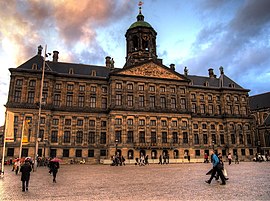
The building was built in 1665 according to the project of Jacob van Kampen , inspired by Roman architecture ( Dutch classicism ). According to the creators, the classical forms and luxury of interior interiors emphasize the greatness of Amsterdam . The palace is located on Dam Square.
A powerful foundation of 13,659 wooden piles was laid for the construction of the palace, and the walls were erected from yellow sandstone brought from Germany . Three floors are crowned by a dome with a weather vane in the form of a sea vessel. The interior is made using marble . The central hall has dimensions of 36 × 18 m and a height of 27.5 m; the hemispheres of the Earth are depicted on the floor.
The palace was built during the Golden Age and was used as a town hall until 1808, after which it housed the residence of Louis Bonaparte . Subsequently, the palace was transferred to the oran royal house , and in 1935 the state bought the royal palace into its treasury.
Numerous halls and galleries of the palace display paintings by Dutch artists - Rembrandt , Govert Flink , Jacob Jordaens , Jan Livens and Ferdinand Bol . It was for the new town hall that Rembrandt completed his largest-scale painting, The Conspiracy of Julius Civilis .