Korolev ( lat. Korolev ) - a large impact crater on the far side of the moon . The name was given in honor of the Soviet scientist, designer of rocketry Sergey Pavlovich Korolev and approved by the International Astronomical Union in 1970. A crater on Mars is also named in honor of S. P. Korolyov.
| Korolev | |
|---|---|
| lat Korolev | |
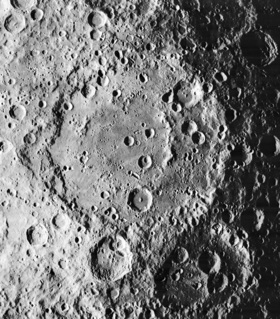 Shot of the Lunar Orbiter 1 probe | |
| Characteristics | |
| Diameter | 423 km |
| Deepest | 3311 m |
| Title | |
| Eponym | S. P. Korolev (1907-1966) - Soviet scientist, designer of rocketry, "father of Soviet cosmonautics" |
| Location | |
| Heavenly body | Moon |


Content
- 1 Crater Description
- 2 Satellite Craters
- 3 See also
- 4 notes
- 5 Literature
- 6 References
Crater Description
The closest neighbors of Korolev Crater are Kongrev Crater in the northwest; Engelhardt Crater in the north; craters Zander and Kibalchich in the northeast; Timiryazev crater in the east; Galois Crater in the southeast; Doppler crater adjacent to the southern part of the shaft of the Korolev crater and Crookes crater in the southwest [1] . The selenographic coordinates of the center of the crater are , diameter 423.4 km [2] , depth 3.3 km [3] . Together with the Hertzsprung and Apollo craters, Korolev Crater is included in the triad of giant ring formations ( thalassoids ) and in the top ten large (with a diameter of over 200 km) craters on the far side of the Moon.
The northern part of the crater is crossed by the lunar equator. The crater is dotted with many small craters, and its shaft is badly damaged. The bottom is relatively flat compared to the relief surrounding the crater.
In the crater bowl there is a less pronounced inner shaft, the diameter of which is approximately half the diameter of the main shaft. The inner rampart is best preserved in the eastern part. In the area of the Korolev crater, the thickness of the lunar crust reaches a maximum of 107 km.
The age of the crater is estimated at 3.7 billion years; thus, its appearance should be attributed to the Late Imbrian period [4] . According to other sources, it was formed in the nectar period [3] .
The crater has numerous satellite craters, the largest of which are Korolev M with a diameter of 58 km in the southern part of the bowl and Korolev C with a diameter of 68 km adjacent to the north-eastern inner part of the rampart. Within the inner shaft there are satellite craters Korolev B , Korolev T , Korolev L.
To the north of Korolev Crater, at a point with coordinates 5.4 N and 201.4 east there is the highest point on the lunar surface with a mark of +10 786 m (the distance of 1,737,400 m from the center of the moon is taken as the zero mark).
Satellite Craters
| Korolev | Coordinates | Diameter, km |
|---|---|---|
| B | 21 | |
| C | 66 | |
| D | 24 | |
| E | 37 | |
| F | thirty | |
| G | 12 | |
| L | 31 | |
| M | 57 | |
| P | eighteen | |
| T | 22 | |
| V | 19 | |
| W | 31 | |
| X | 27 | |
| Y | 19 | |
| Z | eighteen |
- The formation of satellite craters Korolev C, E, L and M belongs to the nectar period [3] .
- The formation of the satellite crater Korolev F belongs to the Late Imbrian period [3] .
- The formation of the satellite crater Korolev W belongs to the Eratosthenesian period [3] .
See also
- List of Craters on the Moon
- Lunar crater
- Morphological catalog of Moon Craters
- Planetary nomenclature
- Selenography
- Mineralogy of the Moon
- Geology of the moon
- Late heavy bombardment
Notes
- ↑ Korolev Crater on the LAC-87 map
- ↑ Handbook of the International Astronomical Union
- ↑ 1 2 3 4 5 Lunar Impact Crater Database . Losiak A., Kohout T., O'Sulllivan K., Thaisen K., Weider S. (Lunar and Planetary Institute, Lunar Exploration Intern Program, 2009); updated by Öhman T. in 2011. Archived page .
- ↑ Universe. The definitive visual guide. - Dorling Kindersley Limited, UK, 2005 .-- ISBN 1 4053 1071 5 .
Literature
- Morphological catalog of the craters of the moon / J. F. Rodionova, A. A. Karlov, T. P. Skobelev, etc. Under the general editorship of V.V. Shevchenko. - M .: Publishing House of Moscow State University, 1987 .-- 173 p.