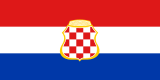
The Croatian Republic of Herceg-Bosna ( Serb-horc . Hrvatska Republika Herceg-Bosna / Hrvatska Republic of Herceg-Bosna , literally translated the Croatian Republic of Herzegovina-Bosnia ) is an unrecognized state in Bosnia and Herzegovina that existed in 1991, Bosnian war . The capital of Herceg-Bosna was West Mostar . Herceg Bosna ceased to exist in 1994 when it joined the Federation of Bosnia and Herzegovina after the signing of the Washington Agreement . Since 1995, after the Dayton Agreement , the territory of the former Republic of Herceg-Bosna has been divided between the individual cantons of one of the two entities (entities) of Bosnia and Herzegovina .
| unrecognized state | |||||
| Croatian Republic of Herceg Bosna | |||||
|---|---|---|---|---|---|
| Horv. and bosn. Hrvatska Republika Herceg-Bosna Serb. Hrvatsk Republic Herceg-Bosna | |||||
| |||||
 | |||||
←   → →1991 (1993) - 1994 | |||||
| Capital | Western Mostar | ||||
| Languages) | Croatian | ||||
| Form of government | parliamentary republic | ||||
| Currency | Croatian dinar | ||||
| Official language | |||||
| Story | |||||
| • June 25, 1991 | The collapse of Yugoslavia | ||||
| • November 18, 1991 | Establishment of the Croatian Commonwealth of Herceg-Bosnia | ||||
| • August 28, 1993 | Declaration of Independence (from Bosnia and Herzegovina) | ||||
| • March 18, 1994 | Joining the Muslim-Croatian Federation | ||||
| • December 14, 1995 | Restoring the territorial integrity of Bosnia and Herzegovina | ||||

Content
- 1 History
- 2 Elimination of Herceg-Bosna
- 3 Current situation
- 4 See also
- 5 notes
- 6 References
History
The ruling party in the Republic of Croatia (Croatian Democratic Commonwealth) organized and controlled the branch of this party in Bosnia and Herzegovina (Croatian Democratic Union of Bosnia and Herzegovina). At the end of 1991, the most radical forces took the leading positions in the party under the leadership of Mate Boban, Dario Cordic and others, with the support of Franjo Tudjman and Goiko Shushak.
On November 18, 1991, Mate Boban and Dario Cordic, later convicted by the International Tribunal for the Former Yugoslavia for war crimes, announced the creation of the Croatian Commonwealth of Herceg Bosn as a separate political, cultural, economic and territorial unit in Bosnia and Herzegovina.
The leadership of Herceg Bosna participated (especially since May 1992, that is, after Bosnia and Herzegovina proclaimed independence from Yugoslavia in April) in the “Croatianization" (ethnic cleansing) of the municipalities that they claimed were part of Herceg Bosna. The number of harassment and discrimination directed against the non-Croatian (in particular, Bosnian) population has steadily increased. The Croatian Defense Council and Croat military units took control of many municipal authorities of local Bosnian leaders. The Croatian authorities seized and controlled the media using military force. Croatian symbols and currencies were introduced, and Croatian programs and the Croatian language were introduced in schools. Many Bosnians and Serbs have been removed from positions in public and private enterprises; humanitarian aid was manageable and limited to Bosnians and Serbs. Many of them were deported to concentration camps: Heliodrome, Dretel, Gabela, War and Sunye.
The CDU participated in the Geneva talks on dividing Bosnia and Herzegovina into three ethnic republics, which was not accepted by the Bosnian side. On August 28, 1993, the Croatian community of Herceg-Bosna declared itself the Croatian Republic of Herceg-Bosna. Its first president was Mate Boban , the second - Kresimir Zubak . The independence of Herceg-Bosna has not been recognized by any state. The Constitutional Court of Bosnia and Herzegovina outlawed Herceg-Bosna on September 14, 1992, and then again on January 20, 1994.
Against the leaders of Herceg Bosna (Jadranko Prlich, Bruno Stoich, Slobodan Praliak , Milivoy Petkovich , Valentin Chorich and Berislav Pushich), an ICTY trial was launched on charges of crimes against humanity, serious violations of the Geneva Conventions and violations of the laws and customs of war.
From the transcript of secret conversations between Franjo Tudjman and the leadership of Herceg Bosna, it became known that they intended to divide Bosnia and Herzegovina between Croatia and Serbia [1] .
Elimination of Herceg-Bosna
Western countries initially negatively reacted to the existence of an independent Croatian state on the territory of Bosnia and Herzegovina . In 1994, under their pressure, Herceg-Bosna ceased to exist, entering the Muslim-Croatian Federation of Bosnia and Herzegovina as a result of the signing of the Washington Agreement .
Since 1995, after the Dayton Agreement , the territory of the Republic of Herceg-Bosna has been divided between the cantons of one of the two entities (entities) of Bosnia and Herzegovina .
Current Situation
Recently, initiatives to restore Herceg-Bosna have been heard more and more often, creating a third entity in Bosnia and Herzegovina. The foundation was laid in 2005 by Ivo Miro Jović , after his phrase: “I do not want to blame the Bosnian Serbs, however, if they have their own Serbian republic , then we must also create the Croatian and Bosnian (Muslim) republics” [ 2] . The official authorities of Bosnia and Herzegovina from the Croats are against such initiatives, but some Croatian politicians support the idea of creating a third (Croatian) authority [3] .
Dragan Čović , the president of one of the main Croatian parties in Bosnia - the Croatian Democratic Union of Bosnia and Herzegovina, said that “... all Croatian parties should come forward with a proposal to divide Bosnia into three ethnic entities and Sarajevo as a separate region. Croatian politicians should be the initiators of a new constitution, which would guarantee the Croats the same rights as other peoples. Each federal unit will have its own legislative, executive and judicial bodies. ” He also noted that the current two-subject system is untenable, as the Croats are assimilated and deprived of basic human rights in the Federation with the Bosnians.
On January 26, 2009, the leaders of the three largest parties in Bosnia and Herzegovina , representing Muslims, Serbs and Croats, at a meeting in the unofficial capital of the Republika Srpska, Banja Luka, made a joint decision to change the existing system, dividing BiH into 4 national administrative units [4] .
The Croatian issue in Bosnia and Herzegovina became aggravated again in early 2011. On April 19, 2011, the "Croatian National Assembly" was held in Mostar with the participation of 500 delegates from ten Croatian parties. The leaders of the Croatian parties of Bosnia and Herzegovina demanded a constitutional reform with a view to the administrative and territorial restructuring of the country and "ending the marginalization of the Croatian people." The initiative of the Croatian National Assembly requires the creation of at least three territorial entities - Muslim, Serbian and Croatian. “Only a thorough reform of the constitution, which would ensure full institutional equality and a new administrative-territorial structure of the country on the basis of several federal units, of which at least one would be with the Croatian majority, can guarantee the real equality of the Croatian people in BiH,” stated in the bridge resolution [5] .
See also
- Bosnian war
- Croats in Bosnia and Herzegovina
- Croatian-Bosnian conflict
- Republic of Bosnia and Herzegovina
- Republika Srpska
- Federation of Bosnia and Herzegovina
- Graz Agreement
- Washington agreement
- Dayton agreement
Notes
- ↑ Croatia wanted to annex Bosnia (Inaccessible link) . Date of treatment August 13, 2012. Archived on May 8, 2013.
- ↑ Bosnian Croats demand their own “republic” if the republic remains with the Serbs
- ↑ Bosnia: proposal for dividing into regions on a table. Archived February 22, 2014.
- ↑ Bosnia and Herzegovina: “Bosnia and Herzegovina will sooner rather than become Republika Srpska.”
- ↑ Bosnian Croat leaders call for rebuilding Bosnia and Herzegovina
Links
- Wikimedia Commons has media related to the Croatian Republic of Herceg-Bosna