The New York Public Library ( NYPL ) is one of the largest libraries in the world . In addition, one of the largest scientific library systems in the world. It is a private non-profit organization with a public mission and enjoys both private and public funding. Historian David McCullough called the New York Public Library one of the most important libraries in the United States of America (in addition to it, this library includes the Library of Congress , the Boston Public Library, and Harvard and Yale University Libraries) [6] .
| New York Public Library | |
|---|---|
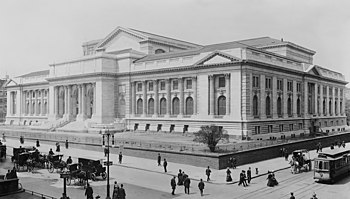
 Central building built between 1897 and 1911 | |
| A country | |
| Address |  USA , New York USA , New York |
| Founded by | 1895 |
| Branches | 87 |
| Fund | |
| The composition of the fund | books, videos, maps, etc. |
| Fund volume | 53.1 million units [1] (14 million books [2] ) |
| Access and Use | |
| Number of readers | 18 million per year [1] |
| Other information | |
| Budget | $ 50 171 798 |
| Director | Anne Thornton [3] - President, CEO, Paul Leclerc - President-Elect, Anthony Marx [4] |
| Employees | 3,147 [1] |
| Web site | library website in Russian |
New York Public Library has branches in Manhattan , the Bronx and Staten Island . According to the American Library Association, among these branches is the twenty-sixth largest library in the United States [7] . The other two districts of New York, Brooklyn and Queens , serve the Brooklyn Public Library and the Queens Library respectively. Both of these libraries were founded before the unification of New York.
Currently, the New York Public Library includes 87 divisions: four scientific libraries without home books, four main libraries with subscription issuance, a library for people with disabilities and 77 district branches. All NYPL libraries are free to use. In 2008, the system funds contained 44 160 825 items (books, videos, maps, etc.), of which books were 15 985 192. 7 565 579 items were stored in branches, of which 4 416 812 were books [8] . In 2009, 44 356 334 items in the main collection and 8 708 869 in branches [1] . In total, the system funds contain more than 50 million items, of which more than 20 million are books. Thus, in terms of funds, the New York Public Library is second only to the Library of Congress and the British Library .
Content
- 1 History
- 1.1 Main building
- 1.2 Other scientific departments
- 1.3 Criticism
- 2 Branches
- 2.1 Criticism
- 3 Services
- 3.1 ASK NYPL
- 3.2 Website
- 3.2.1 Criticism
- 4 Library Police
- 5 Initiations
- 6 Other New York Library Systems
- 7 See also
- 8 Notes
- 8.1 Sources
- 9 References
History
One of the first philanthropists of the library was the Governor of New York, presidential candidate Samuel Jones Tilden , who left the bulk of his inheritance (about $ 2.4 million) to “establish and maintain a free library and reading room in the city of New York ". At the time of Tilden’s death (in 1886), two important libraries already existed in New York: the Astor Library (information, without a subscription) and the Lenox Library [9] .
Another contributor to the library was the wealthy New York merchant Robert Watts, the son of politician John Watts.
The Astor Library was located in the East Village , in the building in which the Public Theater is currently located. The building was built in 1854 by William Beckhouse Astor Sr. (see Astors ), the son of the founder of the library, John Jacob Astor. Architect Alexander Zeltzer, a German by birth, designed the building in a round-arched style ( German Rundbogenstil), which prevailed at that time in German civil engineering. Astor also financed the further expansion of the building according to the designs of Griffith Thomas (1859) and Thomas Stent (1881). Both outbuildings are designed so close to the original Seltzer that, as a rule, it remains invisible that the building was built in three stages. In 1920, the building acquired HIAS . By 1965, the building was left without use, and its demolition was planned. The public theater (then called the New York Shakespeare Festival ) convinced city officials to acquire the building and use it as a theater. The building was rebuilt into a new quality by the architect Giorgio Cavalieri [10] .
Another of the main New York libraries was founded by James Lenox, and its main part was an extensive collection of rare books (including the first copy of the Gutenberg Bible in the New World), manuscripts and cultural and historical exhibits (see en: Americana ). The Lenox Library was intended primarily for bibliophiles and humanities scholars. Although the use of the library was free, visitors were still given entrance tickets (the same as those issued today in the British Library [9] .
Thus, although by 1866 there were already two good libraries in New York open to the public, none of them could be called a public institution in the sense that Tilden put into this concept. Nevertheless, Tilden’s plan soon turned out to be fulfilled, and thanks not only to his generous inheritance, but also to his successful choice of executor [9] .
By 1892, both the Astor Library and the Lenox Library were facing financial difficulties. Using a combination of circumstances, New York lawyer John Bigelow, executor of Tilden’s will , put forward a plan to combine the resources of the two libraries using Tilden’s inheritance. Bigelow proposed the name "The New York Public Library, Funds: Astor, Lenox and Tilden" ( Eng. The New York Public Library, Astor, Lenox and Tilden Foundations ). The Bigelow project was adopted on May 23, 1895 and subsequently received positive reviews as an example of private philanthropy for the benefit of society [9] .
In February 1901, the newly founded library merged with the New York Free Library, and philanthropist Andrew Carnegie donated $ 5.2 million to build branches, on condition that they be managed by the city. Later that year, the New York Public Library entered into an agreement with the municipality to open 39 branches in the Bronx, Manhattan and Staten Island. [9]
Unlike most other major libraries, such as the Library of Congress , the New York Public Library was not created by government order. From the first days of the library's existence to the present, there is a tradition of close cooperation between the city government and private charity [9] . According to 2010 data, the scientific libraries included in its system receive significant contributions from private sources, and the regional branches are financed mainly from government funds. Until 2009, scientific libraries and regional branches acted almost like separate library systems, but in the future there was a merger. By the beginning of 2010, partly due to ongoing unification processes, the library staff was reduced by about 16% [11] .
In 2010, as part of the merger program, the New York Public Library moved various office operations to the new Long Island City Library Services Center building. $ 50 million was spent on the repair of the building in which the warehouse was previously located. In the basement there is a machine for sorting books using barcodes (worth $ 2.3 million). According to workers, the machine, which is about two-thirds of the football field in length, is the largest such machine in the world. Books located in one department but requested in another go through a sorting machine, which reduces the wait for the reader by at least a day. The machine and 14 library staff can sort up to 7500 books per hour (125 per minute).
On the ground floor of the Center there is an office of orders and catalogs. The second is the digital image department (previously located in the main library building) and the manuscript and archive department, where a low air temperature is maintained to ensure the integrity of the fund. On the third floor is the department of Barbara Goldsmith, where 10 people work for 2010 (with an official staff of 30) [11] .
Main Building
To create an impressive main building, the organizers of the library chose an elevated place in the central part of the city (between the intersections of Fifth Avenue with 40th and 42nd Streets), which was occupied by the unused Kroton reservoir. The initial design of the building was developed by the first director of the library, Dr. John Shaw Billings, but nowadays the library building is more often called the " Schwarzman Building ". In Billings' project, the seven lower floors were occupied by book depositories and a special system that was supposed to deliver books to readers as quickly as possible, on the eighth floor, where a huge reading room was located. After the competition, in which the most prominent architects of the city took part, the order for a detailed study of the project and the construction of the building went to the relatively little-known company Carrère and Hastings. The final project included the largest marble building in the United States at that time [9] .
The first stone in the foundation of the building was laid in May 1902, but construction progressed slowly and ended up costing $ 9 million. In 1910, more than 120 km (75 miles) of bookshelves were installed, another year was spent transporting books from the Lenox and Astor libraries and placing them on shelves [9] .
On May 23, 1911, an official opening ceremony was held, led by President Taft . The next day, visitors were invited to the new library. On the opening day, the funds contained more than 1 million books. The specified level of research was further supported by Dr. Henry Miller Lindenberg, who served as director of the library in 1934-1941 [12] . The New York Public Library immediately became one of the largest in the country and formed an important part of the intellectual life of America.
Judging by the books issuing magazines, one of the first visitors to the new library took “The Moral Ideals of Our Time” by N. Ya. Grot , a book exploring the works of Leo Tolstoy and Friedrich Nietzsche . The reader filled out a demand sheet at 9:08 in the morning and received the book in just 6 minutes [9] .
Two famous stone lions guarding the entrance were created by sculptor Edward Clark Potter . The statues were originally called Leo Astor and Leo Lenox, in honor of the founders of the library. Then these “names” turned into “Lady Astor” and “Lord Lenox”, although both lions are males. In 1930, the mayor of New York, La Guardia, gave the statues the nicknames "Patience" and "Persistence", believing that these qualities will be needed by the city residents to overcome the Great Depression . “Patience” is on the south side (on the left hand, if you stand facing the entrance), and “Resistance” is on the north [9] .
The main reading room of the Scientific Library (room 315) is a magnificent room 23.8 m wide and 90.5 m long, the ceiling height in the hall is 15.8 m. The lower level of the hall and the balcony are occupied by rows of open shelves lined with thousands of reference books . Tall windows and heavy chandeliers provide the necessary light; most of the furniture in the room is comfortable chairs and sturdy tables with brass lamps on them. Already today, computer equipment has appeared in the hall, providing access to library collections and the Internet , as well as docks for laptops . Separate rooms are dedicated to outstanding authors and scholars, many of whom were engaged in research in the library [9] .
In 1965, the building was given the status of a national historical monument [13] .
Over the decades, new and new branches appeared in the system, and the scientific collection grew until in the 1970s it became clear that the library funds would eventually outgrow the existing building. In the 1980s, the central scientific library added to the existing space more than 12 thousand m 2 and literally kilometers of bookshelves - based on future acquisitions. Such expansion required significant restructuring, and during excavation Bryant Park , located west of the library building, was closed to the public. New library storage facilities are located below ground level, and after construction was completed, the park was restored.
On July 17, 2007, all the libraries in the building had to be urgently evacuated, and the police cordoned off the neighborhood: a suspicious package was found across the street from the building. Later it turned out that he was wearing old clothes [14] .
Over the course of three decades, until 2007, the interior of the building was gradually updated [15] .
On December 20, 2007, a planned reconstruction of the exterior decoration of the building, damaged by weather and air pollution , was announced. 3 years are allotted for the work, the total project cost is $ 50 million [16] . The project is overseen by the company Wiss, Janney, Elstner Associates, Inc., which had previously been engaged in the reconstruction of the facades of the Metropolitan Museum and the granite finish of the American Museum of Natural History [17] . The restoration project was secured by a donation from Stephen Schwartzman ($ 100 million), whose name will be carved on the foundations of the columns surrounding the entrances to the building. The completion of work is scheduled for 2010 [18] .
Other research units
Even despite the significant expansion of the central scientific library on 42nd Street, in the 1990s it was decided to transfer part of the literature on science, technology and business to another place. The empty department store B. Altman on 34th Street was chosen as such a place. In 1995, the year of the centenary of the founding of the library, the Science, Industry and Business Library (SIBL) was opened for visiting. The authors of the project are Gwathmey Siegel & Associates of Manhattan. After the branch was opened on 34th Street, the Central Scientific Library on 42nd Street was renamed the Library of Humanities and Social Sciences.
To date, the library system of the New York Public Library includes four libraries with a total fund of about 44 million books. In total (taking into account the funds of the branches), about 50.6 million books are stored in scientific libraries. The Library of Humanities and Social Sciences on 42nd Street is still the heart of the science library system, but the younger Library of Science, Industry, and Business, which makes extensive use of modern electronic resources, is rapidly gaining influence. Today it stores about 2 million books and about 60 thousand periodicals. The Library of Science, Industry, and Business is the largest library in the United States dedicated to science and business [19] . The other two scientific libraries of the system are the Schomburg Center for African American Studies and Culture, located on 135th Street and Lenox Avenue in Harlem , and the New York Public Library of Performing Arts, located at the Lincoln Center . In addition to the reference books located in the reading rooms of these scientific libraries, the Library of Science, Industry and Business and the Library of Performing Arts can also take books to their homes, and the scientific subscription is managed by branches.
Criticism
The reduction in library stocks and the range of its services has been a constant source of criticism since 2004, when David Ferriero became director of scientific libraries [20] . The management of the New York Public Library instructed Booz Allen Hamilton to investigate the state of affairs in the organization entrusted to it, and Ferriero called the report a big step “in the process of updating the library” [21] . However, when the same firm made similar recommendations to the Library of Congress, its senior librarian, James Billington, rejected them. [22]
The New York Public Library has announced its participation in the Google Books Library Project project , in which, according to agreements between Google and the largest libraries in the world, a series of books in the public domain should be scanned and made publicly available online mode [23] . Negotiations between partners led to speculations on both sides about how libraries might evolve in the future [24] . According to the terms of the agreement, data cannot be found by other search engines , their downloading and further distribution is also not allowed [25] .
Branches
The New York Public Library carries out its duties as a public subscription library, managing branches in the Bronx , Manhattan and Staten Island , including the Mid-Manhattan Library ( English Mid-Manhattan Library ), Andrew Heyskell Library (which stores books in print Braille and audio books for people with vision problems), subscriptions to the Libraries of Science, Industry and Business and the Library of Performing Arts. These passes offer a wide range of services, programs and collections, including the famous painting collection in Mid-Manhattan Library and the Donnel Library Center .
Of the 82 library system branches, 35 are in Manhattan, 34 in the Bronx and 12 in Staten Island.
Criticism
The sale of the former Donnell Library , which received separate funding, received its share of criticism. [26] The liquidation of the library center also meant the disbandment of collections of children's, youthful and foreign literature. Donnel Media Center also ceased to exist, its individual parts were transferred to other branches [27] .
The library management presents these changes as a path to new activities [28] , but the restructuring has led to the dismissal of some librarians with extensive experience [29] .
Services
ASK NYPL
Since 1968, the telephone inquiry service has been an important part of the New York Public Library reference system, although on a smaller scale this service began to operate much earlier. Nowadays, the service is called ASK NYPL , it works around the clock and gives answers over the phone and via the Internet - via chat, email and via the library website. Questions can be asked in Spanish and English.
In 2007, the service completed almost 70 thousand information requests. There are a variety of questions, from serious and vital (a call from New Orleans from a person who lost his birth certificate during Hurricane Katrina and wanted to know how to get a copy of the certificate - in the end it turned out that he was born in Brooklyn) to funny ones (writer , who worked on the story, was interested in the history of Gorgonzola cheese). In 1992, a selection of the most unusual and interesting questions became the basis of the book “Answer Book: The Most Unusual and Interesting Questions Received by the New York Library Help” published by Fireside Books. Among the questions asked were newspaper reporters, writers, celebrities, scientists, secretaries, executive directors - literally anyone.
Since 2008, reference questions are accepted at 917-ASK-NYPL, which is easy to remember. Every day, except Sundays and holidays, from 9:00 to 18:00 EST, any subscriber, regardless of age and location, can dial 917-275-6975 and ask a question. Library workers do not answer questions from crosswords and quizzes, do not do homework for children, and do not answer philosophical questions [30] .
Website
The New York Public Library website ( www.nypl.org ) provides access to library catalogs, online collections and subscription databases, as well as information on upcoming events in the library system, exhibitions, computer courses and English as a second language course. Two online catalogs, LEO (search in subscription funds) and CATNYP (search in the collections of scientific libraries), allow you to search for necessary books, journals or other materials in the library collections. The LEO system allows cardholders to order book delivery between any two library departments.
Нью-Йоркская публичная библиотека также даёт владельцам карточек бесплатный доступ с домашних компьютеров к тысячам современных и исторических журналов, газет, научных журналов и справочников, содержащимся в подписных базах данных, таких как EBSCOhost , в которой хранятся полные тексты наиболее известных газет, полный текст New York Times (с 1995 по настоящее время), Gale's Ready Reference Shelf , в которой содержится Энциклопедия Ассоциаций и каталоги периодики, Книги в печати и Ulrich's Periodicals Directory .
Цифровая галерея Нью-Йоркской публичной библиотеки [31] представляет собой базу данных из более чем 700 тыс. оцифрованных изображений из коллекций библиотеки. Цифровая галерея вошла в число пятидесяти лучших сайтов 2005 года по версии журнала Time (см. 50 Coolest Websites of 2005 ) и получила звание лучшего научного сайта 2006 года от международной группы музейных работников (см. Best Research Site of 2006 ).
Среди других баз данных, доступных только из библиотеки — журналы Nature , IEEE , Wiley, архивы журнала Wall Street Journal , а также Factiva .
Criticism
Новый стратегический курс Нью-Йоркской публичной библиотеки, принятый в 2006 году, предполагает слияние районных филиалов и научных библиотек в «единую NYPL». Среди организационных изменений — появление единого онлайн-каталога для всех фондов и новых библиотечных карточек, действующих как в районных филиалах, так и в научных библиотеках [27] .
Несмотря на заверения пресс-служб, процесс обновления онлайн-каталогов и веб-сайта, начавшийся в 2009 году, проходил не слишком гладко: как руководители, так и работники библиотеки время от времени оказывались в замешательстве по поводу того, как работать с новой системой. После первоначального внедрения новой системы вновь последовали ободряющие пресс-релизы, а в районных филиалах и научных библиотеках разместили уведомления об изменениях [32] .
Библиотечная полиция
Нью-Йоркская публичная библиотека содержит подразделение специальных патрульных, в задачи которых входит поддержание порядка и обеспечение безопасности в различных филиалах библиотеки, а также следователей, наблюдающих за безопасностью библиотечных объектов. Этим должностным лицам разрешено арестовывать нарушителей — в соответствии с уголовным правом штата Нью-Йорк . В то же время некоторые из филиалов библиотеки прибегают к услугам охранных агентств для обеспечения должной безопасности.
Посвящения
Выдержки из мемуаров и эссе , где упоминается Нью-Йоркская публичная библиотека, вошли в антологию «Reading Rooms» (1991). Среди прочих в книге содержатся воспоминания Альфреда Казина, Генри Миллера и Кейт Саймон [33] .
Декорации, копирующие внешний вид библиотеки, хранятся также в Universal Studios Singapore и Universal Studios Florida.
Библиотеке посвящён документальный фильм Фредерика Уайзмана 2017 года « Экслибрис. Нью-Йоркская публичная библиотека ».
Другие библиотечные системы Нью-Йорка
Нью-Йоркская публичная библиотека, обслуживающая Манхэттен , Бронкс и Статен-Айленд , является одной из трёх отдельных и независимых библиотечных систем Нью-Йорка. Другие две — Бруклинская публичная библиотека и Библиотека Куинса .
Согласно последнему управленческому отчёту, составленному для мэра города, читатели распределились между библиотечными системами следующим образом: Нью-Йоркскую публичную библиотеку и Бруклинскую публичную библиотеку (всего 143 подразделения) за год посетили 15 млн человек, Публичную библиотеку Квинса (62 подразделения) — 20 млн человек. За 2006 год все три библиотечных системы обслужили 37 млн читателей.
Список частных библиотек Нью-Йорка, некоторые из которых открыты для посещения, содержится в Директории специальных библиотек и информационных центров .
See also
- Музеи Нью-Йорка
- Образование в Нью-Йорке
- Библиотечный проект Google Books
- Коллекция Бенджамина Миллера — коллекция почтовых марок, хранящаяся в Нью-Йоркской публичной библиотеке
- Экслибрис. Нью-Йоркская публичная библиотека
Notes
- ↑ 1 2 3 4 The New York Public Library's 2009 Annual Report (англ.) (недоступная ссылка) (2009). Дата обращения 15 июля 2010. Архивировано 23 марта 2012 года.
- ↑ Find Books, DVDs & More | The New York Public Library (англ.) (2009). Дата обращения 14 июля 2010. Архивировано 23 марта 2012 года.
- ↑ Contact List - The New York Public Library . Дата обращения 23 мая 2010. Архивировано 23 марта 2012 года.
- ↑ New York Public Library Names Dr. Anthony Marx Next President . Дата обращения 30 января 2011. Архивировано 23 марта 2012 года.
- ↑ archINFORM — 1994.
- ↑ Simon & Schuster:David McCullough . Дата обращения 12 октября 2007. Архивировано 29 сентября 2006 года.
- ↑ American Library Association: The Nation's Largest Libraries (недоступная ссылка) . Дата обращения 17 марта 2009. Архивировано 23 марта 2012 года.
- ↑ [New York Public 2008 Annual Report (PDF) (недоступная ссылка)
- ↑ 1 2 3 4 5 6 7 8 9 10 11 «History» , New York Public Library. Retrieved 2010-06-13.
- ↑ Barbaralee Dimonstein, The Landmarks of New York , Harry Abrams, 1998, p. 107.
- ↑ 1 2 Taylor, Kate, «That Mighty Sorting Machine Is Certainly One for the Books» , article, New York Times , April 21, 2010, retrieved same day
- ↑ Dain, P.(1997). Harry M. Lydenberg and American library resources: A study in modern library leadership. Library Quarterly , 47(4), p.454
- ↑ New York Public Library (недоступная ссылка) . National Historic Landmark summary listing . National Park Service (16 сентября 2007). Дата обращения 30 января 2011. Архивировано 23 марта 2012 года.
- ↑ New York Public Library being evacuated . Twitter (17 июля 2007). Дата обращения 17 июля 2007. Архивировано 29 сентября 2007 года.
- ↑ Pogrebin, Robin, «A Centennial Face-Lift For a Beaux-Arts Gem: Restoration of Library Facade Begins With Visions of a Nightly Spectacle», article, The New York Times , page B1, December 20, 2007
- ↑ [1] Web page (news release?) titled «The New York Public Library Will Restore its Fifth Avenue Building's Historic Facade / Project to be Completed in Time for Building's 2011 Centennial / (New York City, December 20, 2007)» at the New York Public Library Web site, accessed December 20, 2007
- ↑ Pogrebin, Robin (December 20, 2007). «A Centennial Face-Lift for a Beaux-Arts Gem». " https://www.nytimes.com/2007/12/20/nyregion/20library.html?ref=arts» . The New York Times. Retrieved 3-30-2009.
- ↑ Santora, Marc. «After Big Gift, a New Name for the Library» , New York Public Library. April 23, 2008.
- ↑ «Science, Industry and Business Library» Архивная копия от 9 июня 2011 на Wayback Machine , June 19, 2003 Press Release, New York Public Library. Retrieved 2010-06-13.
- ↑ Norman Oder, «One NYPL,» Many Questions, Library Journal , November 1, 2007 Архивная копия от 4 июля 2008 на Wayback Machine .
- ↑ Oder, Norman. «NYPL Reorganization Coming», Library Journal (October 1, 2007). Vol. 132, Issue 16, p. 12.
- ↑ Congressional Oversight Committee Reviews Library of Congress .
- ↑ New York Public Library + Google
- ↑ Rothstein, Edward. «If Books Are on Google, Who Gains and Who Loses?» New York Times. November 14, 2005.
- ↑ Library and Information Technology Association, «Contracting for Content in a Digital World»
- ↑ Chan, Sewell. «Sale of Former Donnell Library Is Back on Track» , New York Times. July 9, 2009.
- ↑ 1 2 LeClerc, Paul. «Answers About the New York Public Library, Part 3» , New York Times. December 12, 2008.
- ↑ Oder, Norman. «NYPL: Synergy on the Way?» Library Journal (February 1, 2005), Vol. 130, Issue 2
- ↑ «NYPL head = Natl. archivist; New Catalog, Restructuring», Library Journal (August 1, 2009, Vol. 134, Issue 13.
- ↑ «Library Phone Answerers Survive the Internet» , The New York Times 19 June 2006.
- ↑ NYPL Digital Collections
- ↑ Slotnik, Daniel E. «Library System Resolves Catalog Problems» , New York Times. July 20, 2009.
- ↑ Craig Nelson. Secrets of the New York Public Library (англ.) . NewYork.com (4 September 2013). Дата обращения 14 ноября 2016.
Sources
Links
- (рус.) Нью-Йоркская публичная библиотека
- (англ.) Нью-Йоркская публичная библиотека
- Нью-Йоркская публичная библиотека в « Твиттере »
- NYPL Research Libraries
- LIVE from the NYPL
- Databases and Indexes Online From Home
- NYPL Digital Collections
- Picture Collection Online
- NYPL Best of Reference
- NYPL Treasures Video series
- The Life of Samuel J. Tilden