Calcium carbonate ( calcium carbonate ) is an inorganic chemical compound , a salt of carbonic acid and calcium . Chemical formula .

| Calcium carbonate | |
|---|---|
 | |
  | |
| Are common | |
| Systematic name | calcium carbonate |
| Traditional names | calcium carbonate |
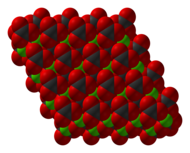
| Chem. formula | CaCO 3 |
| Physical properties | |
| condition | solid white crystals |
| Molar mass | 100.0869 g / mol |
| Density | (calcite) 2.74 g / cm³ (aragonite) 2.83 g / cm³ |
| Thermal properties | |
| T. melt. | (calcite) 825 ° C, (aragonite) 1339 ° C |
| T. | 900–1000 ° C |
| Vapor pressure | |
| Chemical properties | |
| pK a | 9.0 |
| Water solubility | (25 ° C) 0.0015 g / 100 ml |
| Optical properties | |
| Refractive index | 1.60 |
| Structure | |
| Crystal structure | trigonal, spaces. gr. 2 / m |
| Classification | |
| Reg. CAS number | |
| Pubchem | |
| Reg. EINECS number | |
| SMILES | |
| Inchi | |
| Codex Alimentarius | |
| RTECS | |
| CHEBI | |
| Chemspider | |
| Security | |
| Toxicity |  0 0 0 |
In nature, it is found in the form of numerous minerals, for example, calcite , aragonite and vaterite , is the main component of limestone , marble , chalk , is part of the shell of bird eggs.
Insoluble in water and ethanol .
Registered as a white food dye ( E170 ) .
Content
Application
Used as a white food dye E170. Being the basis of chalk , used for writing on the boards . It is used in everyday life for whitewashing ceilings, painting tree trunks, for alkalizing the soil in gardening.
Mass production / use
Calcium carbonate, purified from impurities, is widely used in the paper and food industries , as a filler in the production of plastics , paints , rubber , household chemicals , and in construction.
In the production of paper, calcium carbonate is used simultaneously as a bleach, filler, as well as a deoxidizer.
Used in the manufacture of silicate glass , - material for the production of window glass, glass bottles, fiberglass.
It is used in the manufacture of hygiene items (eg, toothpaste), in medicine.
In the food industry, it is often used as an anti-caking agent and to prevent sticking of dry milk products in clumps.
When used in excess of the recommended dose (1.5 g per day), it can cause a milky-alkaline syndrome ( Burnett syndrome ). Recommended for bone diseases .
Plastic producers are one of the main consumers of pure calcium carbonate (more than 50% of total consumption). Used as a filler and dye, calcium carbonate is necessary in the production of polyvinyl chloride (PVC), polyester fibers ( crimple , polyester , etc.), polyolefins . Products from these types of plastics are ubiquitous - pipes, plumbing, tile, tile, linoleum, carpeting, etc. Calcium carbonate is about 20% of the pigment used in the manufacture of paints .
In construction
Construction is another major consumer of calcium carbonate. For example, as a filler for fillers and sealants .
Calcium carbonate is also an important element in the production of household chemicals - sanitary ware cleaners, shoe creams.
Calcium carbonate is widely used to deoxidize acid soils.
Being in nature
Calcium carbonate is found in minerals in the form of polymorphs :
- Aragonite
- Calcite
- Vaterite (or μ-CaCO 3 )
The trigonal crystalline structure of calcite is the most common.
Calcium carbonate minerals are found in the following rocks :
- a piece of chalk
- Limestone
- Marble
- Travertine
- Dolomite
Calcite
Aragonite
Marble
Travertine
Geology
Calcium carbonate deposits in the form of Cretaceous formations - deposits of lime shells of mollusks, mostly of the Cretaceous period, are a common mineral on all continents.
In nature, there are three crystalline modifications (minerals with the same chemical composition, but with a different crystal structure): calcite , aragonite, and vaterite (vaterite).
Some rocks (limestone, chalk, marble, travertine and other calcareous tuffs ) are almost entirely composed of calcium carbonate with various impurities.
Calcite is a stable crystalline modification of calcium carbonate and is found in a wide variety of geological conditions: in sedimentary, metamorphic and igneous rocks.
About 10% of all sedimentary rocks are limestone, composed mainly of calcite remnants of the shells of marine organisms. Aragonite is the second most abundant crystal modification of CaCO 3 and is mainly formed in mollusk shells and skeletons of some other organisms. [ what? ] .
Aragonite can also be formed in inorganic processes, for example, in karst caves or hydrothermal springs.
Vaterite is the least stable variety of this carbonate, and very quickly turns into water either in calcite or aragonite. In nature, it is relatively rare when its crystal structure is stabilized by one or other impurities.
Getting
The overwhelming amount of calcium carbonate extracted from minerals is used in industry. Pure calcium carbonate (for example, for food production or use for pharmaceutical purposes) can be made from a natural mineral with a small amount of harmful impurities, for example, from marble.
In the laboratory, calcium carbonate can be prepared by pre-quenching calcium oxide - quicklime. This forms calcium hydroxide , and then carbon dioxide gas is blown into the suspension to produce calcium carbonate [2] :
Chemical Properties
When heated to 900–1000 ° C, it decomposes into acid oxide — carbon dioxide CO 2 and basic oxide — quicklime CaO:
It dissolves in water with an excess of carbon dioxide to form an acid salt - calcium bicarbonate Ca (HCO 3 ) 2 :
- .
Because of this reaction, stalactites , stalagmites are formed . Natural groundwater, abundant in carbon dioxide, dissolve poorly soluble calcium carbonate to form calcium bicarbonate much better than water, and when groundwater is released in the form of droplets from cave ceilings, when carbon dioxide is lowered into the air, the back reaction of calcium bicarbonate becomes bad soluble precipitate of calcium carbonate, forming beautiful natural forms in the caves, and because of this mechanism karstic caves are formed.
When roasting with a temperature above 1500 ° C with carbon, for example, in the form of coke , it forms calcium carbide and carbon monoxide:
- .
Notes
- ↑ http://www.cdc.gov/niosh/npg/npgd0090.html
- ↑ Solvay Precipitated Calcium Carbonate: Production . Solvay SA (March 9, 2007). Archived February 9, 2012.