
Early Dutch painting (rarely Old Dutch painting ) is one of the stages of the Northern Renaissance , an era in Dutch and, in particular, Flemish painting , covering about a century in the history of European art, starting from the second quarter of the 15th century. The art of late Gothic was replaced at this time by the early Renaissance . If late Gothic, having appeared in France , created a universal language of art form, which many Dutch masters of painting also contributed to, then in the described period a clearly recognizable independent painting school was formed in the Netherlands, which was characterized by a realistic style of writing, which found its expression primarily in the genre of portraiture .
Historical background
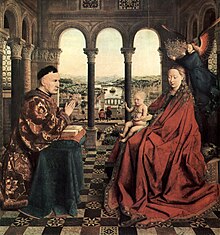

Since the fourteenth century, cultural and sociological changes have taken place in these territories: secular philanthropists have replaced the church as the main customer for works of art. The Netherlands as a center of art began to push back the art of late Gothic at the French court.
The Netherlands was also associated with France by the common Burgundy dynasty , therefore the Flemish, Walloon and Dutch artists easily found work in France at the courts of Anjou , Orleans , Berry and the French king himself. Prominent masters of international Gothic, the Limburg brothers from Geldern were essentially French artists. With rare exceptions in the person of Melchior Bruderlam at home, in the Netherlands, only painters of a lower rank remained.
After the Battle of Agincourt in 1415 and the death of the Duke of Berry, Jean Valois, the Duke of Burgundy, Philip the Good, returned to Flanders. The Burgundy court, which moved with him to Flanders, created the best conditions for local artists to work in their homeland. The need to leave for France has disappeared. Regional art schools began to take shape. If earlier the mastery of the exceptional talents of Jean de Bondol , Jean Maluel or the Limburg brothers grew up on the basis of the "international style", now Franco-Flemish artists have become Dutch. Erwin Panofsky even talked about "the repatriation of the Flemish genius . " A new generation of Dutch artists abandoned the universal language of Gothic forms and is therefore regarded as a specific Dutch school.
The wealth of shopping centers played a role in this development, leading art workshops were now very close. The heyday of the Flemish and Brabant cities of Bruges , Antwerp , Ghent , Brussels , Ypres , Mechelen and Leuven allowed the local rich to compete on equal terms with the princes , not yielding to them in either wealth or power. This third group of customers and patrons along with the nobility and the church influenced the choice of themes for paintings. But religious works of art, such as altar paintings , were often not ordered directly by the church, but received from merchant guilds.
Thanks to the orders of paintings, which were demonstrated for representational purposes in the houses, an entirely new genre of art arose - portraiture, which brought into the art an individualization element that fully corresponded to the dictates of the time.
Features
In the XV century, at the courts of the Dukes of Burgundy in Dijon , Bruges and Tournais, an own art school appeared, combining Gothic and Renaissance. Some art historians see its roots in French-Flemish book miniatures, for example, in the works of Jean Püsel or the Limburg brothers.
These paintings are sharply different from their Gothic predecessors in almost photographic realism. The impulse received from the early and mature Italian Renaissance, combined with local traditions, led to the formation of an independent, completely new artistic language. Dutch attention to nature was expressed in landscape painting. First, the golden background of medieval paintings was replaced by realistic landscapes, and then the landscape became an independent genre in art.
The accuracy in observing natural phenomena has extended to the image of the human body. The image of naked Adam and Eve on the Ghent Altar of Jan van Eyck is distinguished by naturalness, unprecedented from ancient times . Unlike Italian artists, who were interested in anatomical details in their nude images, Jan van Eyck studied the surface and movement of the human body and reflected to the smallest detail in his works.
The novelty of early Dutch painting consisted, on the one hand, of a detailed description of the surfaces of objects, and on the other hand, of plasticity , achieved through precisely noticed and successfully applied lighting effects. The new style was based on a new painting technique - oil .
Before Robert Kampen and van Eyck, both Dutch and Flemish paintings focused on international Gothic , which is often called the "beautiful" or "soft style." Even the largest masters for a long time could not completely get rid of this influence, elongated figures and richly pleated robes clearly indicate more ancient painting traditions. In general, early Dutch painting until the 15th century is currently given little attention. The paintings are considered provincial and second-class, in many publications on the history of art early Dutch painting is considered only starting with the Flemish master .
The origins of early Dutch painting, understood in a narrow sense, are Jan van Eyck, who in 1432 finished work on his main masterpiece - the Ghent Altar . Even contemporaries considered the works of Jan van Eyck and other Flemish artists “new art”, something completely new. Chronologically Old Dutch painting developed at about the same time as the Italian Renaissance.
With the advent of the portrait, a secular, individualized theme became for the first time the main motive of painting. Genre paintings and still lifes made their breakthrough in art only during the 17th-century Dutch baroque period . The bourgeois character of early Dutch painting speaks of the advent of modern times . Increasingly, in addition to the nobility and clergy , customers were rich nobility and merchants. The man in the paintings was no longer idealized. Real people with all their human defects appear before the viewer. Wrinkles, bags under the eyes - everything without embellishment was naturally depicted in the picture. The saints no longer lived exclusively in temples, they entered the houses of citizens.
Artists
One of the very first representatives of new artistic views along with Jan van Eyck is the Flemish master , who is currently identified as Robert Kampen . His main work is the altar (or triptych) of the Annunciation (another name: the altar of Merode ; circa 1425), now kept at the Cloisters Museum in New York .
For a long time now, the very fact of Jan van Eyck’s brother Hubert has been questioned. Recent studies have shown that Hubert van Eyck, mentioned in only a few sources, was just a mediocre artist of the Ghent school, who had neither a kinship nor any other relation to Jan van Eyck.
Rogier van der Weyden is considered a student of Kampen, who probably took part in the work on the triptych of Merode. In turn, he influenced Dirk Bouts and Hans Memling . Memling's contemporary was Hugo van der Hus , first mentioned in 1465 .
From this series stands out the most mysterious artist of this time, Jerome Bosch , whose work has not yet received an unambiguous interpretation.
Along with these great masters, early Dutch artists such as Petrus Christus , Jan Provost , Colin de Coter , Albert Bouts , Gosvin van der Weyden and Quentin Massey deserve mention.
A striking phenomenon was the work of artists from Leiden: Cornelis Engelbrechtsen and his students Artgen van Leiden and Lucas van Leiden .
So far, only a small fraction of the works of early Dutch artists has been preserved. Countless paintings and drawings fell victim to iconoclasm during the reformation and wars. In addition, many works received serious damage and require expensive restoration. Some works were preserved only in copies, while most were lost forever.
The work of the early Dutch and Flemish is presented in the largest art museums in the world. But some altars and paintings are still in their old places - in churches, cathedrals and castles, such as the Ghent Altar in the Cathedral of St. Bavon in Ghent. However, you can now look at it only through thick armored glass.
Impact
Italy
In the homeland of the Renaissance, in Italy, Jan van Eyck was highly respected. A few years after the death of the artist, the humanist Bartolomeo Fazio even called van Eyck "the prince among the painters of the century . "
While the Italian masters used complex mathematical and geometric means, in particular, the perspective system, the Flemings were able to correctly display the "reality" without much, as it seems labor. The action in the paintings no longer occurred as in Gothic at the same time on the same stage. The premises are depicted in accordance with the laws of perspective, and landscapes are no longer a sketchy background. A wide, detailed traced background takes you to infinity. And clothes, and furniture, and furnishings were displayed with photographic accuracy.
The Flemish manner ( Italian: maniera Fiamminga ) had a huge impact on the art of the Italian quattrocento . Antonello da Messina even for a long time was considered a direct student of Jan van Eyck. Italian art collectors ordered numerous paintings from northern masters, philanthropists provided young artists with the opportunity to study in Flemish workshops.
Van Eyck has long been considered the creator of oil painting . In fact, his paintings are made in mixed media: the traditional tempera is complemented by elements of oil technology. The master also used terpentine oils (white varnish) as an astringent. Due to them, the paint dries much faster and acquires a greater juiciness of color. These innovations were quickly picked up by other European artists.
Along with the amazing juiciness of colors, the Italians were especially impressed by the “internal piety” of the Flemings. Humanism left its mark on Italian painting; northern art managed to combine naturalism with deep religiosity.
Germany
A new artistic direction, which was destined together with Italian painting to determine the fate of European art for almost two centuries, naturally penetrated into neighboring Germany . Giorgio Vasari even considered Albrecht Dürer and his predecessor Martin Schongauer to be Flemish. And indeed, the work of both artists is impossible to imagine without Dutch influence.
Dürer studied under Michael Wolgemuth , who, in turn, a student of Hans Pleidenwurf , was strongly influenced by Dutch painting technique. Between 1520 and 1521, during his travels in the Netherlands, the great son of Nuremberg was given the opportunity to learn Flemish art locally.
One of the earliest German paintings in the Flemish manner is considered “Calvary of the Wasserfasses” . The Burgundian-Flemish influence is even more pronounced in Stefan Lochner . Due to its territorial proximity, Cologne and the Lower Rhine region were particularly strongly influenced by Dutch art. In 1455, the representative of the Cologne nobility, Goddert von dem Wasserfass, ordered Rogier van der Weyden “Altar of Columbus” (aka “Altar of the Three Kings” ), which is currently kept in the Old Pinakothek of Munich .
Spain
The first evidence of the spread of northern painting techniques in Spain is found in the kingdom of Aragon , which included Valencia , Catalonia and the Balearic Islands . King Alfons V back in 1431 sent his court painter Luis Dalmau to Flanders. In 1439, the artist from Bruges, Louis Alimbrot ( Luís Alimbrot, Lodewijk Allyncbrood ), moved to Valencia with his studio. Jan van Eyck probably visited Valencia as early as 1427 as part of the Burgundian delegation.
Valencia, at that time one of the most significant centers of the Mediterranean, attracted artists from all over Europe. In addition to the traditional art schools of the "international style" there were workshops working in both the Flemish and Italian styles. Here the so-called “ Spanish-Flemish ” direction of art was developed, the main representatives of which are Bartolome Bermejo , Jaime Uge and Rodrigo de Oson .
In the Kingdom of Castile, the influence of northern painting also manifested itself quite early. But local artists used pine panels instead of ordinary oak panels as the basis for their paintings and still preferred tempera . A distinctive feature of the painting of Castile and Aragon is the "squandering" in the use of sheet gold and gold powder. Another feature is the rich ornamentation and scale of the size of the Spanish retablo .
The Castilian kings owned several well-known works of Rogier van der Weyden, Hans Memling and Jan van Eyck. In addition, the visiting portrait painter of Queen Isabella was the visiting artist Juan de Flandes (“Jan from Flanders”, surname unknown), who laid the foundations of the realistic school of the Spanish court portrait.
Portugal
An independent school of painting arose in Portugal in the second half of the 15th century in the Lisbon workshop of the court artist Nuno Gonçalves . The work of this artist is in complete isolation: he seems to have had neither predecessors nor followers. Flemish influence is felt in particular in his polyptych "Saint Vincent . "
Literature
- Somov A.I. Dutch Painting // Brockhaus and Efron Encyclopedic Dictionary : in 86 volumes (82 volumes and 4 additional). - SPb. , 1890-1907.
- Hans Belting / Christiane Kruse: Die Erfindung des Gemäldes: Das erste Jahrhundert der niederländischen Malerei . - München, 1994
- Till-Holger Borchert (Hg.): Jan van Eyck und seine Zeit. Flämische Meister und der Süden 1430-1530. Ausstellungskatalog Brügge, Stuttgart 2002. Darmstadt 2002.
- Bodo Brinkmann: Die flämische Buchmalerei am Ende des Burgunderreichs. Der Meister des Dresdner Gebetbuchs und die Miniaturisten seiner Zeit. Turnhout 1997. ISBN 2-503-50565-1
- Birgit Franke, Barbara Welzel (Hg.): Die Kunst der burgundischen Niederlande. Eine Einführung. Berlin 1997. ISBN 3-496-01170-X
- Max Jakob Friedländer: Altniederländische Malerei. 14 Bde. Berlin 1924—1937.
- Erwin Panofsky: Die altniederländische Malerei. Ihr Ursprung und Wesen. Übersetzt und hrsg. von Jochen Sander und Stephan Kemperdick. Köln 2001. ISBN 3-7701-3857-0 (Original: Early Netherlandish Painting. 2 Bde. Cambridge (Mass.) 1953)
- Otto Pächt: Van Eyck, die Begründer der altniederländischen Malerei. München 1989. ISBN 3-7913-1389-4
- Otto Pächt: Altniederländische Malerei. Von Rogier van der Weyden bis Gerard David. Hrsg. von Monika Rosenauer. München 1994. ISBN 3-7913-1389-4
- Jochen Sander, Stephan Kemperdick: Der Meister von Flémalle und Rogier van der Weyden: Die Geburt der neuzeitlichen Malerei: Eine Ausstellung des Städel Museums, Frankfurt am Main und der Gemäldegalerie der Staatlichen Museen zu Berlin , Ostfildern: Hatje Cantz Verlag, 2008
- Norbert Wolf: Trecento und Altniederländische Malerei. Kunst-Epochen, Bd. 5 (Reclams Universal Bibliothek 18172). ISBN 3-15-018172-0
See also
- Золотой век голландской живописи
Links
- Статья написана по материалам одноимённой статьи в немецкой Википедии
- На Викискладе есть медиафайлы по теме Ранние нидерландские художники