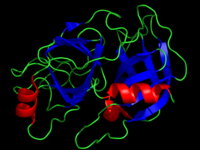
Trypsin is an enzyme of the class of hydrolases that breaks down peptides and proteins ; also has esterase (hydrolysis of esters) activity.
Trypsin is synthesized in the pancreas as an inactive precursor ( proenzyme ) of trypsinogen . Trypsins of a number of animals were obtained in crystalline form (for the first time in 1932). The bovine trypsin molecule (molecular weight of about 24 kDa) consists of 223 amino acid residues forming one polypeptide chain and contains 6 disulfide bonds. The isoelectric point of trypsin lies at a pH of 10.8, and the optimum catalytic activity lies at a pH of 7.8–8.0.
Trypsins belong to the group of serine proteases and contain serine and histidine residues in the active center. Trypsins are easily self-digested (autolysis), which leads to contamination of trypsin preparations with inactive products (an industrial preparation contains up to 50% of inactive impurities). High purity trypsin preparations are obtained by chromatographic methods.
Content
Physical Properties
Trypsin is a colorless crystalline substance with a melting point of about 150 ° C.
Biological Properties and Functions
The main function is digestion. Catalyzes the hydrolysis of proteins and peptides. May be inactive as trypsinogen. It is activated, including by the intestinal enzyme enteropeptidase , by cleaving the hexapeptide . It also catalyzes the hydrolysis of ester waxes. The optimum catalytic activity is at pH 7.8-8. The active center has a protein nature and consists mainly of serine and histidine . It is synthesized as trypsinogen in the pancreas and is used in the intestines of mammals and fish . Turns the remaining hydrolase proenzymes into active enzymes .
Application
Trypsin is used to make drugs . Trypsin preparations have anti-inflammatory and decongestant effects (with intravenous and intramuscular administration); capable of selectively cleaving tissues that have undergone necrosis . In medicine, trypsin is used to treat wounds, burns, thrombosis, often in combination with other enzymes and with antibiotics . It is used in the analysis of the primary structure of the protein , due to the fact that it selectively hydrolyzes the bonds between the residues of positively charged amino acids of lysine and arginine.
Related Enzymes
The "closest relatives" of trypsin are trypsinogen , pepsin , chymotrypsin . Anionic trypsin analogues were found in higher animals, and neutral in many animals and plants.
Changing Hydrolytic Properties
Trypsin activity is suppressed by organophosphorus compounds, some metals, as well as a number of high molecular weight protein substances - trypsin inhibitors contained in the tissues of animals, plants and microorganisms. Ions Ca 2+ , Mg 2+ , Ba 2+ , Sr 2+ , Mn 2+ increase the hydrolytic activity of trypsin.
Literature
- Northrop D., Kunitz M., Herriott R. Crystalline enzymes, trans. from English., M., 1950;
- Mosolov V.V. Proteolytic enzymes, M., 1971.
- V. I. Struchkov, A. V. Grigoryan, V. K. Gostishchev, S. V. Lokhvitsky, L. S. Tapinsky Proteolytic enzymes in purulent surgery., M., 1970;
- KN Veremeenko Proteolytic enzymes of the pancreas and their use in the clinic. Kiev, 1967
- Systemic enzyme therapy. Experience and Prospects / Ed. IN AND. Kulakova, V.A. Nasonova, V.S. Savelyeva. - SPb .: Inter-Medica. 2004 .-- 264 p.
Links
- Trypsin (Trypsin): instructions, application and formula - Encyclopedia of medicines and pharmaceutical products.