Adam Olearius ( German: Adam Olearius ; Adam Olschlegel, c. September 24, 1599 , Aschersleben - February 22, 1671 , Gottorp Castle, Schleswig ) - German traveler , geographer , orientalist , historian , mathematician and physicist . He is the designer and curator of the creation of the Gottorp Globe from 1654 to 1664 [5] .
| Adam Olearius | |
|---|---|
| Adam olearius | |
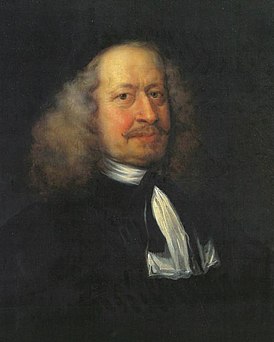 Adam Olearius (1669) Portrait of the work of Jürgen Ovens . | |
| Date of Birth | |
| Place of Birth | Aschersleben |
| Date of death | |
| A place of death | Gottorp ( Schleswig ) |
| A country | |
| Scientific field | geography , oriental studies , history , mathematics , physics |
| Alma mater | University of Leipzig |
| Academic degree | Master of Philosophy |
| Famous students | |
| Known as | author of "Description of Travel to Muscovy" [4] |
Adam's real name is Olschlegel ( Oehlschlegel / Ölschläger ). He Latinized her in Olearius .
As secretary of the embassy, sent by the Duke of Schleswig-Holstein to the Persian Shah, he recorded and published his notes collected during the trip
Content
- 1 Biography
- 2 Travel
- 2.1 First trip to Muscovy
- 2.2 Travel through Muscovy to Persia
- 2.3 Travel Summary
- 3 Life after travel
- 4 Family
- 5 Book
- 5.1 Moscow Plan of 1638
- 6 Performance Evaluation
- 7 Proceedings
- 7.1 Intravital Editions of Travel Descriptions
- 7.2 Translation into Russian
- 8 Notes
- 9 Literature
Biography
His father was a tailor and died shortly after the birth of his son, leaving his family in extreme poverty. Despite this, Olearius managed in 1620 to enroll in the theological faculty of the University of Leipzig ; in parallel, he studied philosophy and mathematics. In 1627, he defended his thesis of the master of philosophy, then taught at the schools of St. Nicholas and St. Thomas , and five years later he became an assessor of the Faculty of Philosophy [5] . Olearius at that time was fluent in Russian, Arabic and Persian [6] .
The calamities of the Thirty Years' War of 1618-1648 forced Olearia to leave Leipzig and seek protection from the Schleswig-Holstein Duke Frederick III .
Travel
First trip to Muscovy
In 1633, Duke Frederick III sent from his residence in Gottorp an embassy to the Russian Tsar Mikhail Fedorovich and the Persian Shah Sephi I. The goal is to establish trade relations with Moscow and especially with Persia: the duke wanted to take over land trade in silk raw. The embassy was led by the skilled diplomat Philippe Crusius von Kruzenshtern from Eisleben and the Hamburg merchant Otto Brugman (Bruggemann). They were accompanied by a retinue in the amount of 34 people, and as an secretary and, mainly, an interpreter who knew the languages of those countries where the embassy went, Olearius.
Having reached Riga by sea, the embassy arrived in Narva by dry route, where it spent the winter and spring, and in the summer moved through Novgorod to Moscow. On August 14, 1634, the embassy solemnly entered the Russian capital and stayed there for 4 months. Having received the king’s consent for the Holstein embassy to pass through Persian borders through Russian borders, the embassy left on December 24 back to Gottorp, where it arrived on April 6, 1635 .
Travel through Muscovy to Persia
Soon after, the second embassy was equipped, at the head of which the former persons were put, and Olearius took the place of not only the secretary, but also the adviser to the embassy. The embassy consisted of more than 90 persons, among whom were a friend of Olearia, a young poet Paul Fleming , and , known for his description of travels in India (this description was subsequently published by Olearius).
The embassy carried rich gifts to both the Moscow Tsar and the Persian Shah. October 22, 1635 it sailed from Hamburg , but was shipwrecked near the island of Hohland : gifts and credentials were lost, people barely managed to escape. For almost a month they wandered around the Baltic Sea until they reached Revel .
March 29, 1636 the embassy had a ceremonial entry into Moscow. The embassy did not dare to go to Nizhny right away due to damaged roads. In Moscow, Olearius noted the Kremlin and St. Basil’s Church, which he carefully sketched for the book. Olearius described the Muscovites (Russians):
Muscovites have mostly tall, strong and fat men, with skin and complexion similar to other Europeans.
Muscovites really appreciate long beards and thick bellies. Those with these qualities are held in high esteem.
Many Muscovites seriously believe that in the Trinity-Sergius Monastery there is a miraculous pot, from which no matter how many scoops were scooped for treating the brethren, their number did not decrease ...
... The Moscow Tsar single-handedly controls the state, reverence his peasants, nobles and even princes as his slaves. Muscovite administration should be considered as closely related to the tyrannical ... [6]
June 30 moved to Persia; at first it rode the Moscow River to Kolomna , then the Oka to Nizhny Novgorod . A sailing-rowing ship Frederic was built specifically for the embassy’s trip along the Volga , under the direction of the Lübeck master Cordes, who accompanied the embassy.
On July 30, the embassy set off down the Volga and further along the Caspian Sea to Persia, but after a storm the ship washed ashore near the village of Nizabat ; On December 22, the embassy arrived in Shamakhi , where for 4 months it was waiting for the Shah’s permission to continue the journey, and only on August 3, 1637 reached the Persian capital Ispahani , where he lived until December 20; through Astrakhan, Kazan and Nizhny Novgorod, returned to Moscow, where it arrived on January 2, 1639 . Here the embassy remained 2 months.
Tsar Mikhail Fedorovich liked Olearius, who invited him to stay in Moscow as a court astronomer and geologist; but negotiations on this subject were without result. On August 1, 1639, the embassy returned to Holstein.
Travel Summary
The trip was worth enormous costs, but it did not reach its main goal - to establish trade relations with Persia through Russia. Upon returning to Gottorp, Olearius had to come forward as an accuser against Otto Brugman, who headed the embassy, who committed many abuses during his journey: in 1640, Brugman was executed.
Life After Travel
Returning from Persia, Olearius settled in the residence of the Duke of Frederick III at Gottorp Castle, holding the position of court librarian and mathematician. In 1643, he was again in Moscow, where the tsar again invited him to his service, but Oleari refused and returned to Germany.
In 1654, an expedition to Greenland , organized at the initiative of King Frederick III by the chief customs officer of Copenhagen Heinrich Miller, brought three Danish Eskimos to Denmark, later brought to Gottorp , where Olearius could get to know them in person. Having written down about a hundred words from their language, the scientist also noted a certain similarity in the appearance and habits of the Greenland women with the Samoyeds that he had encountered in Russia. The history of the study of Greenland, the culture and customs of its indigenous population is the subject of chapter IV of the book of the 3rd work of Olearius about Russia [7] .
Olearius is one of the best German prose writers of his time. He also owns the translation of "Gulistan" by Saadi , under the title "Persianisches Rosenthal" (Schleswig, 1654). He compiled a Persian dictionary remaining in the manuscript.
He died in 1671 .
Family
Olearius was married to Catherine Müller, daughter of the Reval Magistrate Councilor Johann Müller. They had two children. Daughter - Maria Elizabeth (born 1640) and son - Philip Christian Olearius (born April 14, 1658) [5] .
Book
The embassy in which Olearius took part was described by him in detail, day after day, and this description is one of the most remarkable literary phenomena of the 17th century, and at the same time, due to its accuracy, it is also one of the most important sources for studying the history of Russia. time.
In addition to the necessary scientific information and knowledge of the languages of Russian and Arabic, Olearius possessed observation, caution, and critical tact. He has errors, but they do not reduce the significance of the book. For the first time, the composition of Olearius was published in Schleswig in 1647 , with a dedication to the Duke Frederick and with the addition of a letter from von Mandelssoel to Olearius about his journey to East India, a poem by Olearius on the death of von Mandelsohl and his epitaph. The second edition, altered by Olearius himself, was published in 1656 , the third - in 1663 , the fourth, after the death of Olearius - in 1696 . These publications are equipped with drawings of localities, clothes, scenes of home and public life, etc., taken by Olearius from life. In 1656, a French translation appeared, withstood several editions, in 1651 - Dutch, in 1662 - English. In 1658, the first three books in Italian appeared. Full Russian translation appeared only in 1869-1870. in the “Readings of the Moscow Society of Russian History and Antiquities” . It was made by P.P. Barsov from the 3rd edition of 1663 . The book was re-translated (with small reductions) by A. Lovagin and printed in 1906 , reprinted in 1996 [8] and in 2003 [4] .
Moscow Plan of 1638
From the book of Adam Olearius "Description of the journey of the Holstein Embassy to Muscovy and Persia." Moscow’s plan from Olearius’s book, Description of the Holstein Embassy’s Travel to Muscovy and Persia, is the first of Moscow’s plans to show changes in Moscow’s layout after the 1626 fire.
The main change is the appearance in the Zamoskvorechye Zemlyanoy Val with a moat and bastions and Skorodoma with all its towers. Information on the development of Moscow is selective. The Spasskaya Tower is already depicted with a built-in top. In other parts of the city, wooden and stone buildings stand out among the buildings, the appearance of which is conveyed in detail and, probably, reliably. Some of them are included in separate drawings in the book. All, from the point of view of Olearia, the sights of Moscow are given on a large-scale plan. All this makes the Olearius plan a very valuable source of information about the urban development of Moscow in the mid-17th century.
Performance Measurement
In the facts known from the life of Olearius, he appears as a firm, truthful, enterprising person. At the same time, unlike many figures of the 17th century, he was characterized by a kind of sensitive sentimentality, manifested, for example, in a long friendship with the poet P. Fleming [5] .
Of particular importance are his work as a draftsman. Performed with all possible care, they, along with a detailed description in the life book of Muscovy of the 17th century, are extremely valuable witnesses of a bygone era [5] .
Proceedings
Intravital Editions of Travel Descriptions
- Offt begehrte Beschreibung Der Newen Orientalischen Reise / So durch Gelegenheit einer Holsteinischen Legation an den König in Persien geschehen: Worinnen Derer Orter und Länder / durch welche die Reise gangen / als fürnemblich Rußland / Tartenen undurnen der Nürnemn und Persen göndern und Persen beschrieben / und mit vielen Kupfferstücken / so nach dem Leben gestellet / gezieret / Durch M. Adamum Olearium, Ascanium Saxonem, Fürstl: Schleßwig-Holsteinischen Hoff-mathemat. Item Ein Schreiben des WolEdeln [et] c. Johann Albrecht Von Mandelslo: worinnen dessen OstIndianische Reise über den Oceanum enthalten; Zusampt eines kurtzen Berichts von jetzigem Zustand des eussersten Orientalischen König Reiches Tzina. Schleswig 1647 Duke Augustus Library at Wolfenbuttel
- Vermehrte Newe Beschreibung Der Muscowitischen und Persischen Reyse So durch gelegenheit einer Holsteinischen Gesandtschaft an den Russischen Zaar und König in Persien geschehen. Schleswig 1656 Bavarian State Library
- Ausführliche Beschreibung der kundbaren Reyse Nach Muscow und Persien. So durch gelegenheit einer Holsteinischen Gesandschafft von Gottorff auß an Michael Fedorowitz den grossen Zaar in Muscow / und Schach Sefi König in Persien geschehen ... Schleswig 1663 Duke of Augustus Library in Wolfenbüttel
Translation into Russian
- A detailed description of the journey of the Holstein embassy to Muscovy and Persia in 1633, 1636 and 1637, compiled by the Embassy Secretary Adam Olearius / Per. P.P. Barsova . - M .: OIDR , 1870 .-- 1156 p.
- Olearius A. Description of travel to Muscovy and through Muscovy to Persia and vice versa / Introduction, translation, notes and index by A. M. Lovyagin. —- SPb .: Edition of A. M. Suvorin, 1906 —— XXVIII, 582 p., 66 ill. in the text, 19 ill. on vacation page. Full scan on the museum’s rare book site of MGIMO-University
Notes
- ↑ 1 2 German National Library , Berlin State Library , Bavarian State Library , etc. Record # 118736256 // General regulatory control (GND) - 2012—2016.
- ↑ BNF ID : 2011 Open Data Platform .
- ↑ Ratzel F. Olearius, Adam // Allgemeine Deutsche Biographie - L : 1887. - Vol. 24. - S. 269–276.
- ↑ 1 2 Oleari A. Description of a trip to Muscovy / Per. with him. A. M. Lovyagin . - Smolensk: Rusich, 2003 .-- 480 p. - 3000 copies. - ISBN 5-8138-0374-2 .
- ↑ 1 2 3 4 5 A. M. Lovyagin . Introduction // Description of travel to Muscovy. - Smolensk: Rusich, 2003 .-- 480 p. - 3000 copies. - ISBN 5-8138-0374-2 .
- ↑ 1 2 1936 // Science and life: journal. - October ( No. 10 ). - S. 51-52 . - ISSN 0028-1263 .
- ↑ A detailed description of the journey of the Holstein embassy to Muscovy and Persia in 1633, 1636 and 1637, compiled by the Secretary of the Embassy Adam Olearius / Per. P.P. Barsova. - M .: OIDR , 1870. - S. 537–556.
- ↑ Oleari A. Description of a trip to Muscovy / Per. with him. A. M. Lovyagin . - M.: Russian seeds, 1996 .-- 368 p.: Ill. - ISBN 5-87639-096-8 .
Literature
- Olearius, Adam // Brockhaus and Efron Encyclopedic Dictionary : in 86 volumes (82 volumes and 4 additional). - SPb. , 1890-1907.
- Fursenko. Olearius, Adam // Russian Biographical Dictionary : in 25 volumes. - SPb. - M. , 1896-1918.
- Adam Olearius. Description of the journey of the Holstein Embassy to Muscovy and Persia . (On the site of Oriental literature )
- Olearius, Adam . Eastern literature . Date of treatment March 29, 2011. Archived February 9, 2012.
- Olearius, Adam, Original of the book "Description of Travel to Muscovy" . Date of treatment June 3, 2011. Archived on February 9, 2012.
- Fr v. Adelung, Uebersicht der Reisenden in Russland (II);
- H. I. Kostomarov, "Preface to the translation of the city of Mikhailov, part 3 of the book" Travels of O. ", in the" Archive of Historical and Practical Information "by N. Kalachov (1859, Prince III);
- P. Barsov, “Preface of the translator to the Russian translation of O.'s journey” (“Readings in General History and Ancient Ross.”, 1868, Prince I); * Grosse, "Adam Olearius" (Angersleben, 1867);
- "Allgemeine Deutsche Biographie" (vol. XXIV; literature on O. is also indicated there).