Paul van Ostaien ( 1896 - 1928 ; Dutch. Paul van Ostaijen ) - Belgian poet , Flemish . He wrote in Dutch .
| Paul van Osteyen | |
|---|---|
| Paul van ostaijen | |
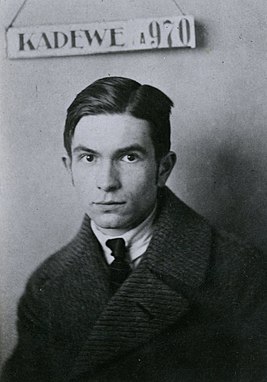 | |
| Date of Birth | February 22, 1896 |
| Place of Birth | Antwerp |
| Date of death | March 18, 1928 (32 years old) |
| Place of death | Belgium |
| Citizenship | Belgium |
| Occupation | poet |
| Language of Works | |
Biography
Born February 22, 1896 in Antwerp , was the seventh child in the family. He studied at the Royal Athenaeum of Antwerp (an analogue of the classical school in the pre-revolutionary education system), but in 1913 he dropped out of school without graduating. Since March 1914, he worked as an employee in the Antwerp City Hall, in his spare time he independently studied French and German , and after learning them, he began to study French and German literature . In February 1914, his first newspaper article was published.
Already at this time, Osteyen became close to the Flamingants - supporters of the cultural and political independence of Flanders . During the years of German occupation, he joined the movement of the so-called activists. Activists believed that by working with the Germans they could achieve Flanders independence. In 1916 the first collection of Ostayen’s poems, Music hall, was released . In 1918 - a collection of Het seinjaal .
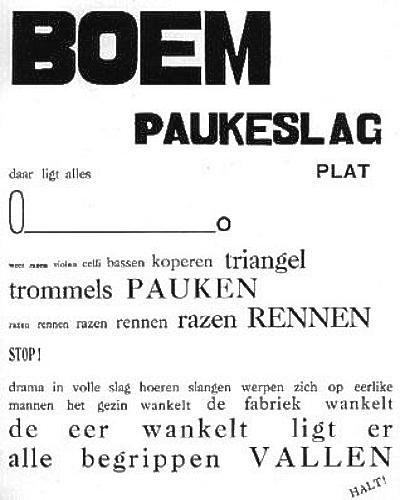
After the end of World War I , fearing persecution on charges of collaboration , he moved to Berlin , where he lived by casual work, changed many jobs - from the elevator to the seller of women's shoes. During his stay in Berlin, Osteyen became acquainted with Dadaism , which was reflected in his next poetic collection - Bezette stad .
In the fall of 1921, Ostyen returned to Belgium. He was acquitted under an amnesty and was drafted into the army. Demobilized in 1923 .
In 1927, Ostayen fell ill with tuberculosis . He was treated in a sanatorium in the Ardennes , and died on March 18 of the following year. He was buried at the Antwerp cemetery Schoonselhof ( Schoonselhof ).
Ostayen’s poetry was influenced by modernism , expressionism , Dadaism and early surrealism , although Ostayen’s own style cannot be unambiguously attributed to any particular direction.
Language
Ostyen was quite free to deal with generally accepted spelling rules. He wrote his poems “phonetically,” that is, he wrote as he heard, and not as follows the rules, for example, sienjaal instead of signal (this word was borrowed from French and retained the original spelling).
Poetry collections
- Music Hall ( 1916 )
- Het Sienjaal ( 1918 )
- Bezette Stad ( 1921 )
- Feesten van Angst en Pijn (written in 1921, but published posthumously)
- Nagelaten gedichten (a collection of Osteyen's last poems, compiled after his death, published in 1928 )
Links (all in Dutch)
Russian translations
- Translations of Marina Paley : “New World” 1997, No. 7
- Translations by Maya Schwartzman : The International Poetry Contest " Emigrant Lyre "
- Translations by E. Dolmatovsky // From modern Belgian poetry. M., 1965.
- Translations by N. Maltseva // West European poetry of the XX century. M., 1977 .-- S.142-143.
- Translations by Dmitry Sachs // Language and Culture. Materials of the conference "Belgium-Netherlands-Russia". Second issue. M., 1999.
Literature
- Brief Encyclopedia of Literature. T.5. M., 1968.- S. 486.
- Tengbergen M., Mikhailova I. Antwerp literary. Antwerp poet Paul van Ostijen. In: St. Petersburg-Antwerp. 50 years of partnership. St. Petersburg: "European House", 2008. - S.149-171. ISBN 978-5-8015-0236-6
- Gerrit Borgers, "Kroniek van Paul van Ostaijen 1896 - 1928", Uitgeverij Scheltens & Giltay, Den Haag; Uitgeverij Orion, Brugge, 1975, 154 blz., ISBN 90 264 3526 6
- Beekman, EM Homeopathy of the absurd. The Grotesque in Paul van Ostaijen's Creative Prose. Den Haag. Nijhoff. 1970.-X, 196 p.
Notes
- ↑ BNF ID : 2011 Open Data Platform .