Vladimir Alekseevich Saprykin ( August 24, 1916 , p. Sukhodol , Tambov province - April 24, 1990 , Toronto , Canada ) - Soviet officer, captain, Hero of the Soviet Union .
| Vladimir Alekseevich Saprykin | |||||
|---|---|---|---|---|---|
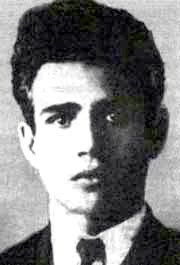 Vladimir Alekseevich Saprykin before the war . | |||||
| Date of Birth | August 24, 1916 | ||||
| Place of Birth | Sukhodol , Lebedyansky Uyezd , Tambov Province , Russian Empire | ||||
| Date of death | April 24, 1990 (73 years old) | ||||
| A place of death | Toronto Canada | ||||
| Type of army | infantry | ||||
| Years of service | 1939 - 1943 | ||||
| Rank | captain  | ||||
| Part | 612th Infantry Regiment of the 144th Infantry Division | ||||
| Commanded | battalion | ||||
| Battles / wars | The Great Patriotic War | ||||
| Awards and prizes |
| ||||


Content
- 1 Biography
- 1.1 Childhood and youth
- 1.2 Military service
- 1.2.1 Peacetime
- 1.2.2 War years
- 1.2.2.1 Hero of the Soviet Union
- 1.3 Captivity
- 1.4 Emigration
- 1.4.1 Reasons for emigration
- 1.4.2 Life in exile
- 1.4.3 Deprivation and restoration of the title of Hero of the Soviet Union
- 1.5 Death and burial
- 2 Awards and titles
- 3 Memory
- 4 Literature
- 5 Links
Biography
Childhood and Youth
Born on August 24, 1916 in the village of Sukhodol (now in the Krasninsky district of the Lipetsk region ). He graduated from ten years, rabfak, then Voronezh Pedagogical Institute . He began his career as a teacher in a secondary school in the village of Olkhovatka, Voronezh Region.
Military Service
Peacetime
He was drafted into the Red Army in 1939. In May 1941 he graduated from the Grozny Infantry School. He was sent to the unit on the territory of Belarus with the rank of lieutenant in 1941.
War years
From the first days of the war, lieutenant Saprykin in the army, commanded a platoon, company, battalion. By October 1941, he rose to the rank of chief of staff of the 845th Infantry Regiment of the 303rd Infantry Division and was promoted to senior lieutenant. Then he fell into German surroundings under the village of Yelnya . In December, one returned to his own, retaining his uniform, weapons and documents. Passed a test in the filtration camps of the Horovets. The command considered that Saprykin had betrayed his unit, and by a decision of the Supreme Court of the USSR on June 15, 1942 he was convicted by the military tribunal of the 16th Infantry Division under article 193-7, clause “d” of the Criminal Code of the RSFSR for 10 years in prison, with a delay in the execution of the sentence and heading to the front in the penal battalion.
A month later, after being wounded, he atoned for guilt and was sent to serve in the 612th Infantry Regiment of the 144th Infantry Division. From July 17 until the last battle he fought in the positions of company commander, assistant chief of staff of the regiment, commander of the 2nd infantry battalion. Near the village of Prudka, the Germans recaptured about 1,000 civilians and was awarded the Order of the Red Star . For the capture of Vyazma he was awarded the Order of Alexander Nevsky .
Title of Hero of the Soviet Union
On December 1, 1943, near the village of Krasnaya Sloboda, the battalion of Saprykin, cut off from the regiment, defended against the Germans for 3 days. When less than 30 people remained in the battalion, Saprykin called fire on himself. The title of Hero of the Soviet Union was awarded June 3, 1944 to captain Vladimir Alekseevich Saprykin posthumously .
Captivity
However, Saprykin managed to survive. He received a through wound in the chest, was picked up by German soldiers and sent to a concentration camp . It was there that he met the news of the victory of the USSR in the Great Patriotic War.
Emigration
Vladimir Alekseevich escaped from a concentration camp and emigrated to Canada .
Reasons for Emigration
Official version - Saprykin decided that after the fascist camps and the penal battalion he had nothing to do in the USSR. However, there is another version - he had a conflict with the Soviet colonel, who promised him, as a " rat camp " in the Soviet Union, death or life imprisonment.
Life in exile
He lived in the city of Toronto. He changed many professions. He worked as a port loader, a taxi driver. Took on any work. In parallel, he studied French . Vladimir Alekseevich, at the cost of incredible efforts, was able to occupy a high position in society. Yesterday's prisoner of war graduated from a prestigious university, received an engineering degree, got a job in a company, became a leading specialist. Everything turned out well, but the soul yearned for homeland. He invited Soviet sailors to visit him. Those who were not afraid to come to the emigrant later recalled: they lived modestly, their only wealth was a library of Russian books, they connected it with their homeland. He guessed that at home he was considered dead or missing, but did not even imagine that he was awarded such a high rank. In the mid-1970s, he sent a letter to his father through the Red Cross: “Dear papa! It's hard for me to write. A through wound to the chest makes itself felt to this day. Understand and do not condemn my non-return. Your son is not a traitor to the motherland. Thoughts about her were and remain a single conviction in life. ” There is a reliable fact that he drove out his Soviet roommate from the apartment only because in the Canada - USSR hockey match he was ill against the USSR national team player Valery Kharlamov .
Deprivation and restoration of the title of Hero of the Soviet Union
On August 25, 1977, Vladimir Saprykin was stripped of the title Hero of the Soviet Union, accused of treason and service in punitive units. The reason for the appearance of such information was the mistake of a person who worked with documents of prisoners of war. Registration mark on the card of V. A. Saprykin “Ex. Leg ”was incorrectly translated as“ former legionnaire ”. However, on December 4, 1991, the honorary title was returned.
Death and Burial
The hero died on April 24, 1990, having not lived a bit before recognizing his feat in his homeland. They buried V. A. Saprykin at the Russian cemetery in Toronto ( Canada ). In July 1999, the hero’s ashes were reburied, now the battalion commander is resting in a mass grave near the village of Krasnaya Sloboda along with his soldiers.
Awards and titles
Soviet state awards and titles:
- Hero of the Soviet Union (June 3, 1944);
- Order of Lenin (June 3, 1944);
- Order of Alexander Nevsky (October 15, 1943);
- Order of the Red Star (July 5, 1943).
Memory
A school in the native village of Sukhodol is named after the hero.
In Olkhovatka, a bust of the hero is set.
Literature
- Belarusian encyclopedia: At 18 t. / Redkal .: G.P. Pashkoў іnsh. - Mn. : BelEn, 2002. - T. 14: Rele - Slavyavіna. - S. 173-174. - 512 s. - 10,000 copies. - ISBN 985-11-0238-5 . (belor.)
- Dunaev P.M. The star and the cross of the battalion commander: Fates of war veterans: Feat and tragedy. 1941-1945 .. - M .: Centerpolygraph, 2007 .-- 440 p. - (On the front line. The truth about the war). - 6000 copies. - ISBN 978-5-9524-2596-5 .
- Zvyagintsev V.N. Found guilty of treason to the Motherland // Tribunal for heroes. - M .: OLMA-PRESS, 2005 .-- 572 p. - 3000 copies. - ISBN 5948496430 .
- Bortakovsky T. V. Lost! Unknown pages of the Great Patriotic War. - Veche, 2015. - ISBN 978-5-4444-3590-8
Links
- Saprykin, Vladimir Alekseevich . Site " Heroes of the country ".
- Tatyana Sinitsyna. Peter Dunaev: “I returned the honor to the battalion commander” . RIA Novosti (May 8, 2007). Date of treatment December 30, 2014.
- Berezin A. Winners: Star and cross of the battalion commander Saprykin . Brother (December 2006). Date of treatment January 2, 2015.