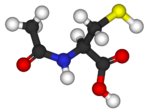
Acetylcysteine ( N- acetyl- L- cysteine, NAC) is a mucolytic , expectorant, and antioxidant. It is used for infectious diseases, which may be accompanied by the formation of viscous, difficult to separate sputum . It is also prescribed for otitis media, rhinitis and sinusitis.
| Acetylcysteine | |
|---|---|
 | |
 | |
| Chemical compound | |
| IUPAC | ( R ) -2-acetamido-3-sulfanylpropanoic acid |
| Gross formula | C 5 H 9 NO 3 S |
| Molar mass | 163.19 |
| CAS | |
| Pubchem | |
| Drugbank | |
| Classification | |
| ATX | |
| Pharmacokinetics | |
| Bioavailable | 6-10% ( inside ) <3% ( externally ) |
| Metabolism | Liver |
| The period is half out. | 5.6 hours (adults) 11 hours (newborns) |
| Excretion | the kidneys |
| Dosage Forms | |
| tablets, solution for inhalation, solution for injection | |
| Other names | |
| Acetin, Acetylcysteine, Acetylcysteine Canon, Acetylcysteine Sediko, Acetylcysteine Teva, ACC, ACC Long, ACC injection, Vicks Active EkspectoMed, Mukoneks, N-AC-ratiofarm, Rinofluimucil, Fluimucil-Antibody, Fluimucil-AntibiTsil-Antibacter, Fluimucil-Antibacter, Fluimucil-AntibiTsil-AntibiTsil-Antibiocil, Antimycil-antibiotic, Fluimucil-antibiotic, Fluimucil-AntibiTsil-AntibiTsil-AntibiTsil-AntibiTsil-Antibiocil | |

Acetylcysteine is on the list of vital and essential drugs .
N-acetylcysteine has been shown to be highly effective in preventing bacterial adhesion and dissolution of the mature biofilm matrix. [1] [2]
History
In the 1950s, Professor Vittorio Ferrari, working on a task from the pharmaceutical company Zambon, drew attention to the ability of a chemical substance, acetylcysteine, to break the disulfide bonds of mucopolysaccharides in mucus. This discovery laid the foundation for the development of mucolytic class drugs. [3] Since the late 1980s Acetylcysteine is used as an antioxidant , which has both a direct antioxidant effect due to the presence of a free thiol group and indirect due to the fact that it is a precursor of glutathione . [four]
Pharmacodynamics
Acetylcysteine is a derivative of the amino acid cysteine . It has a mucolytic effect, facilitates the discharge of sputum, directly affecting the rheological properties of sputum. The mucolytic effect is due to the ability of the drug to break the disulfide bonds of mucopolysaccharide chains and cause the depolymerization of mucoproteins of sputum. [5] It has an antioxidant effect, which is based on the ability of its reactive sulfhydryl groups (SH-groups) to bind to oxidizing radicals, neutralizing them. Promotes the synthesis of glutathione, an important component of the antioxidant system and chemical detoxification of the body. [6]
Due to the antioxidant effect, the anti-inflammatory property of acetylcysteine is also realized - the antioxidant effect of acetylcysteine increases the protection of cells from the damaging effects of free radical oxidation, which is characteristic of an intense inflammatory reaction. The antioxidant and anti-inflammatory effects of acetylcysteine are especially important in acute respiratory viral infections with high fever and flu . [7]
It has anti-inflammatory properties, due to the suppression of the formation of free radicals and reactive oxygen metabolites, responsible for the development of acute and chronic inflammation in the lung tissue and airways. The prophylactic use of acetylcysteine helps to reduce the frequency and severity of exacerbations of bacterial etiology in patients with chronic bronchitis and cystic fibrosis . [8] [9] [10]
Indications
Diseases of the respiratory system, accompanied by the formation of viscous difficult to separate sputum: acute and chronic bronchitis, obstructive bronchitis; tracheitis , laryngotracheitis; pneumonia lung abscess bronchiectatic disease, bronchial asthma , chronic obstructive pulmonary disease (COPD), bronchiolitis; cystic fibrosis; acute and chronic sinusitis , inflammation of the middle ear (otitis media). [11] [12] Chronic bacterial cystitis [2] [13]
Application
Use in children
Acetylcysteine has a high safety profile and can be recommended for the treatment of cough with acute respiratory viral infections in adults and children. [14]
It is a mucolytic of direct type of action, can be used in children with various respiratory diseases, accompanied by cough and mucostasis. It is advisable to prescribe diseases in the early stages with the aim of thinning viscous sputum, normalizing the rheological properties of bronchial secretions, improving mucociliary clearance, and also as an active antioxidant, the inclusion of which in therapy helps to more quickly stop the symptoms of intoxication and reduce the hospital stay in children with acute respiratory infections.
Recommended dosages: Children aged 2 to 6 years - 2-3 times a day, 100 mg (200-300 mg / day). Children aged 6 to 14 years - 3-4 times a day, 100 mg or 2 times a day, 200 mg (300-400 mg / day).
Adult Use
Dosage in adults and children over 14 years of age: 1-3 times a day, depending on the dosage (400-600 mg / day). [12]
Side effect
According to the World Health Organization ( WHO ), unwanted effects are classified according to their frequency of development as follows: very often (⩾ 1/10), often (⩾1 / 100, <1/10), infrequently (⩾1 / 1000, < 1/100), rarely (⩾1 / 10000, <1/1000) and very rarely (<1/10000); the frequency is unknown (the frequency of occurrence of the phenomenon cannot be determined based on available data).
Disorders from the immune system: infrequently - hypersensitivity reactions: skin itching, rash, urticaria; very rarely anaphylactic / anaphylactoid reactions;
From the organs of the gastrointestinal tract: infrequently - nausea, vomiting, heartburn, abdominal pain, stomatitis, diarrhea; rarely - dispersion; From the respiratory system: rarely - shortness of breath, bronchospasm (mainly in patients with bronchial hyperresponsiveness with asthma);
Disorders from the cardiovascular system: infrequently - lowering blood pressure, tachycardia; very rare: bleeding; Other: infrequently headache, drowsiness, fever; noise in ears; reflex cough, local irritation of the respiratory tract, rhinorrhea (with inhalation use); burning at the injection site (with parenteral administration). [11] [12]
Interactions with Other Medicines
Acetylcysteine with antitussive agents should not be used, since suppression of the cough reflex can increase sputum congestion. Joint use with antibiotics can lead to a decrease in the activity of both drugs, since tetracyclines (excluding doxycycline), ampicillin , amphotericin B can interact with the thiol SH-group of acetylcysteine. The interval between taking acetylcysteine and antibiotics should be at least 2 hours (except cefixime and loracarbef). With the simultaneous administration of acetylcysteine and nitroglycerin, the vasodilator and antiplatelet effect of the latter may increase. Acetylcysteine reduces the hepatotoxic effect of paracetamol . Pharmaceutically incompatible with solutions of other drugs. [eleven]
It has been demonstrated that n-acetylcysteine associated with substances such as d-mannose, lactoferrin and citrus leaf morinda successfully fights chronic cystitis. In case of male infertility, N-acetylcysteine has a sperm-liquefying effect. [15]
Comparative Studies
- For three years, a study was conducted at the Department of Children's Diseases of the Russian State Medical University , in which 259 children with acute chronic bronchopulmonary pathology aged 0 to 15 years took part. 92 children received acetylcysteine, 117 children received ambroxol in the form of tablets, syrup, inhalation and injection, 50 patients made up the comparison group - 30 took bromhexine, 20 received mucaltin. The duration of therapy ranged from 5 to 15 days.
The assessment was carried out according to the following criteria: the timing of the appearance of a productive cough, the decrease in its intensity, the timing of recovery, the viscosity of sputum.
According to the results of the study, acetylcysteine showed the best clinical effect. Bromhexine and ambroxol also showed a pronounced mucolytic effect, but at a later date than acetylcysteine. The smallest clinical efficacy showed mucaltin . [sixteen]
- In 2013, the Cochrane Library published a systematic review of studies evaluating the efficacy and safety of acetylcysteine and carbocysteine in the treatment of acute upper and lower respiratory tract infections in children without chronic bronchopulmonary pathology. Acetylcysteine was studied in 20 studies, the number of participants aged 2 months to 13 years was 1080, of which 831 received treatment (the rest were control). All controlled studies showed good clinical safety, with the exception of mild gastrointestinal adverse events (vomiting) in 46 patients (2%). Overall, safety was good, but very little data was available to evaluate safety for children under 2 years of age. [17]
- A double, blind, placebo-controlled study by the Swedish Society of Lung Diseases included 259 patients with chronic bronchitis. Patients received 200 mg of acetylcysteine per day for 6 months. Long-term prophylactic administration of acetylcysteine in patients with chronic bronchitis significantly reduced the risk of exacerbation. The exacerbation rate of chronic bronchitis was 52.5% lower in the group of patients treated with acetylcysteine for a long time compared with the placebo group. [18]
- A meta-analysis of 39 studies of the use of acetylcysteine in chronic bronchitis over the period from 1976 to 1994 was carried out; 11 of them met inclusion criteria (the rest were uncontrolled or did not contain relevant data on the effects of acetylcysteine when taken orally). Data for 2011 patients were available for analysis: 96 people took acetylcysteine, 1015 people took placebo.
Acetylcysteine in all studies was administered orally two or three times a day (400 or 600 mg / day). Duration of treatment averaged from 12 to 24 weeks.
Results:
- When using acetylcysteine, almost 2 times more patients noted an improvement in their condition (61.4% -acetylcysteine, 34.6% - placebo), the difference in favor of acetylcysteine was statistically significant.
- No differences were found between acetylcysteine and placebo in the frequency of adverse events from the gastrointestinal tract. When using acetylcysteine, 10.2% of patients complained of adverse reactions from the gastrointestinal tract (dyspepsia, diarrhea or heartburn), while in the control group - 10.9%.
- For prophylactic purposes, patients can take acetylcysteine constantly or at least every winter (on the recommendation of a doctor).
Conclusion: oral administration of N-acetylcysteine for 3-6 months. patients suffering from chronic bronchitis are well tolerated, accompanied by a statistically significant reduction in the risk of exacerbations and a significant decrease in symptoms of bronchitis. [nineteen]
In vitro research
Today it is known that most bacteria exist in nature not in the form of free-floating cells, but in the form of specifically organized biofilms (Biofilms). Moreover, the bacteria themselves make up only 5-35% of the biofilm mass, the rest is the interbacterial matrix. Studies have been undertaken that show that N-acetylcysteine effectively destroys biofilms. It has been shown that N-acetylcysteine in various concentrations is able to reduce bacterial adhesion. Comparative studies showed the ability of acetylcysteine to reduce the viability of Staphylococcus aureus biofilms (after 5 and 48 hours) compared with ambroxol and bromhexine 5-6 times higher, the decrease in bacterial matrix synthesis in acetylcysteine - 72%, in ambroxol - 20%. [20] [21]
Promising areas
The use of acetylcysteine for the treatment and prevention of poisoning has been widely studied. [22]
Studies are underway on the therapeutic effect of schizophrenia , [23] bipolar disorder , [24] obsessive-compulsive disorder, [25] AIDS, [26] polycystic ovary syndrome [27], and other conditions. In experiments on old mice, it was found that a mixture of acetylcysteine with the amino acid glycine can have a geroprotective effect, protecting against cardiovascular diseases [28] .
In addition to antioxidant activity, recent experimental results have confirmed the effectiveness of N-acetylcysteine in disaggregating and reducing the number of viable forms of bacteria present in biofilms , such as Staphylococcus aureus and Escherichia coli . The efficacy of fosfomycin and ibuprofen in synergism with N-acetylcysteine in infections caused by biofilms of uropathogenic Escherichia coli and nonspecific urinary tract infections was emphasized. The activity performed by N-acetylcysteine, even when used in synergistic association with single antibiotics, opens up new and important therapeutic prospects for chronic infectious pathologies of the respiratory tract and urinary tract caused by biofilm microorganisms, which are almost impossible to eradicate using general antibiotic therapy [2] [ 13]
The high antioxidant activity of N-acetylcysteine, its ability to prevent the formation of biofilms, to destroy the polymer membrane of mature bacterial and fungal biofilms, makes pathogens sensitive to drugs and the immune system reaction. [29]
N-acetylcysteine is used to destroy bacterial biofilms of the bladder, the main cause of chronic cystitis. It has been demonstrated that n-acetylcysteine, associated with substances such as d-mannose, lactoferrin and Morinda citrus leaf extract, successfully fights chronic cystitis. In case of male infertility, N-acetylcysteine has a sperm-liquefying effect. [15]
Notes
- ↑ Venkatesh M, Rong L, Raad I, Versalovic J. Novel synergistic antibiofilm combinations for salvage of infected catheters (Eng.) // Journal of Medical Microbiology . - Microbiology Society , 2009. - No. 58 (Pt 7) . - S. 936-944 .
- ↑ 1 2 3 Naves P, Del Prado G, Huelves L, Rodriguez-Cerrato V, Ruiz V, Ponte MC, et al. Effects of human sierum albumium, ibuprofen and N-acetil-L-cysteine against biofilm formation by pathogenic Escheriachia Coli strains. // Journal of Hospital Infection. - 2010. - No. 76 . - S. 165-170 .
- ↑ Birth of the class of mucolytics. As it was in fact . Date of treatment May 3, 2017.
- ↑ O. I. Simonova. Mucolytics in pediatric practice: rational choice, therapeutic effects and features of therapy // Questions of modern pediatrics. - 2013 .-- T. 12 (4) . - p . 136-141 .
- ↑ Kakhnovsky I.V. Evaluation of the effect of acetylcysteine on the rheological properties of sputum // Clinical Pharmacology and Therapy. - 1997. - T. 6 , No. 1 . - S. 29-30 .
- ↑ The use of fluimucil (N-acetylcysteine) for lung diseases . Date of treatment May 3, 2017.
- ↑ S. Ya. Batagov. Acetylcysteine in the treatment of lower respiratory tract infections in adults // Attending physician. - 2014. - No. 10 .
- ↑ ACC Long . Date of treatment May 3, 2017.
- ↑ Acetylcysteine Canon . Date of treatment May 3, 2017.
- ↑ State register of medicines . Date of treatment May 3, 2017.
- ↑ 1 2 3 Acetylcysteine (Acetylcysteine) . Date of treatment May 3, 2017.
- ↑ 1 2 3 Acetylcysteine . Date of treatment May 3, 2017.
- ↑ 1 2 Marchese A, Bozzolasco M, Gualco L, Debbia EA, Schito GC, Schito AM. Effect of fosfomycin alone and in combination with N-acetylcysteine on E. Coli biofilm // International Journal of Antimicrobial Agents. - 2003. - No. 22 . - S. 95-100 .
- ↑ Chalumeau M, Duijvestijn YCM. Acetylcysteine and carbocysteine for acute upper and lower respiratory tract infections in pediatric patients without chronic broncho-pulmonary disease // Cochrane Database of Systematic Reviews. - 2013. - No. 5 .
- ↑ 1 2 Giovanni Palleschi, Antonio Carbone, Pier Paolo Zanello, Rita Mele, Antonino Leto, Andrea Fuschi, Yazan Al Salhi, Gennaro Velotti, Samer Al Rawashdah, Gianluca Coppola, Angela Maurizi, Serena Maruccia, Antonio L. Pastore. Prospective study to compare antibiosis versus the association of N-acetylcysteine, D-mannose and Morinda citrifolia fruit extract in preventing urinary tract infections in patients submitted to urodynamic investigation // Archivio Italiano di Urologia e Andrologia. - 2017. - March ( t. 89 , No. 1 ). - S. 45-50 .
- ↑ Zaitseva O.V. The rational choice of mucolytic therapy in the treatment of respiratory diseases in children // breast cancer. - 2009.
- ↑ Chalumeau M, Duijvestijn YCM. Acetylcysteine and carbocysteine for acute upper and lower respiratory tract infections in pediatric patients without chronic broncho-pulmonary disease // Cochrane Database of Systematic Reviews. - 2013. - No. 5 .
- ↑ Boman G, Backer U. Oral acetylcysteine reduces exacerbation rate in chronic bronchitis: report of a trial organized by the Swedish Society for Pulmonary Diseases // European journal of Respiratory diseases. - 1983 .-- No. 64 (6) . - S. 405-415 .
- ↑ Stey C. The effect of oral N-acetylcysteine in chronic bronchitis: a quantitative systematic review // European Respiratory Journal. - 2000. - S. 253-262 .
- ↑ Roveta, S., Shito, AM, Debbia, EA Confronto tra gli effetti di N-acetil-cisteina, Ambroxol, Bromexina e Sobrerolo sui biofilm di Staphylococcus aureus // GIMMOC. - 2004. - No. 8 . - S. 131-142 .
- ↑ Pintucci JP Biofilms and infections of the upper respiratory tract // European Review for Medical and Pharmacological Sciences. - 2010. - T. 14 , No. 8 . - S. 683-690 .
- ↑ Promising directions for the clinical use of N-acetylcysteine
- ↑ Berk M., Copolov D., Dean O., Lu K., Jeavons S., Schapkaitz I., Anderson-Hunt M., Judd F., Katz F., Katz P., Ording-Jespersen S., Little J., Conus P., Cuenod M., Do KQ, Bush AI N-acetyl cysteine as a glutathione precursor for schizophrenia - a double-blind, randomized, placebo-controlled trial (Eng.) // Biol. Psychiatry : journal. - 2008 .-- September ( vol. 64 , no. 5 ). - P. 361-368 . - DOI : 10.1016 / j.biopsych.2008.03.004 . - PMID 18436195 .
- ↑ Berk M., Copolov DL, Dean O., et al . N-acetyl cysteine for depressive symptoms in bipolar disorder - a double-blind randomized placebo-controlled trial (Eng.) // Biol. Psychiatry : journal. - 2008 .-- September ( vol. 64 , no. 6 ). - P. 468-475 . - DOI : 10.1016 / j.biopsych.2008.04.022 . - PMID 18534556 .
- ↑ N-Acetylcysteine Augmentation in Treatment-Refractory Obsessive-Compulsive Disorder — Full Text View — ClinicalTrials.gov
- ↑ Breitkreutz R., Pittack N., Nebe CT, et al . Improvement of immune functions in HIV infection by sulfur supplementation: two randomized trials (англ.) // J. Mol. Med. : journal. — 2000. — Vol. 78 , no. 1 . — P. 55—62 . — PMID 10759030 .
- ↑ Fulghesu AM, Ciampelli M., Muzj G., et al . N-acetyl-cysteine treatment improves insulin sensitivity in women with polycystic ovary syndrome (англ.) // Fertil. Steril. : journal. — 2002. — June ( vol. 77 , no. 6 ). — P. 1128—1135 . — DOI : 10.1016/S0015-0282(02)03133-3 . — PMID 12057717 .
- ↑ Cieslik, KA, Sekhar, RV, Granillo, A., Reddy, A., Medrano, G., Pena Heredia, C., ... & Gupte, AA (2018). Improved Cardiovascular Function in Old Mice after N-Acetyl Cysteine and Glycine Supplemented Diet: Inflammation and Mitochondrial Factors . The Journals of Gerontology: Series A. DOI : 10.1093/gerona/gly034
- ↑ Smith A, Buchinsky FJ, Post JC. Eradicating chronic ear, nose and throat infections: a systematically conducted literature review of advances in biofilm treatment. // Journal of Otolaryngology - Head & Neck Surgery. — 2011. — № 144 . — С. 338—347 .
Links
- Ацетилцистеин // Лекарственные средства / М. Д. Машковский . — Справочник Машковского on-line .
- Ацетилцистеин (Acetylcysteine): инструкция, применение и формула . РЛС. Архивировано 7 августа 2012 года.
- Ацетилцистеин (Acetylcysteine) - Энциклопедия лекарств и товаров аптечного ассортимента . РЛС Патент. - Active substance.