

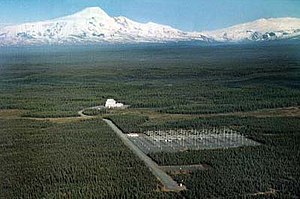
HAARP ( High Frequency Active Auroral Research Program - a program for studying the ionospheric scattering of high-frequency radio waves ) is an American research project to study the interaction of the ionosphere with powerful electromagnetic radiation . The project was launched in the spring of 1997 , in Gakon , Alaska .
Content
- 1 Tasks
- 2 Structure
- 3 Radiation powers
- 4 History
- 5 Similar research projects
- 6 See also
- 7 notes
- 8 References
Tasks
The ionospheric research complex (HAARP) was built to study the nature of the ionosphere and the development of air defense and missile defense systems .
Structure
HAARP includes antennas , incoherent radiation radar with a twenty-meter diameter antenna, laser locators , magnetometers , computers for signal processing and antenna field control. The entire complex is powered by a powerful gas power station and six diesel generators . The complex is developed and researched by the Philips Laboratory located at the US Air Force base in Curtland, New Mexico . She is subordinated to the laboratory of astrophysics , geophysics and weapons of the US Air Force Space Technology Center.
Radiation Power
- HAARP (USA) - presumably up to 4.8 MW (in 2009 it was 3.6 MW) (exact power)
- Sura - about 200 MW [1]
- EISCAT (Norway, Tromso ) - 1.2 MW
- SPEAR (Norway, Longyearbyen ) - 288 kW
Unlike broadcasting stations, many of which have 1 MW transmitters, but low-directional antennas, HAARP and similar systems use highly directional transmitting antennas, usually phased array antennas , capable of focusing almost all the radiated energy in a narrow beam and, therefore, in a small area space.
History
The station was launched in 1997 .
As of 2008, HAARP incurred about $ 250 million in construction, operating and tax costs.
- Stop and prospects
In early May 2013, due to the termination of the contract with BAE Systems Advanced Technologies, HAARP work was stopped. The conclusion of a new contract is expected, perhaps the customer will be the Agency for Advanced Defense Research and Development of the United States (DARPA).
It was supposed to conduct a series of studies in the fall of 2013 - in the winter of 2014. [2] In May 2014, the US Air Force spokesman David Walker stated that the command was no longer going to support the installation, and further ways to control the ionosphere that HAARP was to study would be developed. It was planned to close the station in June 2014, after the completion of the last research project of the DARPA program. Subsequently, the final closure of the station was postponed until May 2015 [3] . The facility and its equipment were transferred to the University of Alaska in mid-August 2015.
HAARP, like the Sura installation, was the target of conspiracy theorists who claimed that it was able to modify the weather , turn off satellites , control people's minds and the like [1] , that it is used as a weapon against terrorists. They blamed HAARP for earthquakes, droughts, hurricanes, floods, diseases ( Gulf War Syndrome and Chronic Fatigue Syndrome ), the crash of TWA Flight 800 in 1996, and the destruction of the Columbia space shuttle in 2003.
Commentators and scholars say the proponents of these theories are “ignorant,” because most of the theories put forward fall far beyond the capabilities of an object and often go beyond the natural sciences [4] [5] . The HAARP radiation power is vanishingly small even in comparison with a lightning discharge (50–100 lightning flashes in the atmosphere per day), and the solar wind energy is much higher [1] .
Similar research projects
HAARP system is not unique. There are two other stations in the USA: one in Puerto Rico (not far from the Arecibo Observatory ), and the other, known as , in Alaska near the town of Fairbanks . Both of these stations have active and passive instruments similar to HAARP.
Two world-class ionosphere research complexes have also been installed in Europe, and both are located in Norway : the more powerful EISCAT ( English uropean I ncoherent Scatter radar site ) is located near the city of Tromsø , the less powerful SPEAR ( English S pace P lasma E xploration by A ctive R adar ) - on the Svalbard archipelago.
Similar complexes and stations are located:
- in Vasilsursk (Russia) - “ SURA ”, the second in terms of radiated power after HAARP [1] ;
- several complexes of active influence in Tomsk on the basis of the ionospheric station of the Siberian Physicotechnical Institute and the Institute of Atmospheric Optics , now most of them are disbanded;
- ~ 5 km from Zmiev , Kharkov region (Ukraine) - radio astronomy complex “ URAN-1 ” [6] ;
- in Dushanbe (Tajikistan) - the Horizon radio engineering system (2 vertical rectangular antennas);
- at Hikamarca in Peru .
The primary goal of all these systems is to study the ionosphere, and most of them have the ability to stimulate small, localized areas of the ionosphere. HAARP also has such capabilities. But HAARP differs from these complexes in an unusual combination of research tools, which allows you to control radiation, wide-frequency coverage, etc.
See also
- Tesla Science Center at Wardenclyffe
Notes
- ↑ 1 2 3 4 Fishman, 2019 .
- ↑ HAARP Facility Shuts Down // arrl.org
- ↑ closure postponed until 2015 (inaccessible link)
- ↑ Baird, Austin . HAARP conspiracies: Guide to most far-out theories behind government research in Alaska (September 20, 2011). Date of treatment December 8, 2012.
- ↑ Flock, Elizabeth . Conspiracy Theorists Say Obama Engineered Hurricane Sandy (October 29, 2012). Date of treatment December 8, 2012.
- ↑ Radio astronomy complex URAN-2 Archived on February 3, 2012.
Links
- High Frequency Active Auroral Research Program. Official website
- Space Plasma Exploration by Active Radar Official Site
- HAARP photo gallery on geochronography site
- HAARP To Quadruple Its Power
- Eastlund Scientific Enterprises Corporation
- An article detailing various conspiracy theories around HAARP
- Fishman, Roman. Top Secret // Popular Mechanics: Journal. - 2019 .-- No. 6.