The Battle of Calabria is a naval battle, also known in Italian sources as the Battle of Punto Stilo (at Cape Stilo) ( Italian: Battaglia di punta Stilo ). It happened on July 9, 1940 in the Mediterranean Sea during World War II between the Italian fleet and the Mediterranean fleet of Great Britain. It was the first major clash of both fleets in the outbreak of war.
| Fight at Calabria | |||
|---|---|---|---|
| Main Conflict: World War II | |||
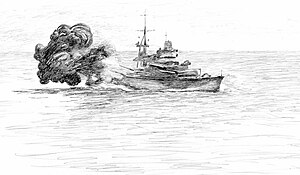 The battleship "Conte di Cavour" is firing from stern guns of the main caliber | |||
| date | July 9, 1940 | ||
| A place | Mediterranean Sea off the coast of Calabria | ||
| Total | the uncertain, moral victory of the British | ||
| Opponents | |||
| |||
| Commanders | |||
| |||
| Forces of the parties | |||
| |||
| Losses | |||
| |||


Content
Strategic pre-battle environment
At the beginning of July 1940, the fleets of England and Italy were tasked with ensuring the conduct of convoys with important cargoes.
The Italian army in Libya in preparation for the invasion of Egypt needed reinforcements (about 13,000 soldiers) and a large amount of military cargo (about 40,000 tons). To deliver the bulk of the troops and cargo to Africa, the fleet command decided to organize a convoy of 5 transport ships. The Italians were sure that the British fleet would try to intercept such an important convoy, therefore, a rather powerful fleet formation was used to protect it. The convoy left Naples on July 6, accompanied by six destroyers, the next day its cover was significantly strengthened. To ensure near and long-term protection of the convoy, 42 destroyers , 12 light cruisers , 6 heavy cruisers ( Paula, Zara, Fiume, Gorizia , Trento , Bolzano ) and 2 battleships ( flagship ) went to sea "Giulio Cesare" and "Conte di Cavour" ). In addition, about 30 Italian submarines patrolled areas where the appearance of the British fleet was most likely. The Italian unit was commanded by Admiral Inigo Campioni .
At this time, the British also began their escort operation, the fleet was to guard 2 convoys sent from Malta to Alexandria . The escort was covered by the British Mediterranean Fleet under the command of Admiral Andrew Cunningham . In the evening of July 7, the British unit went to sea, it consisted of 3 battleships ( Warspite - the flagship, Malaya , Royal Sovereign ), the Eagle aircraft carrier, 5 light cruisers and about 20 destroyers. English submarines and aircraft based in Malta were also deployed to cover the convoy.
The general plan for the British operation provided that the Gibraltar- based Compound H (2 battleships, battle cruiser, aircraft carrier, 3 light cruisers and 11 destroyers) would carry out a distracting sortie into the Western Mediterranean and conduct an air attack on the airfield in Cagliari in Sardinia . The command hoped that this would distract part of the Italian aviation and confuse the Italians' guesses about their plans. But the Italians were more concerned about the safe arrival of their convoy to Libya, they were not going to be distracted by the maneuvers of Compound H, provided that it did not go too far east. The Italians suspected that the British Mediterranean fleet went to sea, these fears were confirmed by the message of the submarine Beyulul, patrolling in the central region of the Mediterranean Sea. The boat reported contact with the enemy, but failed to attack the British. In turn, Admiral Cunningham received the first accurate confirmation that the Italian linear fleet is at sea. On the morning of July 8, the Phoenix submarine broadcasted the coordinates and course of two Italian battleships, accompanied by four destroyers, which were 180 miles east of Malta and 500 miles west of the British. The boat fired a torpedo salvo from the limit, but was not successful.
Fight
Having discovered the English connection, the Italians conducted a series of air attacks against it, using the SM-79 Sparviero horizontal bombers from airfields on islands in the Aegean . As a result of the attacks, the light cruiser Gloucester received a direct hit, the ship's commander, 6 officers and 11 sailors were killed, and the control and rangefinder post was damaged. Although the cruiser remained in service, he did not take an active part in the battle. Italian pilots reported a lot of hits in British ships (which in fact turned out to be false) and the command decided that the British suffered significant damage. However, according to the latest intelligence reports, the British compound continued to move stubbornly to the west. The intentions of the British to cut off the Italian battleships from their base in Taranto became increasingly apparent.
By the evening of July 8, the Italian convoy arrived safely in Benghazi and Admiral Campioni realized that when he returned to bases in Italy, his formation could meet with British ships. This meeting was supposed to happen on favorable conditions for Italians: near their own bases, with the strong support of coastal aviation and the possibility of successful attacks by Italian submarines deployed on the path of British ships.
However, the calculation of aviation assistance was not justified - the Italian Air Force showed amazing passivity, despite the numerous radiograms sent by Campioni to their headquarters in Messina . Moreover, the British Sunderland flying boats , which transmitted their data on the coordinates and course of the Italians, with impunity, watched the Italian ships. All this happened less than 50 miles off the coast of Calabria, but Italian planes never appeared. When around 13.00 on July 9, the heavy Kampioni cruisers were attacked by the Swordfish torpedo bombers , it became apparent that the British compound was somewhere nearby (the English torpedo bombers could attack Italians only from an aircraft carrier). The cruisers managed to evade the torpedoes, the torpedo bombers safely returned to the Eagle, which was already less than 90 miles from the Italian ships. At this time, Kampioni finally received a report from reconnaissance planes, which he had been expecting all morning: 2 battleships and 8 destroyers are only 80 miles from his own formation. If we take into account the recent attack on aircraft carriers, the Italian admiral realized that the British are well aware of all his movements. This allowed Cunningham to take a position between the Italian fleet and its main base. Therefore, Campioni decided once again to change course before the British finally cut it off.
At 14.15 the Italians lifted 3 seaplanes from light cruisers and after 15 minutes one of them said that he saw a suspicious ship in the southeast. The British first saw the Sydney Australian cruiser smoke on the horizon. At the same time, another seaplane told Campioni that the enemy fleet was located about 30 miles from Italian and was scattered over a large area. In fact, on the English side, one battleship (Worspite) took part in the clash, since Malaya and Royal Sovereign had too low speed and lagged behind the flagship.
The clash began with a shootout of enemy light cruisers, then heavy ships approached the battlefield. The battle was a shootout of ships at long distances (14,000-20000 meters), since the Italians avoided rapprochement with the British ships and had superiority in speed. The Worspite fired about 10 salvos at the light cruisers, after which they retreated under the cover of a smokescreen set by destroyers. They tried to hide behind the stern of the battleships “Giulio Cesare” and “Conte di Cavour” suitable from the west.
At 15.51, the Italian and British linear fleets saw each other, they walked almost parallel, gradually approaching. The battleships of the opponents opened fire at the same time, the Worspite gunners fired the flagship Giulio Cesare with several volleys. Meanwhile, the Malaya battleship entered the fray, he fired four volleys at Conte di Cavour, raising his 381 mm guns to maximum elevation, but the shells fell short of missiles, as did the 320 mm shells of the Cavour itself, which fell near Worspite. The Italian heavy cruisers also opened fire from the utmost range. The shootout went on for 7 minutes, both sides achieved cover, but there were no direct hits. Nonetheless, each new Worspite salvo lay closer to Cesare, and at 15.59 a 381-mm shell of the British battleship hit the middle of the Italian flagship. This shell destroyed one of the light anti-aircraft guns on the starboard side, along with the calculation. Explosion and splinters seriously damaged the case. A fire broke out, the smoke from which dragged fans into the boiler rooms, it became impossible to be there and the personnel was evacuated. After the loss of four boiler rooms, the speed of the battleship dropped to 18 knots . The Cesare left the battle formation, leaving the Cavour to continue the battle along with the heavy cruisers. However, at 16.05, Cavour also turned its back and followed Cesare, increasing the distance from the British. Kampioni ordered the destroyers to put a smokescreen and go in torpedo attacks to cover the withdrawal of battleships. The veil was put up quickly, but torpedo attacks were carried out quite fragmented. However, because of them, Cunningham did not dare to chase the Italian battleships hidden in the veil. An attempt to catch up with the enemy before entering the curtain did not lead to anything, since Worspite was able to develop only 17 knots, which was 1 knot less than the speed of the damaged Cesare. Heavy cruisers of Italians participated in the production of a smoke screen and covered the withdrawal of battleships. During the skirmish with the English light cruisers, the heavy cruiser Bolzano was damaged. Shrapnel from close shell explosions pierced the stern and jammed the steering. The cruiser described the circulation, but subsequent close breaks freed the rudders. During this shootout, the heavy cruisers were attacked by the Swordfish torpedo bombers from the Eagle aircraft carrier and they had to dodge the dropped torpedoes (which they succeeded). After this attack, from 16.15 to 16.25 the Italian cruisers ceased fire and disappeared into the smokescreen. The active phase of the battle was completed.
Battle Results
The only exact hit of Worspite in the Italian flagship from a distance of 13 miles decided the outcome of the collision, the Italian admiral stopped the fight, until it led to more serious consequences for the Italians. These consequences could well have occurred if 2 other English battleships entered into a direct battle. Therefore, Kamponi’s decision should be considered quite prudent, especially since the main task set before his connection was completed - the strategic convoy arrived safely at its destination. The advantageous position of the Italian fleet did not bring him any benefit (naturally, with the exception of the opportunity to take refuge in their bases in a timely manner). Italian bombers appeared after the battle ended, and some of them dropped bombs on their own ships, and they also failed to inflict any damage on the enemy. Before the battle, Kampioni had to plan their actions based only on assumptions, and not on accurate reports of air reconnaissance. While Cunningham almost always had information about the movements of the Italian fleet. The calculation of the Italians for their submarines was also not justified, the British managed to safely avoid contact with them.
The Italian admiral can be partly blamed for the inefficient use of heavy cruisers, he firmly “tied” them to battleships to strengthen his battle line, although an attempt to cover the English compound from the north-west was straightforward. If these high-speed and powerful ships managed to perform such a maneuver before the Cesare was damaged, this would seriously complicate the situation of Cunningham. He would have to split the fire of his ships in two directions and make sure that the enemy did not break through to the Eagle aircraft carrier, which was guarded by the damaged Gloucester light cruiser.
The results of the battle can be defined as a draw, both fleets completed the main tasks that they set for themselves. The complete insolvency of Italian air reconnaissance and the lack of coordination in the actions of the fleet and aviation became apparent. In general, the British won an unconditional moral victory off the coast of Calabria, wielding the initiative and leaving behind a battlefield.
Links
Sources
- Bragadin M.A. The Battle of the Mediterranean. The look of the vanquished. - M .: AST, 2001. - 624 p. - 8000 copies. - ISBN 5-17-002636-6 .
- Peter C. Smith (translated from English). Fight is inevitable !. - “AST”, “Transitbook”, 2005. - 428 p. - 3000 copies. - ISBN 5-17-030340-8 .