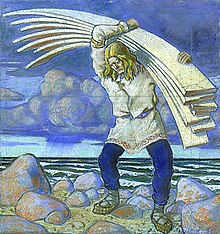
Kalevipoeg ( Est. Kalevipoeg , son of Kalev) - in Estonian mythology , the giant athlete, the son of the hero Kalev , as well as the Estonian heroic epic about him (publication 1857-1861) [1] . The original image of Kalevipoeg is a giant, whose activities were associated with the features of the geographical relief: clusters of stones scribbled by Kalevipoeg; plains - places where Kalevipoeg mowed down the forest, ridges of hills - traces of his plowing, lakes - his wells, ancient settlements - the bed of Kalevipoeg, etc. Kalevipoeg is also a fighter with evil spirits, with oppressors of the people and with foreign enemies.
Based on folk tales and songs, an Estonian writer and doctor of German descent, Friedrich Reinhold Kreutzwald ( German: Friedrich Reinhold Kreutzwald , 1803 - 1882 ), composed, like the Karelian-Finnish Kalevala, the heroic epic Kalevipoeg ( 1857 - 1861 ), which had a significant influence on Estonian literature. The author of the idea of the epic about Kalevipoeg was Friedrich Robert Faehlmann ( 1798 - 1850 ).
Epic consists of 20 songs. The original verse “Kalevipoega” is the so-called runic verse that is inherent in ancient Estonian folk songs; the language of the epic is archaic. On the basis of the Kalevipoeg epic, many art and musical works have been created.
Content
Translations
- The first Russian translation of the epic was published in 1876 in the Riga magazine “Baltic Herald”
- It was also published in Russian under the name “Kalevich” (Yu. Trusman, 1886–1887) and “Son of Kalev” (N. Alekseev, 1893–1897)
- Shortly after Estonia became part of the USSR, in the late 1940s and 1950s, the epic was published several times in Russian in a new translation. In the introductory article to the 1956 edition, “Kalevipoeg” was called “a deeply popular heroic epic” permeated with “the idea of struggle and justice”, emphasizing that “mutual study of the national epic brings the fraternal peoples of the Soviet republics even closer” [2] .
- In 1975, a translation into Esperanto by Hilda Dresen was published, see Kalevipoeg en Esperanto .
Notes
- ↑ Petrukhin V.Ya. Myths of the Finno-Ugric peoples. - M.: Astrel: AST: Transitbook, 2005.
- ↑ Kalevipoeg. Estonian folk epos. Translation Vl. Derzhavin and A. Kochetkov. . - Moscow: State Publishing House of Fiction, 1956. - S. 4, 17-18.
Literature
- Annist, A. Ya. Estonian epic tradition and the Kalevipoeg epic // Soviet Ethnography , 1965, No. 1.