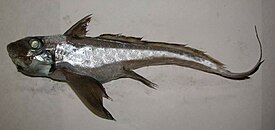
The European chimera [1] ( Latin Chimaera monstrosa ) is a cartilaginous fish , the most famous species of the chimera - like order, found in the East Atlantic from Iceland and Norway to the Mediterranean Sea and off the coast of South Africa, as well as the Barents Sea, between 75 ° C. w. and 27 ° c. w. and between 32 ° c. d. and 35 ° c. d. at a depth of up to 1400 m. Reaches 1-1.5 meters in length. It feeds on crayfish , shells and small fish. Lays eggs. Of little interest for commercial fishing [2] .
| European chimera |
 |
| Scientific classification |
|---|
| No rank : | Bilateral symmetrical |
| Squadron : | Holocephalomorphs |
|
| International scientific name |
|---|
Chimaera monstrosa Linnaeus , 1758 |
| Security status |
|---|
Close to vulnerableIUCN 3.1 Near Threatened : 63114 |
|
Content
A European chimera lives in the North Atlantic and adjacent seas of the Arctic Ocean . Distributed off the coast of Norway , Iceland , Ireland , Great Britain , France , Italy , Portugal , Morocco , the Azores and Madeira , in the Mediterranean Sea . Data on the presence of this species in the waters of South Africa require confirmation [3] . This marine bathidemersal oceanodromic fish is found at a depth of 40 to 1400 m [2] . In the north, it most often keeps at depths of 200-500 m, and in the south - 350-700 m. In winter, it approaches the shores; at this time, the European chimera comes across in the Norwegian fjords at a depth of 90-180 m [3] .
The head is thick with a rounded snout. The eyes are large. The mouth is lower, small, transverse. There are 4 on the upper jaw, and 2 large beak-shaped dental plates on the lower jaw. The body is elongated, it is very thin in the back. A narrow, sphenoid tail ends with a long thread. The pectoral fins are very large. The first dorsal fin is tall and short, with a strong long spine at the anterior margin; the second dorsal fin in the form of a low rim, which reaches the beginning of the caudal fin. Anal fin small. On the head there is a system of sensitive channels. The skin is bare and soft, occasionally covered with rudimentary spines. The dorsal surface is dark brown with a reddish tint, the sides are stained, the ventral side is light. The caudal, anal and posterior parts of the second dorsal fins have a blackish-brown fringing. The length of adult chimeras reaches 1.5 m [3] , and the maximum recorded weight is 2.5 kg [2] .
Males have a thin bony outgrowth between the eyes between the eyes. The skin is smooth and casts in a variety of colors.
The European chimera has large eyes, a long pectoral tail and large pectoral fins
Lays eggs enclosed in a horn capsule [4] . Reproduction year round. Up to 200 eggs develop in the ovaries of females. The female lays two eggs several times without repeated fertilization. Before laying, the female wears eggs attached to the outlets of the oviducts . Then she lays them at the bottom at rather great depths, sometimes up to 400 m. The diameter of the yolk is 26 mm. The capsule has a fin-shaped rim up to 4 mm high. The lower end of the capsule is cylindrical in shape, the upper has the appearance of a narrow filiform appendage, which serves to attach the egg. The capsule is 163–77 mm long and about 25 mm wide. The appendage is 30–40 mm long. Glossy brown to olive green capsule. Eggs develop about a year. Newborns hatch completely formed. Young ones rarely come across. Cases of capture are known from the Faroe Islands at a depth of 1000 m and from Ireland at a depth of 600 m. Young individuals are 11 cm long. Males are generally less than females [3] .
European chimera - benthophagus. Her diet consists mainly of invertebrates : crustaceans , mollusks , worms and echinoderms . Sometimes fish comes across in the stomach [3] .
At the beginning of the 20th century, fish did not have commercial value: meat was considered inedible, but sometimes the fat extracted from their liver was used in medicine or as a lubricant. Eggs were considered a treat. In Norway , chimeras were credited with healing agents [4] . The meat is stiff, but in some countries it is eaten [3] .
According to the International Council for the Exploration of the Sea , although this species is not a commercial species [5] , there have been cases of targeted catch [6] . Usually, single individuals fall during trawling , but in spring dozens of chimeras are caught from Northwest Norway. World catch is insignificant (in tons): 1992 - 106, 1994 - 60, 1995 - 106, 1996 - 21, 1997 - 15, 1998 - 32, 1999 - 12, 2000 - 15. Caught in by- catch in bottom trawls when fishing for other fish. The International Union for Conservation of Nature has assigned the species a conservation status of “Close to Vulnerability” [7] .
- ↑ Reshetnikov Yu.S. , Kotlyar A.N. , Russ T.S. , Shatunovsky M.I. The Bilingual Dictionary of Animal Names. Fish. Latin, Russian, English, German, French. / edited by Acad. V. E. Sokolova . - M .: Rus. Yaz., 1989 .-- S. 49 .-- 12,500 copies. - ISBN 5-200-00237-0 .
- ↑ 1 2 3 European chimera in the FishBase database.
- ↑ 1 2 3 4 5 6 Commercial fish of Russia. In two volumes / Ed. O.F. Gritsenko, A.N. Kotlyar and B.N. Kotenev. - M .: VNIRO publishing house, 2006. - T. 1. - S. 58. - 624 p. - ISBN 5-85382-229-2 .
- ↑ 1 2 Chimeric // Brockhaus and Efron Encyclopedic Dictionary : in 86 volumes (82 volumes and 4 additional). - SPb. , 1890-1907.
- ↑ Long Term Dynamics of the Chondrichthyan Fish Community in the Upper Tyrrhenian Sea ( PDF ). ICES (2005). Date of treatment January 24, 2013. Archived February 2, 2013.
- ↑ Widely distributed, migratory and deepwater stocks (English) ( PDF ). ICES (2006). Date of treatment January 24, 2013. Archived February 2, 2013.
- ↑ Chimaera monstrosa (English) . The IUCN Red List of Threatened Species .