East Malaysia ( Malaysian. Malaysia Timur ) - located in the Malaysian administrative-territorial units - the states of Sabah and Sarawak , as well as the federal territory of Labuan .
| East Malaysia | |
|---|---|
| Malaysian Malaysia timur | |
| A country | |
| History and Geography | |
| Square | 198 161 km² |
| Timezone | UTC + 8: 00 |
| Largest cities | Kuching , Kota Kinabalu , Sandakan , Tawau |
| Population | |
| Population | 5 764 790 people ( 2010 ) |
| Density | 29.09 people / km² |
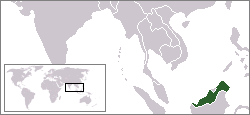 | |


The coastline of East Malaysia stretches for 2250 km along the northern coast of the island of Kalimantan , in the east it is divided into deep bays (Darvel, Sandakan, Kimanis, Labuk, Marudu) and islands, the largest of which are Jambongan, Bangui , Labuan and the northern part of Sebatik (southern belongs to Indonesia ).
East Malaysia borders on the south and southeast with the Indonesian provinces of West Kalimantan , East Kalimantan and North Kalimantan , and in the north with the Sultanate of Brunei .
Geography
The relief of East Malaysia is predominantly mountainous. Here is the highest point in Malaysia - Mount Kinabalu (4101 m). Mountains and plateaus descend to the coast, along which stretches a narrow strip of low-lying, often marshy plains. The bowels of East Malaysia are rich in copper ores, gold, coal and oil, also extracted on the shelf. There are many karst caves in the mountains, one of the most famous of which is the Niah Caves .
The rivers, the largest of which are Kinabatangan , Rajang and Baram , due to the abundance of precipitation, are full-flowing year-round and transport a significant amount of suspended particles. In the mountains, rivers abound with waterfalls and rapids, as a potential source of electricity, and in the lower reaches there are many large deltas, and rivers flow into many branches and channels and are navigable for a considerable length.
The climate of East Malaysia is equatorial. On the coast, the average temperature is 25–28 ° С all year round, in the mountains it is cooler. The average annual rainfall is from 3,750 mm in the plains to 5,000 mm in the mountains. Precipitation falls all year round, but as a result of the alternation of the northeastern and southwestern monsoons , seasonal variation is found: in Sarawak, dry weather is more frequent than in Sabah.
The soil and climatic conditions of East Malaysia favor the growth of moist tropical forests , replaced by mixed and coniferous forests in the mountains. The biodiversity of forests is striking in its wealth: 8 thousand species of flowering plants, a thousand species of orchids , 300 species of palm trees , 500 species of ferns , 60 species of bamboo , 3 thousand species of woody plants. On the coast stands a wide strip of mangrove forests . The fauna is extremely diverse: elephants , orangutans , gibbons , macaques , fat lori , woolly wings , bats , bats , Malay bears , crocodiles , and the Sumatran rhino is occasionally found. The bird fauna includes 600 species, including rhinoceros birds , parrots , long-tailed drongo , argus, etc. There are a lot of fish in rivers and coastal waters. In addition, crustaceans are found in the sea, ranging from small shrimps to huge lobsters , as well as mollusks and sea turtles .
History
The first state formations on the territory of East Malaysia were created by the Malays in the 10th century. BC e. In the X-XII centuries. the territory was in vassal dependence on the Malayan empire of Srivijaya , in the XIV-XV centuries. - from the Javanese state of Majapahit , then from the 16th century. until the first half of the XIX century. belonged to the Sultan of Brunei . In 1580, the Spanish colonialists tried to gain a foothold here, but they managed to expel them. In the XVIII century. For some time a British East India Company trading post existed on this territory. At the beginning of the XIX century. it housed one of the largest bases of piracy and slave markets. In 1842, the English adventurer J. Brooke received control of the Sultan of Brunei Sarawak and the title of Raja for help in suppressing the rebellion of the Dayak tribes. Then he and his heirs gradually expanded their possessions at the expense of the territory of the Sultanate of Brunei in 1861-1905. In 1847, Great Britain captured the island of Labuan from Brunei. In 1877–78 the Sultan of Brunei rented Sabah to the English businessman Dent and the Austro-Hungarian Consul in Hong Kong Overbeck. Then all rights to the territory of Sabah passed to the English trade syndicate, which transferred them to the Provisional Association of North Borneo, which received a letter of privilege from the English government in 1881; in 1882, the association created the British company North Borneo , which began to manage this territory. In 1888, North Borneo (Sabah) and Sarawak became protectorates, and in 1946 - colonies of Great Britain. In 1890, Labuan was annexed to North Borneo. In 1891, the border was determined between the British and Dutch possessions on Kalimantan, which is now the Malaysian-Indonesian border. On September 16, 1963, after lengthy negotiations, the Federation of Malaysia was proclaimed, consisting of Sabah and Sarawak, as states. The creation of Malaysia caused discontent and confrontation from neighbors - Indonesia and the Philippines, which claimed North Kalimantan. Diplomatic relations were broken, but in 1966 all three countries agreed to normalize relations and formed the Association of Southeast Asian Nations (ASEAN) . In 1984, the island of Labuan was removed from Sabah and directly subordinated to the federal government.
Population
The population density of East Malaysia is three times lower than the average density in the country, since only 21% of the population of Malaysia lives on its territory, which occupies 61% of the country's area. The ethnic composition is dominated by the indigenous population of Kalimantan - Dayaks living in the interior, followed by the Chinese living in cities, and the Malays , who are a minority and occupy the coastal plain.
| No. | Name | Status | Code | Administrative center | Square, km² | Population, people (2010) | Density, people / km² |
|---|---|---|---|---|---|---|---|
| one | Sabah | State | Sbh | Kota Kinabalu | 73 619 | 3 206 742 | 43.56 |
| 2 | Sarawak | State | SWK | Kuching | 124,450 | 2 471 140 | 19.86 |
| 3 | Labuan | Federal territory | Lb | Victoria | 92 | 86 908 | 944.65 |
| Total | 198 161 | 5 764 790 | 29.09 |