Durova Street is a street in the center of Moscow in the Meshchansky District of the Central Administrative District between Suvorovskaya Square and Prospekt Mira . On the street is the famous theater of animals "Corner of grandfather Durov . "
| Durov street | |
|---|---|
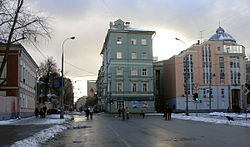 Durov Street, the intersection with Shchepkina Street . | |
| general information | |
| A country | Russia |
| City | Moscow |
| District | CAO |
| Area | Meshchansky |
| Length | 0.65 km |
| Underground | Peace Avenue |
| Former names | Bozhedomka street, street Old Bozhedomka |


Content
Origin of title
Named in 1927 in honor of Vladimir Leonidovich Durov (1863-1934) - the ancestor (together with his brother Anatoly) of the dynasty of animal trainers, who lived on the street and opened a living corner in his house, later called the “Durov Corner”. Initially, the street was called Bozhedomka , then (with the emergence of New Bozhedomka , now Dostoevsky Street ) - Old Bozhedomka . The name comes from the place where the bodies of the dead vagrants and drowned men were brought and left until spring for subsequent burial. For example, there was a church of the Exaltation of the Holy Cross, “that on the poor houses” (XVIII century).
History
Shortly before the revolution, Vladimir Leonidovich Durov bought a large house on Bozhedomka Street, where animals were placed and where he could conduct psychological experiments and training with them, and on January 8, 1912, he opened the theater of a living corner in his house, which later became known as Durov Corner . Revolutionary devastation forced to stop work. However, the new government soon reacted favorably to the "corner". In 1919, the Durov Corner was reopened there, but scientific work was no longer conducted (see Art. Durov, Vladimir Leonidovich ). Many years later, in 1982, the Corner was transformed into the Durov Animal Theater.
Location
Durov Street starts from Suvorovskaya Square, runs southeast, crosses Delegatskaya Street on the right and Samara Lane on the left, then Olympic Avenue , Vypolzov Lane (on the left), Meschanskaya Street (on the right), Shchepkin Street and Gilyarovsky Street and goes to Mira Avenue.
Notable buildings and structures
On the odd side:
- № 3/13 - residential building. Here lived the actors Boris Khmelnitsky [1] , Maria Pastukhova [2] . The building houses the Russian Sports Bowling Federation ;
- № 13/1 - City courier service;
- No. 49 - The building of the Meshchansky police unit (1838, architect L. S. Tomashevsky ), now - Exhibition exposition of the Main Directorate of the Ministry of Emergency Situations of Russia for the city of Moscow;
On the even side:
- No. 4 - Theater Corner of Grandfather Durov ; Museum of Durov's grandfather (1911–1912, architect ND Polikarpov ; new building - 1980, architects G. E. Saevich , L. I. Gorbunova, T. T. Lazarenko)
- No. 26 - Clinical Hospital No. 63.
Street Art
In the cinema
- The address "Bozhedomka, 7" appears in the Soviet film " The meeting place can not be changed " ( 1979 ).
In literature
- The street “Old Bozhedomka” appears in the story “Childhood on the outskirts” by LF Voronkova . This story about Sonya Goryunova’s childhood leads us to the outskirts of the old, pre-revolutionary Moscow, where poor people — small artisans, shoemakers, laundresses, tailors, landless peasants who came to work in Moscow — huddled in small wooden houses.
- In Bulgakov’s work The Master and Margarita, the wife of Stepa Likhodeev was found on Bozhedomka.
See also
- Dostoevsky Street
- Corner of grandfather Durov
Notes
- ↑ Khmelnitsky Boris Alekseevich // Moscow Encyclopedia. / Ch. ed. S. O. Schmidt . - M. , 2007—2014. - T. Tom I. Faces of Moscow : [in 6 books.].
- ↑ Pastukhova Maria Fominichna // Moscow Encyclopedia. / Ch. ed. S. O. Schmidt . - M. , 2007—2014. - T. Tom I. Faces of Moscow : [in 6 books.].