Jungfrau ( German: Jungfrau ) is one of the most famous mountain peaks in Switzerland .
| Jungfrau | |
|---|---|
| him. Jungfrau | |
 Jungfrau and Jungfraujoch | |
| Highest point | |
| Absolute height | 4158 [1] m |
| Relative height | 687 m |
| First climb | Johann Rudolph and Jerome Mayer |
| Location | |
| A country |
|
| Cantons | Bern , Valais |
| Mountain system | Western Alps |
| Ridge or array | Bernese Alps |

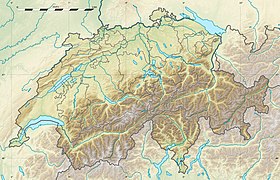


Its height is 4158 meters above sea level. This is the third highest mountain of the Bernese Alps , which forms a remarkable trio together with the Eiger ( German Eiger ) and Mönch ( German Mönch ) mountains [2] .
On December 13, 2001, Mount Jungfrau, as part of Jungfrau- Alec - Bichhorn, was inscribed on the UNESCO World Heritage List in Europe and is the first natural site in the Alps to be included in this list.
Mount Jungfrau ( Russian virgin, virgin ) owes its name to the nuns from Interlaken , whose monastery was located near the foot of the mountain. Then the name passed to the mountain itself.
For the first time this name was indicated on a topographic map in 1577 .

Content
Geographical position
The border between the cantons of Bern and Valais runs along the summit of Jungfrau.
The mountain is unusually peculiar. In the north and north-west, its snowy peaks Wengen-Jungfrau, Schneehorn, both Zilberhorn and Schwarzmönch are visible. In the west, there is almost no snow on it and it is unremarkable; it rises 3250 m above the Lauterbrunnen valley (this is the longest slope in the Alps after Mont Blanc). Its southern part rises above the Rottal glaciers hidden from view, and the eastern part rises above the saddle of the Jungfraujoch Pass covered with eternal snow.
Geology
From a geological point of view, Jungfrau is very remarkable. The foot of the mountain is formed from crystalline , the front ridges are Schwarzmönch, Rothbrett and Schneehorn from limestone formations, and Silberhorn , Wengen-Jungfrau and the central peak are from igneous rocks.
Science
Directly below the peak, above the Great Aletsch Glacier , which goes down, is the alpine international geophysical observatory, which conducts year-round comprehensive scientific observations of the state of the atmosphere, glaciosphere and lithosphere [3] .
Mountaineering
The first ascent was made by the Swiss Johann Rudolph and Jerome Mayer with guides Joseph Bortis and Alois Volker on August 3, 1811 from the side of Grimsel . Since then, the people jokingly referred to the untouched Jungfrau as "Madame Mayer."
Routes for climbers go from the north, northwest, southwest and south of Jungfrau. On July 12, 2007, an avalanche was summoned at an altitude of 3800 m and six recruits of the Andermatt school fell into the abyss 1000 m deep. Eight recruits along with the guides escaped. The military court subsequently acquitted the mountain guides, pointing out the incorrectly assessed risk of avalanches. The press, as well as numerous experts in the field of mountaineering, argued that the disaster could have been prevented, because the initial risk of avalanches was very high: about 50-60 cm of new snow fell a day before the accident.
Europe's highest mountain railway
From 1896 to 1912, the Jungfrau Railway was built here. The construction was carried out by the Swiss . True, plans to lay it to the very top of Jungfrau remained unrealized. It leads only to the saddle Jungfraujoch .
The route goes from the Kleine-Scheidegg station to the Eigergletcher station in an open area, and then through the tunnel upwards with views through panoramic windows from the Aigerwand station to alpine landscapes, and from the Aismmeer station to eternal ice and rocks.
Attractions
The terminal station is the “ Top of Europe ”, the highest mountain railway station in Europe. Galleries are cut into the rocks and glacier covering the Jungfraujoh saddle. From the observation deck of the observatory and weather station an alpine panorama of 360 ° opens, a view of the longest glacier in Europe, Aletsch (24 km) and the valley of Lake Tuna .
Ascent to the “Sphinx” is carried out by a high-speed elevator carrying up to 1200 passengers per hour, and overcoming a path of 110 m in 25 seconds.
The famous Ice Palace is one of the most popular places of Jungfraujoch. It occupies about 1000 m² and is located 20 meters under the Aletsch Glacier . In its halls, all exhibits are carved from ice.
In addition, at Jungfraujoch, you can watch an audiovisual show, an exhibition of scientific research, ride a dog sled on the glacier (only in summer). There are also several restaurants with amazing views.
At the foot of Jungfrau is the village of Wengen . This village, together with Murren , Grindelwald and Lauterbrunnen, forms the famous ski area Jungfrau Top Region .
Every year in September, the Jungfrau Mountain Marathon takes place in the Jungfrau region.
Interesting Facts
- Sparkling whiteness of the mountain Jungfrau and the adjacent black mountain Schwartzmenh (respectively, “Young Maiden” and “Black Monk”) became the basis of the legend of the priest's unrequited love for a young maiden.
- Jungfrau is mentioned in fiction, for example, by Karamzin in “ Letters of a Russian Traveler ” and by Friedrich Schiller in “ William Tell ”, as well as in Byron ’s famous dramatic poem “ Manfred ” (1816-1817), and by I. S. Turgenev in a poem in prose "Conversation" (1878).
- Jungfrau is depicted in Karl Seifert 's painting “Mount Jungfrau in Switzerland”.
- In honor of Mount Jungfrau , a commemorative bimetallic coin in denomination of 10 Swiss francs was issued in 2005 .
Gallery
View of Lake Tuna , in the background the trident Eiger , Mönch and Jungfrau (from left to right)
Aletsch and Jungfrau Glacier
Swiss commemorative coin "Jungfrau", 2005
See also
- Mönch
- Eiger
Notes
- ↑ Peakbagger.com
- ↑ Jungfrau // Brockhaus and Efron Encyclopedic Dictionary : in 86 volumes (82 volumes and 4 additional). - SPb. , 1890-1907.
- ↑ Bobrovnikov S.M. Rainbow over Jungfrau.
Literature
- Jungfrau // Brockhaus and Efron Encyclopedic Dictionary : in 86 volumes (82 volumes and 4 additional). - SPb. , 1890-1907.