Petro-Slavyanka is a village in Russia , an intracity municipality in the Kolpinsky district of the city of federal significance of St. Petersburg . The population is 1368 [2] people. (2019).
| Village [1] | |||||
| Petro-Slavyanka | |||||
|---|---|---|---|---|---|
| |||||
| A country |  Russia Russia | ||||
| Subject of the federation | St. Petersburg | ||||
| Area | Kolpinsky | ||||
| History and Geography | |||||
| Timezone | UTC + 3 | ||||
| Population | |||||
| Population | ↗ 1368 [2] people ( 2019 ) | ||||
| Digital identifiers | |||||
| Postcode | 196642 | ||||
| OKATO Code | 40277552 | ||||
| OKTMO Code | |||||
| mops.sankt-peterburg.info | |||||
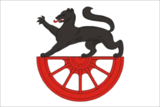

The village is named after the Slavyanka River , a tributary of the Neva .

Content
History
On the plan of 1781, a calico factory of Baron Stroganov with a mill is indicated, which dates back to Peter's time, when the tsar’s decree was issued: “ The Slavyanka River is 10 versts on both sides and 300 fathoms left for the construction of the sovereign’s mills”. The dam with a stone building on the right bank of the Slavyanka stood until the middle of the 20th century, when it was dismantled during the war. On the plans of 1808 and 1817 in this place appears the cottage of Count Zubov [3] . In 1831, Zubov sold the cottage to the merchant A. S. Karavaev. After Karavaev, the landowner Trifonov became the owner of the manor.
The settlement began to form actively in the second half of the 19th century , which was associated with the laying of the Nikolaev railway and reflected the wide scope of the summer cottage construction that unfolded around St. Petersburg . After the construction of the Nikolaev railway, the Fedotov Platform arose, named for the peasant, whose land bordered the railway and was alienated for construction. The platform was located on the 16th verst from St. Petersburg and in 1891 had barracks and a bridge team for two crossings over the railway and a bridge over the river. Slavyanka - first wooden, and then in 1880 made of metal structures according to the project of engineers Belodyubsky and Zubov.
The small village at the manor received its name Petrograd Slavyanka only in 1914. On February 19, 1918, Petro-Slavyanka was separated into a separate administrative unit, the Village Council was formed, and the main road leading to the central part of the village was called the road to Petro-Slavyanka , which remains intact today. [4] . Until 1924, the village was called the Petrograd Slavyanka, from 1924 to 1927 - the Leningrad Slavyanka . In 1927 it was renamed to the village of Petro-Slavyanka , which in February 1927 became part of the October Volost, and in August of the same year as part of the Kolpino District of the Leningrad Region. In May 1930, Petro-Slavyanka received the status of a holiday village. During the development of the village were opened: school to them. L. N. Tolstoy, kindergarten them. Karl Liebknecht Roses Luxembourg.
By a decree of the Presidium of the Supreme Council of the RSFSR of May 23, 1950, Petro-Slavyanka was assigned to the category of workers' settlements.
By a decree of the Presidium of the Supreme Council of the RSFSR of July 25, 1953, the Pavlovsky District was abolished, and Petro-Slavyanka was transferred to the Kolpinsky District Council of Leningrad. By the decision of the Leningrad City Executive Committee of April 9, 1973, the Petro-Slavic Council was abolished, the Petro-Slavic Council was subordinated to the Ust-Izhora Council. With the entry into force of St. Petersburg Law No. 186-59 of December 25, 1996 “On the Administrative Territorial Structure of St. Petersburg”, Petro-Slavyanka lost the status of an independent settlement and later became considered intracity territory of St. Petersburg endowed only with the status of a municipality.
Population
| Population | ||||||
|---|---|---|---|---|---|---|
| 2002 [5] | 2010 [6] | 2012 [7] | 2013 [8] | 2014 [9] | 2015 [10] | 2016 [11] |
| 1337 | ↘ 1085 | ↗ 1099 | ↗ 1745 | ↘ 1290 | ↘ 1264 | ↗ 1274 |
| 2017 [12] | 2018 [13] | 2019 [2] | ||||
| ↗ 1292 | ↗ 1326 | ↗ 1368 | ||||
Streets
May 1st Street
- Vitebsk street
- Gogol street
- Kommunarov Street
- Lugovaya street
- Marat Street
- Mayakovsky Street
- Novo-Sadovaya street
- Tverskaya street
- Labor Street
- central Street
- Komsomolskaya street
- Krasnoarmeyskaya street
- Sosnovaya street
- 3rd Five Year Street
- Izhorskaya street
- Club street
- Soviet Avenue
- Forest Avenue
Education
There is one comprehensive school No. 465 in the village. Currently, only primary education is received at the school.
Culture and leisure
- House of Culture [14]
- Equestrian club named after Yulia Rusakova
Transport
Roads connect Petro-Slavyanka with Kupchino, Moskovsky highway and the village of Metallostroy.
In the village there is a station Slavyanka of the Moscow direction of the October Railway.
Bus Routes
| room | Ending station (from the station) | Ending station (on the other hand) |
|---|---|---|
| 396 | Metallostroy , Palace of Culture. Mayakovsky | st. Third Five Year Plan |
| 396a | Metallostroy, NIIEFA | Fishing Fishing |
Economics
There are storage facilities in the village [15]
Attractions
| Object of cultural heritage, Object No. 7800523000 |
- Mass grave of Soviet soldiers who died in the Great Patriotic War (1941-1944, military cemetery) historical monument (regional)
| Object of cultural heritage, Object No. 7800527000 |
- Mass grave of Soviet soldiers who died in the Great Patriotic War (1941-1944, military cemetery, site number 2) historical monument (regional)
Notes
- ↑ Petro-Slavyanka settlement is an intracity municipality of St. Petersburg
- ↑ 1 2 3 The number of permanent residents by municipalities of St. Petersburg as of January 1, 2019 . Date of appeal April 27, 2019.
- ↑ Petro-Slavyanka (Unavailable link) . Date of treatment July 19, 2012. Archived December 8, 2013.
- ↑ History of Petro-Slavyanka
- ↑ 2002 All-Russian Population Census. Tom. 1, table 4. The population of Russia, federal districts, constituent entities of the Russian Federation, regions, urban settlements, rural settlements - district centers and rural settlements with a population of 3 thousand or more . Archived February 3, 2012.
- ↑ 2010 All-Russian Population Census. St. Petersburg . Date of treatment August 14, 2014. Archived on August 14, 2014.
- ↑ Population of the Russian Federation by municipalities. Table 35. Estimated resident population as of January 1, 2012 . Date of treatment May 31, 2014. Archived May 31, 2014.
- ↑ The population of the Russian Federation by municipalities as of January 1, 2013. - M.: Federal State Statistics Service of Rosstat, 2013. - 528 p. (Table 33. The population of urban districts, municipalities, urban and rural settlements, urban settlements, rural settlements) . Date of treatment November 16, 2013. Archived November 16, 2013.
- ↑ Table 33. The population of the Russian Federation by municipalities as of January 1, 2014 . Date of treatment August 2, 2014. Archived on August 2, 2014.
- ↑ The population of the Russian Federation by municipalities as of January 1, 2015 . Date of treatment August 6, 2015. Archived on August 6, 2015.
- ↑ Population of the Russian Federation by municipalities as of January 1, 2016
- ↑ The population of the Russian Federation by municipalities as of January 1, 2017 (July 31, 2017). Date of treatment July 31, 2017. Archived July 31, 2017.
- ↑ The population of the Russian Federation by municipalities as of January 1, 2018 . Date of treatment July 25, 2018. Archived July 26, 2018.
- ↑ PETROSLAVYANKA, Palace of Culture
- ↑ A worker died in Petroslavianka