
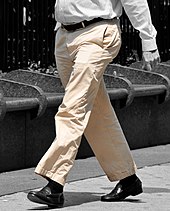
Trousers ( Dutch broek ), trousers (borrowed from the Turkic languages [1] ), or trousers ( dr. Russian patts [2] ) - an item of outer clothing that covers the lower part of the body and both legs separately with the help of trousers.
In the classic version, the trousers below reach the ankles or the upper part of the foot . Traditionally worn at the waist , although many modern models have an understated fit and are worn on the hips . To fix the trousers on the body, a trouser belt or suspenders can be used. Often there is a fly, or codpiece - a slit-valve, which is fastened with buttons , buttons or zippers .
Content
History
The most ancient find of this garment was made during excavation of the burial site (Yanghai, 42 ° 48′ – 42 ° 49′N, 89 ° 39′ – 89 ° 40′E), located near the Turfan oasis (northwest China). Woolen trousers about 3,000 years old were discovered in two graves (dating from radiocarbon analysis : between the 13th and 10th centuries BC). It is assumed that the appearance of trousers is associated with the beginning of the use of horses for riding (bare-footed riding is uncomfortable) [3] [4] [5] [6] .
The ancient Greeks and the ancient Romans , as a rule, did not wear pants (the ancient Greeks wore a hematium , and the Romans wore toga ). They perceived their pants as a hallmark of the barbarians [7] , the Persians wore shalvars .
Pyotr Komestor in Scholastic History (1173), which for many centuries served as a teaching tool in European universities, attributes the invention of the pants to the Babylonian queen Semiramis [8] ; this opinion is also expressed by other scribes of Western Europe of the 12th – 13th centuries ( Rodrigo Jimenez de Rada [9] , Salimbene of Parma [9] , Luke Tuisky [10] , etc.).
Etymology
The word "pants" appeared in Russian much earlier than the word "pants". It has a Turkic origin (yshtan, išton ). In Turkic languages, this word means pants or underpants .
The word "trousers" (from the Dutch broker ) appeared in Russia in the 18th century, in connection with the Petrine reforms, and originally meant " sailor 's pants". Initially, each leg of a sailor was a separate subject, so in many languages the name of this type of clothing is a plural or dual noun. Although trousers are traditionally considered to be pairs and are used only in the plural, nevertheless, the term " Brucean " is used in Russian marine terminology, which is used in the singular. In appearance, the Brugan is just “half the trousers,” being a sleeve that closes the annular gap between the deck and the mast and prevents water flowing into the hold from the mast [11] . The really common word "pants" became only a hundred years later. Since the trousers were actually an indicator of social status, in addition to the courtiers, they were also worn by representatives of the highest aristocracy.
Gallery
Pants from the peat bog Torsberg, Germany, 4th century AD e.
Skiff wearing pants
An Amazon wearing trousers and a shield with attached patterned fabric and a quiver. Ancient Greek Attic White Alabastron , circa 470 BC e., British Museum , London
Trouser details
Transformable ventilated pants, one leg open
See also
- Trousers
- Breeches
- Breeches
- Jeans
- Pumps
- Leggings
- Hakama
Notes
- ↑ Definition of “ pants ” in Wiktionary
- ↑ Definition of “ portki ” in Wiktionary
- ↑ Archaeologists were surprised by the quality of pants sewn in China 3,000 years ago.
- ↑ The world's oldest pants found in China / Society / News / News agency Atmosphere news of the Altai Territory, Barnaul news
- ↑ Beck Ulrike, Wagner Mayke, Li Xiao, Durkin-Meisterernst Desmond, Tarasov Pavel E. The invention of trousers and its likely affiliation with horseback riding and mobility: A case study of late 2nd millennium BC finds from Turfan in eastern Central Asia .) // Quaternary International : journal. - 2014 .-- Vol. 348 . - P. 224-235 . - DOI : 10.1016 / j.quaint.2014.04.04.056 .
- ↑ First pants worn by horse riders 3,000 years ago . Science news. doi : 10.1016 / j.quaint.2014.04.04.056 . Date of treatment December 6, 2015.
- ↑ Ethnic groups in and without pants
- ↑ “Semiramis fuit mulier, quæ primo adinvenit braccas et usus earum” (“Semiramis was the woman who first invented the pants and used them”). - Petrus Comestor . Scolastica Historia . Cap. XXXVI Add. I.
- ↑ 1 2 Donghi S. “LEGITUR ENIM IN LEGENDA QUADAM ...”: SULLE FONTI DI UN PREDICATORE MILANESE DEL TRECENTO (Italian) // Aevum. - V. 78 , fasc. 2 (Maggio — Agosto 2004) . - P. 541-562 .
- ↑ Luca of Tuy. Chronicle of the world . Prince 1, 21.
- ↑ Brukanets // Brockhaus and Efron Encyclopedic Dictionary : in 86 volumes (82 volumes and 4 additional). - SPb. , 1890-1907.