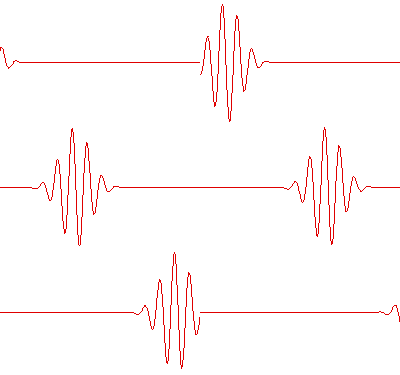
A wave packet ( wave train ) is a certain set of waves having different frequencies that describe a formation possessing wave properties, generally limited in time and space. So, in quantum mechanics, the description of a particle in the form of wave packets (a set of solitons ) contributed to the adoption of a statistical interpretation of the squared modulus of the wave function [1] .
Arbitrary single wave as a function of radius vector and time described by the expression



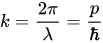
Where - imaginary unit - energy carried by the wave, Is the reduced Planck constant , - the momentum carried by the wave, - its cyclic frequency (normal frequency times ), Is the wave number (defined as ; here speed of light).



For the wave description of an individual particle with a rest mass, it is necessary to add up a certain number of waves having close frequencies, and in this case the wave function will be noticeably different from zero only in some relatively small area of space. Get a wave packet.

We form a wave packet from a superposition (set) of plane waves for which the wave number varies from before (for simplicity, suppose that in the interval of fundamental importance, the amplitudes remain constant and equal ):


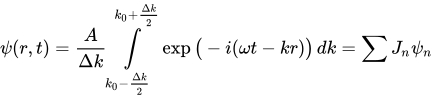
where now denotes the resulting wave function, and the quantities denote the contributions of waves from which the packet is formed into the resulting wave, and .


Content
- 1 Group speed
- 2 Wave packet spreading
- 3 See also
- 4 notes
- 5 Literature
Group Speed
Group velocity is the kinematic characteristic of a dispersive wave medium, usually interpreted as the velocity of the maximum amplitude envelope of a narrow quasimonochromatic wave packet.
Expand frequency in a taylor series as a function of [2] :
After that, confining ourselves only to first-order terms of smallness with respect to we find:
Again, considering only the first-order terms of smallness, after integration over we get:
- ,
and the resulting amplitude of the wave packet will be equal
It follows that the amplitude does not remain constant neither in space nor in time. It is also seen that the spatial distribution of the wave packet obeys a similar law where , , - some quantities, generally variables and distance-dependent to the point of the main maximum and from time to time.
To determine the group speed the motion of the wave packet as a whole must be put , and then
Now consider the spatial distribution of the wave packet. Put . Then . Amplitude squared wave packet reaches the main maximum at point c . Other highs will decrease accordingly: , , , and in points the square of the amplitude vanishes.
Due to this, we can assume that the localization region of the main part of the wave packet located in the vicinity of the main maximum. It’s most rational to “decide” that this area corresponds to half the distance between the first zeros of a function ( ) Then it turns out that . Hence,
However, speaking mathematically rigorously, the wave function is non-zero and outside the package, so it would be more correct to write
As ( Is the wavelength), and ( - Planck's constant (not given!)), We can rewrite this inequality as
It represents the Heisenberg uncertainty relation, one of the most fundamental principles of quantum mechanics. This ratio is true for all wave processes without exception, regardless of their nature. So, in radio engineering and optics there is an incompatibility of acute localization of the corresponding wave processes in time and space with a narrow frequency spectrum. For example, a selective radio ( ) is not able to pick up signals that are short in time, etc.
Wave packet blur
Finally, we consider the terms of decomposition discarded in the above formulas in a row of taylor. Obviously, such an approximation is not always physically justified. In the absence of dispersion ( ), when all monochromatic waves forming a wave packet propagate with the same phase velocity, the initial shape of the wave packet does not change over time, and the maximum of its amplitude moves with an initial velocity equal to the phase. However, if the variance is nonzero ( ), that is, if the phase velocities of the individual component waves are different, the initial shape of the packet will change over time, that is, it will blur.
Let us estimate the propagation time of the wave packet. To do this, consider when considering the integral quadratic member of the taylor series , to a first approximation, discarded. Taking it into account leads to an additional phase.
- ,
which is significant if it reaches order . From here to time the spreading of the wave packet, we obtain the expression
- .
Now we apply the findings to the de Broglie waves. First of all, we pay attention to the fact that the amplitude of the packet is noticeably different from zero only in a small area of space that can be associated with the location of the particle. Further, in the particular case of de Broglie waves ( ) group velocity of the particle as a whole
exactly equal to speed the particle itself. Thanks to this, it is possible to correlate the motion of the main maxima of the wave packets to the motion of individual particles. Therefore, the position of a particle in space can be characterized by the square of the wave amplitude which is simultaneously the squared modulus of the wave function.
Now let’s find out: is it possible to connect the “psi” waves with the structure of the particle itself, or do they only describe its motion? The point of view claiming that it was possible was proposed by E. Schrödinger shortly after he discovered the fundamental equation of quantum mechanics , which suggested that the particle should be a bunch of waves, smeared in space, and its density at this point is equal to . However, this interpretation turned out to be untenable: as shown above, the phase velocities of the waves forming the wave packet are different, and over time it begins to blur.
Let us find the propagation time of the wave packet from the De Broglie waves. In this case, the quadratic term from the above Taylor series, which determines the variance, will be equal to
For simplicity, we restrict ourselves to the nonrelativistic approximation ( Is the rest mass of the particle). Then:
To estimate the propagation time of the wave packet, we obtain (according to the uncertainty relation and a similar formula above):
In the case of a macroscopic particle having a mass of, for example, 1 gram and size cm, the spreading time will be sec, that is, such a wave packet will not actually blur. In the case of a microparticle like an electron, whose mass is of the order of gram, cm, the wave packet will blur almost instantly: sec Due to the fact that the wave packet of microparticles in the general case spreads out very quickly, for their (particles) successful description it is necessary to compose a wave packet of waves whose spread of wave numbers is small, i.e. .
Thus, if the point of view of Schroдингdinger in this respect were correct, the electron could not constitute a stable formation. In addition, it would be impossible to explain the phenomenon of diffraction by replacing the electron beam with many wave packets.
A different, “statistical” interpretation is currently accepted. waves proposed by Max Born. According to this interpretation, the quantity it makes sense the probability (or probability density) of a particle at a given point in space or an infinitesimal (in the general case, just a very small) element of volume.
The statistical interpretation proposed by Born does not connect the wave function with the structure of the particle. In particular, nothing prevents the electron from remaining generally pointlike. When the wave function changes, only the probability of detecting a particle at some point in space changes. In the light of this view, the spreading of the wave packet contradicts the stability of the particle. In the extreme case of a monochromatic wave, a particle can be equally likely to be detected at any point in space.
See also
- De Broglie Waves
- Statistical interpretation of the wave function
Notes
- ↑ Wave Pack - an article from the Physical Encyclopedia
- ↑ Note: In the formulas hereinafter, primes denote wave number differentiation
Literature
- A. A. Sokolov, I. M. Ternov Quantum mechanics and atomic physics. - M .: "Enlightenment", 1970. § 3.
- L. A. Gribov, S. P. Mushtakova Quantum Chemistry. - M .: “Gardariki”, 1999. Chapter 1, p. fourteen.
- Landau, L.D. , Lifshits, E.M. Quantum mechanics (nonrelativistic theory). - 6th edition, revised. - M .: Fizmatlit , 2004 .-- 800 p. - (“ Theoretical Physics ”, Volume III). - ISBN 5-9221-0530-2 .
- Sivukhin D.V. General course of physics. - 3rd edition, stereotyped. - M .: Fizmatlit , MIPT , 2002. - T. IV. Optics. - 792 p. - ISBN 5-9221-0228-1 .