Bissa [1] , or Biss [ 2] , or a real caretta [3] ( lat. Eretmochelys imbricata ) is a species of sea turtles, the only representative of the genus Eretmochelys .
| Bissa | ||||||||||||||||
|---|---|---|---|---|---|---|---|---|---|---|---|---|---|---|---|---|
 Bissa in the waters near Reunion | ||||||||||||||||
| Scientific classification | ||||||||||||||||
| ||||||||||||||||
| Latin name | ||||||||||||||||
| Eretmochelys imbricata L. , 1766 |
International Red Book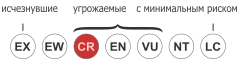 IUCN 3.1 Critically Endangered : 8005 |

Content
Description
Appearance
Bissa looks like a green turtle , but smaller, body length 60–90 cm, and weight 45–55 kg. With a green turtle, bissus is sometimes even combined into one subfamily . [4] The carapace is covered with rather thick horny shields, which in young individuals overlap tiling, but this overlay gradually disappears. It has a heart-shaped shape, the back of it is strongly narrowed and suspended. It features a powerful horny beak. The color of the carapace is brown with a yellow-spotted pattern. On the front flippers, usually two claws.
Distribution
The range extends from the temperate latitudes of the northern hemisphere (the region of Nova Scotia , Great Britain , the Black and Japanese Seas ) to the temperate latitudes of the southern ( southern Africa , Tasmania , New Zealand ). However, caretta nests only in tropical latitudes.
Lifestyle
Bisses spend their whole lives in the sea, going ashore only for breeding.
Reproduction
During the breeding season, females make distant sea migrations to get to permanent nesting beaches. The most famous breeding sites are located in Sri Lanka and the Caribbean Sea on the shores of the Chiriki Gulf on the Isthmus of Panama , on the Mediterranean coast of Turkey , west of Antalya .
The size of the clutch varies in different populations and usually corresponds to the size of the females. During the season, one female makes 2–4 clutches containing from 73 to 182 round eggs with a diameter of up to 40 mm. The incubation period is about 60 days. Females usually arrive at nesting sites with an interval of three years.
Nutrition
It feeds mainly on benthic invertebrates .
Fluorescence
In 2015, Biss fluorescence abilities were detected. [five]
Bissa and Man
Carriage meat is eaten, although this is associated with risk - it can become poisonous if the turtle fed on poisonous animals. Eggs are a delicacy in many countries. Also, turtles are exterminated due to the shell - they are used to obtain the "tortoise bone" . Souvenirs are made from young individuals. For these reasons, despite the rather wide range , the species is at risk. [6]
Protected by law, but often ineffective. The protection of this species is complicated by the fragmentation of nesting sites, the lack of data on the movement of populations [7] and the high sensitivity of turtles to breach of nesting sites.
Currently, the possibility of a complete ban on the sale of shells and stuffed young turtles, as well as control over the collection of eggs, is being considered.
Subspecies
There are two subspecies of bisse - Pacific ( Eretmochelys imbricata bissa ) - it differs completely in black head and fins, and Atlantic ( Eretmochelys imbricata imbricata ). [eight]
Gallery
Links
Literature
- Darevsky I. S. Orlov N. L. Rare and endangered animals. Amphibians and reptiles - M .: Higher school, 1988. S. 198. ISBN 5-06-001429-0
Notes
- ↑ Darevsky I.S. , Orlov N.L. Rare and endangered animals. Amphibians and reptiles: Ref. allowance / ed. V. E. Sokolova . - M .: Higher school, 1988. - S. 198. - 463 p., [16] p. silt - 100,000 copies. - ISBN 5-06-001429-0 .
- ↑ Ananyeva N. B. , Borkin L. Ya. , Darevsky I.S. , Orlov N.L. Amphibians and reptiles. Latin, Russian, English, German, French. / edited by Acad. V. E. Sokolova . - M .: Rus. Yaz., 1988 .-- S. 143. - 10,500 copies. - ISBN 5-200-00232-X .
- ↑ TSB
- ↑ Subfamily Green turtles - Cheloniinae
- ↑ Scientists have found the world's first reptile glowing in the dark . Date of appeal September 30, 2015.
- ↑ APUS.RU: Byssa, or the real carriage
- ↑ Data for 1988 .
- ↑ ITIS. Eretmochelys imbricata