
A nuclear missile engine ( NRE ) is a type of rocket engine that uses fission or fusion energy to create reactive thrust .
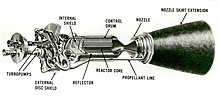
The traditional NRE as a whole is a design of a heating chamber with a nuclear reactor as a heat source, a working fluid supply system and a nozzle. The working fluid (usually hydrogen ) is fed from the tank to the reactor core, where, passing through channels heated by the nuclear decay reaction, it is heated to high temperatures and then ejected through the nozzle, creating reactive thrust . There are various designs of NRE: solid-phase, liquid-phase and gas-phase - corresponding to the state of aggregation of nuclear fuel in the reactor core - solid, melt or high-temperature gas (or even plasma ).
In the USSR, a detailed government decree on the creation of a nuclear engine was signed in 1958. With this document, the management of the work as a whole was assigned to academicians Keldysh MV , Kurchatov IV and Korolev S. P. [2] [3] . Dozens of research, design, engineering, construction and installation organizations were connected to the work. NREs were actively developed by the KBHA in Voronezh and were tested in the USSR (see RD-0410 ) and the USA (see NERVA ) since the mid-1950s. Research is ongoing in 2018 [4] .
According to estimates by A. V. Bagrov, M. A. Smirnov and S. A. Smirnov, a nuclear rocket engine can reach Pluto in 2 months [5] [6] and return back in 4 months with a cost of 75 tons of fuel, to Alpha Centauri for 12 years, and before Epsilon Eridanus for 24.8 years [7] .
Content
Solid Nuclear Rocket Engine
In solid-phase NRE (TFNRD) fissile material, as in conventional nuclear reactors , is placed in rod assemblies ( fuel elements ) of complex shape with a developed surface, which allows efficient heating of a gaseous working fluid (usually hydrogen, less often ammonia), which is also a heat carrier cooling structural elements and assemblies themselves. The heating temperature is limited by the melting temperature of structural elements (not more than 3000 K). The specific impulse of a solid-phase NRE, according to modern estimates, will be 8000–9000 m / s, which is more than double the performance of the most advanced chemical rocket engines. In the XX century, ground-based demonstrators of TfNRD technologies were created and successfully tested at stands ( NERVA program in the USA, RD-0410 in the USSR).
Liquid Nuclear Rocket Engine
Gas-phase nuclear rocket engine
A gas-phase nuclear jet engine (GRE) is a conceptual type of jet engine in which reactive power is generated by the release of a coolant (working fluid) from a nuclear reactor in which the fuel is in gaseous form or in the form of plasma. It is believed that in such engines the specific impulse will be 30000-50000 m / s. The heat transfer from the fuel to the coolant is achieved mainly due to radiation, mostly in the ultraviolet region of the spectrum (at fuel temperatures of about 25,000 ° C).
Nuclear Pulse Engine
Atomic charges with a power of about one kiloton at the take-off stage should explode at a speed of one charge per second. The shock wave - an expanding plasma cloud - was supposed to be taken by a “pusher” - a powerful metal disk with a heat-shielding coating and then, reflected from it, create reactive thrust. The momentum received by the plate of the pusher, through the structural elements must be transmitted to the ship. Then when the height and speed increase, the frequency of explosions can be reduced. During take-off, the ship should fly strictly vertically to minimize the area of radioactive pollution of the atmosphere.
In the United States, space exploration using pulsed nuclear rocket engines was carried out from 1958 to 1965 as part of the Orion project by General Atomics, commissioned by the United States Air Force .
According to the Orion project, not only calculations were carried out, but also field tests. Flight tests of models of an aircraft with a pulse drive (conventional explosives were used for explosions). Positive results were obtained on the fundamental possibility of a controlled flight of an apparatus with a pulse engine. Also, to study the strength of the traction plate, tests were conducted on the Envetok Atoll . During nuclear tests on this atoll, graphite-coated steel spheres were placed 9 meters from the epicenter of the explosion. Spheres after the explosion were found intact, a thin layer of graphite evaporated (ablated) from their surfaces.
The Orion project development program was designed for 12 years, with an estimated cost of $ 24 billion, which was comparable to the planned costs of the Apollo lunar program. Interestingly, the developers carried out preliminary calculations of the construction of a ship of generations with a mass of up to 40 million tons and a crew of up to 20,000 people based on this technology [8] . According to their calculations, one of the reduced versions of such a nuclear-impulse starship (weighing 100 thousand tons) could reach Alpha Centauri in 130 years, accelerating to a speed of 10,000 km / s. [9] [10] However, the priorities changed, and in 1965 the project was closed.
In the USSR, a similar project was developed in the 1950–70s [11] . The device contained additional chemical jet engines, which brought it out 30-40 km from the Earth’s surface and then it was supposed to turn on the main nuclear-pulse engine. The main problem was the strength of the pusher screen, which could not withstand the enormous thermal loads from nearby nuclear explosions. At the same time, several technical solutions were proposed that made it possible to develop the design of a pusher plate with a sufficient resource. The project was not completed. Real tests of pulsed NRE with the detonation of nuclear devices have not been conducted.
Other developments
In the 1960s, the United States was on its way to the moon. Less well-known is the fact that in Zone 25 (next to the famous Zone 51 ), scientists worked on one ambitious project on a Nevada training ground - flying to Mars with nuclear engines. The project was named NERVA . Running at full power, the nuclear engine had to heat up to a temperature of 2026.7 ° C. In January 1965, a nuclear rocket engine was codenamed KIWI.
In November 2017, the China Aerospace Science and Technology Corporation (CASC) published a roadmap for the development of China's space program for the period 2017–2045. It provides, in particular, the creation of a reusable ship operating on a nuclear rocket engine [12] .
In February 2018, there were reports that NASA was resuming research on a nuclear rocket engine [13] [14] [15] .
Nuclear electric propulsion system
YaEDU is used to generate electricity , it, in turn, is used to operate an electric rocket engine .
Since 2010, work has begun in Russia on a project of a megawatt-class nuclear electric propulsion system (YEDU) for space transport systems [16] [17] . According to the director and general designer of NIKIET OJSC, Yuri Dragunov, whose enterprise is designing the reactor installation, according to the plan for nuclear power plants should be ready in 2018 [18] [19] . At the beginning of 2016, preliminary design [20] , design documentation [21] was completed, tests of the reactor control system [22] were completed, fuel elements were tested [23] , tests were carried out on the reactor vessel [24] , and full-scale models of radiation protection of the reactor installation were tested [ 25] .
See also
- Rocket engine
- RD-0410 is the first and only Soviet nuclear rocket engine.
- Atomic plane
- Fusion rocket engine
- Homogeneous nuclear fuel salt rocket engine
- NERVA
- Supersonic Low-Altitude Missile
Notes
- ↑ Panevin, Prishchepa, 1978 .
- ↑ Keldysh Center, 2003 , p. 192.
- ↑ Energomash, 2008 , Essay on the development of nuclear rocket engines in Energomash Design Bureau.
- ↑ Roscosmos began developing a nuclear space ship , Lenta.ru, 10.28.2009.
- ↑ ACADEMIES OF SCIENCES OF THE USSR COMMISSION FOR THE DEVELOPMENT OF SCIENTIFIC HERITAGES K.E. TSIOLKOVSKY STATE MUSEUM OF HISTORY OF COSMONAUTICS them. ke TSIOLKOVSKY LABOR OF THE TWENTY READINGS K. E. TSOLKOVSKY Section "Problems of rocket and space technology" Kaluga, 1985 A. V. Bagrov, M. A. Smirnov, S. A. Smirnov INTERSTELLAR SHIP WITH MAGNETIC MIRROR
- ↑ Bagrov A.V., Smirnov M.A. Caravels for explorers // Science and Humanity . 1992-1994. - M .: Knowledge , 1994.
- ↑ International Yearbook “Hypotheses predictions science and science fiction” 1991. XXI century: building a starship. Alexander Viktorovich Bagrov. Mikhail Alexandrovich Smirnov
- ↑ http://www.astronautix.com/lvs/oritsink.htm Orion Starship - Heat Sink, Encyclopedia Astronautica www.astronautix.com
- ↑ http://www.astronautix.com/lvs/oriative.htm Orion Starship - Ablative, Encyclopedia Astronautica www.astronautix.com
- ↑ Looking Back at Orion by Paul Gilster on September 23, 2006 , Centauri Dreams (centauri-dreams.org)
- ↑ Russian nuclear engines can be used when flying to Mars
- ↑ Andrew Jones // China sets out long-term space transportation roadmap including a nuclear space shuttle. gbtimes.com. 2017-11-16 .
- ↑ NASA Is Bringing Back Nuclear-Powered Rockets to Get to Mars // Fortune, news portal, according to Bloomberg. February 15, 2018 .
- ↑ Daniil Revadze // NASA returns to the idea of a nuclear engine for spacecraft. Portal hightech.fm. February 17, 2018 .
- ↑ Loura Hall . "Nuclear Thermal Propulsion: Game Changing Technology for Deep Space Exploration." nasa.gov. 2018-05-25.
- ↑ A fundamentally new energy propulsion system for space missions is being created in Russia
- ↑ Rosatom development of a new space nuclear installation proceeds according to plan
- ↑ In Russia, they assembled the world's first TVEL for a space power plant . // Lenta.ru
- ↑ Tests of the space reactor control system
- ↑ The first part of the ship’s nuclear engine project will be certified in 2012
- ↑ In 2016, Rosatom will begin to create a space reactor
- ↑ Testing of the regulatory authority of the megawatt-class nuclear reactor
- ↑ Space nuclear power propulsion systems are now possible only in Russia
- ↑ Russia successfully completed tests of a nuclear reactor shell for space
- ↑ NIKIET JSC successfully completed testing of full-scale models of radiation protection of the reactor installation for the transport and energy module
Literature
- Panevin I.G., Prishchepa V.I. Space nuclear rocket engines . - M .: “Knowledge”, 1978. - 64 p.
- KOROTEEV A.S., KONYUKHOV G.V., DEMYANKO Yu.G. NUCLEAR MISSION ENGINES . - M .: Norma-Inform, 2001 .-- 415 p.
- Demyanko Yu. G. , Konyukhov G.V. , Koroteev A.S. , Kuzmin E.P. , Paveliev A.A. Nuclear rocket engines. 2001.
- AKIMOV V.N., KOROTEEV A.S., GAFAROV A.A. other. Nuclear rocket engines: memories of the future // MV Keldysh Research Center. 1933-2003: 70 years at the forefront of rocket and space technology . - M: "Mechanical Engineering", 2003. - S. 190-209. - 439 p. - ISBN 5-217-03205-7 .
- Koroteev A.S. Rocket engines and power plants based on a nuclear reactor.
- Letters and documents of V. P. Glushko from the archives of RSC Energia named after S.P. Korolev (1944-1980). Essay on the development of nuclear rocket engines in KB Energomash. 07/26/1973 // Selected works of Academician V.P. Glushko / Sudakov V.S. - Khimki: NPO Energomash, 2008. - V. 1. - 419 p. - 250 copies.