August Horch ( German: August Horch ; October 12, 1868 , Winningen - February 3, 1951 , Münchberg ) - one of the pioneers of the German automotive industry, design engineer and entrepreneur, founder of Horch and Audi .
| August Horch | |
|---|---|
| August horch | |
 | |
| Date of Birth | October 12, 1868 |
| Place of Birth | Winningen |
| Date of death | February 3, 1951 (82 years old) |
| A place of death | Münchberg |
| Citizenship |  Germany Germany |
| Occupation | Design Engineer, Entrepreneur |

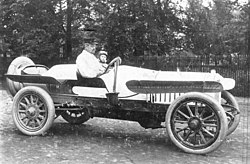

He made a significant contribution to the development of the automotive industry , including the use of a cardan drive , heavy-duty steel and suggested the location of the driver's seat on the left side of the car body.
Content
- 1 Biography
- 1.1 Horch 303 (1926-1927)
- 1.2 Horch (1911)
- 2 References
Biography
August Horch was born on October 12, 1868 in Winningen, on the Moselle, in the family of a blacksmith. The family did not live well, and already at the age of 13 the boy was forced to drop out of school to help his father. At 16, he got a job at the car-building plant in Heidelberg , where he was engaged in more than prosaic affairs - with sledgehammers he pressed steel bandages onto the wheels. Then he changed several more jobs.
Undoubtedly, in these years such traits of Horch’s character as determination, assertiveness and ... inanimacy developed. Only at the age of 20 he finally got the opportunity to seriously study. In the fall of 1888 , after passing the exams, he entered the Saxon School of Engineering in Mittweide . By the way, Jorgen Skaft Rasmussen was also educated here - an engineer and entrepreneur, with whom Horha after many years brought fate into the leadership of Auto-Union .
After graduating from college, Horch worked at a foundry in Rostock , and then at the design bureau of a Leipzig shipbuilding company, where he worked on torpedo boat engines. It was here, in Leipzig , Horch in 1896 first saw the car - Benz Velo . This impressed him so much that he sent a letter to Karl Benz with a request to hire him. And in response he was really invited to Mannheim . Horch received the position of production manager from Benz and held it for three years. But, in the end, the inanimate character made itself felt. “Papa Benz” (as Horch called him) was too conservative for the young production boss. And so I wanted to try my own strength myself, especially since I already had experience gained under the guidance of the inventor of the car.
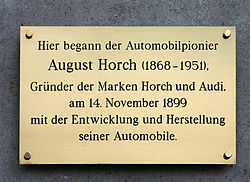
Horch secured financial support from a wealthy industrialist and, in 1899, founded A. Horch & Co. in Erendfeld , near Cologne . The company initially comprised 11 people. Nevertheless, in 1900 the first Horch car came out of the gates of the enterprise. Its two-cylinder engine produces 4-5 hp. distinguished by quiet and smooth work - the designer did his best to surpass the teacher. The engine was located in front, the rear-wheel drive was carried out with a leather belt. The gearbox was locked with the main transmission - a very bold decision for that time. The body was ordered in the Cologne workshop “Utermol”. This was the beginning of the subsequently famous brand.
Horch 303 (1926-1927)
Two years later, the Horch Model 2 was launched with a driveshaft, with main gears made of nickel-chromium steel. The two-cylinder engine developed 10-12 liters. C., to its creation Horch attracted a capable engineer Fritz Seidel (Fritz Seidel). After the birth of the second model, the company moved to Reichenbach. Here, the number of employees has reached ninety - things were going uphill. And Horch, meanwhile, was working hard on the next "Model 3" with a four-cylinder engine with a capacity of 16-20 liters. from.
In 1903, the company moved for the second and last time - now to Zwickau . Horch found additional funds, and the authorized capital of the joint-stock company reached 140 thousand marks - a considerable amount at that time. The plant released the Horch Model 4 with a four-cylinder engine with a displacement of 2600 cm³ and a capacity of 14-17 liters. from. The car fully met the requirements of the beginning of the century - double ignition from a magneto and a battery, a three-speed gearbox, pneumatic tires. We must pay tribute to Horch: his designs can be called not just progressive, but rather bold. In 1906-1909 Horch-Z was a success with a 22-horsepower (2725 cm³) engine: 307 units were built.
The head of the company was absorbed not only in design. He methodically increased its capital, which in two years grew to 525 thousand Reichsmarks. August Horch also showed character. The plant had a fierce system of fines - any violation had a price. So, being late from 5 to 15 minutes “cost” 25 pfennigs , and by half an hour - already 40. The working day at the plant lasted 10.5 hours.
In 1906, cars from Zwickau were exhibited at the Berlin and Paris Motor Show, and a year later the first six-cylinder Horch with an engine capacity of 8 liters and 60 liters was introduced. from. A large, luxuriously finished car was bought by the Sultan of the island of Java .
Horch was one of those who perfectly understood the advertising value of car racing. At the competition, the famous German motorist Dr. Stoss and the designer himself sat behind the wheel of a car. When in 1906 the ZD model appeared with a four-cylinder (5800 cm³) engine with a capacity of 40 liters. with., on its chassis built a sports dashboard. The car participated in races for the Prize of Henry of Prussia, but, alas, unsuccessfully.
This failure had serious consequences - it reinforced Horch’s already existing disagreements with shareholders, who increasingly declared that his designs were “adventurous”. Back in those years, Horch advocated the creation of a load-bearing body, citing horse-drawn carriages as an example, many of which were indeed load-bearing. But at the beginning of the century, this idea seemed completely fantastic. Horch did not know how to compromise. And on June 19, 1909, the creator of the company had to leave it. The designer was paid ridiculous compensation - 25 thousand Reichsmarks, while Horch-ZD cost 15 thousand.
After 4 weeks in the same Zwickau, he founded a new company - "August Horch Automobilwerke GmbH". But the first company he founded was called “Horch”, so its new owners filed a lawsuit and won the case. In the house of one of Horch’s companions, a heated debate was going on. Legend has it that at this time in the next room the master’s son taught Latin . And when one of the shareholders exclaimed: “Listen to the other side!” , The boy either jokingly or seriously seriously loudly translated this phrase into Latin: “Audiatur et altera pars!” The debaters realized that “horch” (in German) - “listen, listen”) is translated into Latin as “audi”. The new company is called "Audi Automobilwerke GmbH".
“Under all circumstances, I tried to build only big and good cars from first-class material, ” said Horch, rolling out business at the new company. Indeed, the plant began with a fairly solid and powerful machines. Since 1910, Audi-AU / 22 was produced. The cylinders, as was then customary, were interlocked in pairs. A four-cylinder engine with a working volume of 2612 cm 3 developed 22 liters. from. The company advertised itself in large posters with the word “Audi” and the image of a huge ear. So one of the most famous car brands appeared today.
Already in 1911, the company introduced a number of new models. One of them - B10 / 28 with a 28-horsepower engine - participated in the second Austrian alpine race. The drivers were Horch himself, Graumuller and Lange. The team finished the distance without penalty points. In the same year, C14 / 35, the most famous car of the company, was released. "Four" with a working volume of 3500 cm 3 with a capacity of 35 liters. from. allowed him to easily accelerate to 100 km / h. On this Audi-C in 1912, a rolling Alpine prize was won, and the car received the name "Alpensieger" - the conqueror of the Alps. Model C was produced until 1925 - a total of 1,116 copies were manufactured.
The 1911th year was the birth of the D and E models - typical of Audi at that time - a four-cylinder engine with upper intake and lower exhaust valves, double ignition from a magneto and a battery. The gas pump worked using exhaust pressure.
On the last pre-war Audi-G8 / 22 stood a motor with a working volume of 2071 cm³ with a capacity of 22 liters. from. A relatively inexpensive model was liked by customers - until 1926 1122 such machines were built. In 1914, the Alpine racing team prize was won on the company's cars.
Until the milestone in the history of 1914, Horch was actively engaged in construction. But relations with shareholders again did not develop too well. At the beginning of the war, the engineer was able to occupy administrative posts in state and near-state structures. He became a member of the supervisory board of Feldkraftwagen, a company with a monopoly on the sale of used army vehicles, a member of the supervisory board of the Society for the purchase of fuel, and took a seat on the board of the German Automobile Manufacturers Union and on the standardization commission. And at the end of 1916 Horch, together with Professor Hoffmann, Dr. von Opel and J. Volmer, entered the commission for the preparation of the production of German tanks. Apparently, Horch tasted this kind of activity. After the war, he actually moved to Berlin: "The heart of Germany was beating there, there was a source, and I wanted to be at the source." In Zwickau, meanwhile, shareholders eliminated Horch from direct management of Audi. He remained only a member of the supervisory board. But this, I must say, did not hurt the authority of the designer in automobile circles.
In 1922, the Braunschweig Institute of Technology awarded Horch the title of Honorary Doctor of Engineering. The "collecting" of administrative posts also continued - he became the chairman of the organizing committee for foreign trade in cars, a member of the supervisory board of AUKA - the organization of automobile exhibitions. In the 1920s, Horch acted as an observer for the Association of German Automotive Manufacturers, where, in particular, he was responsible for relations with sports societies. Finally, he became a member of the Council of the Ministry of Transport and president of the German Union of Automotive Specialists. Horch was constantly present at public events - whether it was tests for profitability, the opening of a monument or a solemn funeral. He never returned to the design of cars, but in 1930 in a special periodical press you could read the announcement: "In critical cases, seek the advice of Dr. Engineer Horch."
Horch (1911)
After the first world factory, Audi built pre-war models and prepared the Audi-K (3560 cm 3 , 50 hp), which appeared in 1921 . By that time, Horch had already retired from factory work, although he continued to attend meetings of the supervisory board. A year later, when the concept of the M18 / 70 model was being developed, a competition for the company logo was announced. Professor Arno Drescher from Dresden and Hermann Gilbert from Leipzig proposed to make the symbol a unit on the background of the globe. At a council meeting, Horch endorsed the idea, saying that this sign best expresses “Audi high quality,” and the proposed symbol is inextricably linked to an amulet that brings happiness, in which numbers, and above all the unit, play an important role. ” A new symbol appeared on the radiator linings, and in 1929 it turned out that one of the Italian margarine companies used almost the same.
The crisis of the early 30s prompted a number of German firms to create the Auto-Union concern. Along with DKW and Wanderer , Horch and Audi also entered here. The “founding father” of the last two, of course, could not stay away. And on August 23, 1932, twenty-three years later, Horch, as a member of the Supervisory Board of Auto-Union, "with indescribable excitement" entered the gate of the factory, still bearing his name. It sounds like a pun, but they gave Horch ... Horch, and on April 29, 1933 he became the director of the plant. True, he was not allowed to design.
In the Third Reich, with his cheers-patriotism Horch was completely at court. To him, as one of the patriarchs of the German automotive industry, the Nazi elite favored. He still sat on the Council of the Ministry. Skillfully playing his part, Horch, in particular, actively advocated restricting the import of American cars. In 1942, the seventy-four- year -old Horch was elected vice-president of the Supervisory Board of Auto-Union, but the concern, like the Reich, had no time to live by then.
Despite the fact that Horch was in plain sight in Hitler Germany, he held important posts, he did not join the National Socialist Party, and, apparently, this saved him after the war from persecution. Quietly resigning, Horch nevertheless, until the last days, was distinguished by a grumpy, inanimate character. He finished his earthly journey on February 3, 1951 in Münchberg , in Bavaria .
Both brands owing their birth to Horch are by no means forgotten. Horch cars are on a par with the most famous cars of the 30s. The Audi brand is still alive today, although its cars are not being built in Zwickau, but in Ingolstadt . Modern Audi have an excellent reputation all over the world - and this is the best memory of Horch - a talented designer whose name will forever remain in the history of automotive industry.