Fabrizio Cristiano De André ( Italian: Fabrizio Cristiano De André ; February 18, 1940 , Genoa - January 11, 1999 , Milan ) - Italian songwriter , poet . In his work he turned to the themes of love, struggle, stories of prostitutes [1] and marginals . You can often hear the nickname De Andre - "Faber" ( Italian Faber ), given a childhood friend Paolo Villaggio .
| Fabrizio De Andre Fabrizio de andré | |
|---|---|
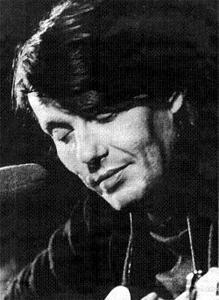 Photograph of the 1980s | |
| basic information | |
| Birth name | |
| Full name | Fabrizio Cristiano De Andre |
| Date of Birth | February 18, 1940 |
| Place of Birth | Genoa , Italy |
| Date of death | January 11, 1999 (58 years old) |
| Place of death | Milan , Italy |
| Buried | |
| A country |  Italy Italy |
| Professions | singer , poet |
| Years of activity | since |
| Instruments | guitar |
| Genres | folk , chanson |
| Aliases | Faber |
| Labels | Karim , Sony BMG , Ricordi |
| Autograph | |
| Website of the Fabrizio De Andre Foundation | |
Content
Biography
De Andre was born in Genoa on Via De Nikolai, 12 ( Italian. Via De Nicolay, 12 , where a small memorial tablet was later placed) in a family belonging to the upper strata of the industrial bourgeoisie . His father, Giuseppe, was the vice-mayor of Genoa and CEO of Eridania Zuccherifici Nazionali (Italian) (the largest Italian company engaged in the production and sale of sugar). According to family tradition, the boy was born to the sounds of Gino Marinuzzi's composition “Village Waltz”, which sounded from a gramophone . Twenty-five years later, Fabrizio De Andre will write his “Waltz in Honor of Love” on the tune of Marinuzzi [2] [3] .
Until thirty-five, De Andre had problems with his left eye. He had a partial paralysis of the century:
| If you try to understand the reason for the peculiarity of my character, my flight from people and wildness, it turns out that it is very simple. From early childhood, I was afraid of other people because of problems with my left eye - I suffered from a form of paresis of the eyelid, due to which it hung, covering half of it. This defect made me feel terrible, I seemed to myself not like everyone else, unattractive. I even got to the point that I began to think that if someone was looking at me, I did it only because I was struck by my flaw. This flaw spoiled my life until I was thirty-five years old. Until all problems have been resolved by a simple operation. It was a terrible, deep complex that spawned others that more or less interfere with me today. [four] Original text (Italian) S'è detto, s'è cercato di capire il motivo di certe mie asperità di carattere, di un mio scappare dalla gente, di una selvatichezza che mi rendeva antipatico e inavvicinabile. La verità è molto banale. Fin da piccolo avevo paura degli altri a causa del mio occhio sinistro. La mia palpebra soffriva di una forma di paresi, per cui mi pendeva sull'occhio chiudendolo più della metà. Questa imperfezione mi faceva sentire brutto, diverso, impresentabile. Ero arrivato al punto di credere che, se qualcuno mi guardava, lo faceva soltanto perché era stato colpito dal mio difetto. Un difetto che ha rovinato la mia vita fino all'età di trentacinque anni. Fino a quando, cioè, con una semplice operazione, ho rimediato a tutto. E 'stato, quello dell'occhio, un complesso gigantesco e terrificante, dal quale sono derivati quasi tutti gli altri che, più o meno, ancora oggi mi affliggono. (In E. Ferri, Il poeta è tornato, "Anna", 16 ottobre 1990) |
Childhood and Youth
When the war broke out, the De Andre family went to a farm near Revignano d'Asti, in Piedmont . The boy's father was an anti-fascist - he was searched by the police, so he joined the partisans [2] [3] . Memories of life in Revignano d'Asti will be a source of inspiration for De Andre up to his most recent works [5] .
In 1945 , the family returned to Genoa , where Fabrizio went to primary school. First to the Sisters Markellina school, and later to the Cesare Battisti school. Then he enters the University of Genoa , where he attended medical and philological courses, before choosing a law faculty [5] . But when there were six exams left before getting the degree, Fabrizio decided to choose a different path - music. He played the cello , then the guitar , and performed with several jazz bands.
Creativity
First Entries
In October 1961 , Karim label released the first record of Fabrizio De André, format “ 45 giri ”, with a standard cover. The disk contained two compositions - Nuvole barocche (“ Baroque clouds”) and E fu la notte (“And the night came”) . In 1962 , Fabrizio married Genoese Enrique Rignon ( Italian: Enrica Rignon ). She belonged to a bourgeois family and was ten years older than him. In the same year, the couple had their first and only son - Cristiano [6] , who, following the example of his father, became a musician and songwriter .
In subsequent years, De Andre wrote his hits : La guerra di Piero (The Pierrot War) [7] [8] , La ballata dell'eroe (The Ballad of a Hero), Il testamento di Tito (The Testament of Titus), La ballata del Miche (“Ballad of Mica”), Via del Campo (“Via del Campo”, literally “Street of Fields”, this is a famous street in Genoa ) , La canzone dell'amore perduto (“Song of Lost Love”), La citta vecchia (“The Old Town”), Carlo Martello ritorna dalla battaglia di Poitiers (“The Return of Carl Martella after the Battle of Poitiers ”) [9] , composed with Paolo Villaggio , and La canzone di Marinella (“Song of Marinella”) . In 1968 , Marinella was recorded and sung by the famous Italian singer Mina [2] [3] .
Volume 1
In 1967 , the first long-playing disc by Fabrizio De Andre - Volume 1 (“Volume One”) , then Tutti morimmo a stento (“We all died in misery”) and Volume 3 (“Volume Three”) - both records hit top of the Italian charts . The first contained a personal version of Eroina (Heroin) by the poet Ricardo Mannerini ( Italian: Riccardo Mannerini ), entitled Cantico dei drogati (The Anthem of the Addicts) .
Good News
In 1970 , De Andre created La buona novella (“Good News”) - the name comes from the etymology of the word “ Gospel ” - a conceptual album based on an apocryphal story about the life of Christ . This album became very famous, and especially the song Il testamento di Tito (The Gospel of Titus ), in which one of the robbers crucified next to Christ , violently refutes the Ten Commandments . Fabrizio De Andre composed a number of songs, for example, Preghiera in gennaio (“Prayer in January ”) and Si chiamava Gesù (“His Name was Jesus ”) , in which he expressed thoughts close to Christianity, and these songs, in addition to “The Gospel of Titus”, also sang in the churches [2] [3] .
No money, no love, no heaven
In 1971 , De Andre wrote another concept album - Non al denaro non all'amore né al cielo (“No Money, No Love, No Heaven”) , based on the book of poetry “Anthology of the Spoon River” by Edgar Lee Masters . The title of the album is a quote from the first poem of Anthology. Of the 246 poems, Fabrizio selected only nine and tried to distance himself from the concrete realities of American life, focusing on more universal topics [10] . The disc was presented in an interview with Fernanda Pivano ( Italian: Fernanda Pivano ), who was the first Italian translator of Anthology. Now the name of Fabrizio De Andre was associated with serious literature and poetry. Some of his songs were published in school books [2] [3] .
Storia di un impiegato and Canzoni
In 1973 , Storia di un impiegato (The Story of a Servant) was released , the most politicized album by Fabrizio De Andre. He tells the story of an anonymous clerk in whom, after years of conformism and selfishness, political consciousness awakens. In the end, the employee decides to blow up the parliament. Storia di un impiegato emerged during a period of aggravation of internal unrest in Italy [11] (see Red Brigades ).
The following year, De Andre publishes Canzoni (“Songs”) , a collection of his translations of Georges Brassens , Leonard Cohen and Bob Dylan . The album included several of his old songs from the 60s .
Volume 8
In 1975 , Fabrizio De Andre (who divorced Enrica Rignon and began a relationship with folk singer Dori Ghezzi ( Italian: Dori Ghezzi )) co-wrote with Francesco De Gregori ( Italian: Francesco De Gregori ), the album Volume 8 (“ Volume Eight "). The lyrics of the album testify to the deep influence of modern poetry on the work of De Andre [2] [3] . Despite the fact that after the first performance in the early 60s , with the exception of several television broadcasts, he always refused to appear in public, in 1975 , De Andre begins a series of concerts. In addition, he decides to move to Sardinia , where he buys the estate of Anyat, near Tempio Pausania , in the northern part of the island, and devotes himself to agriculture and cattle breeding.
In 1977 , Fabrizio De Andre and Dori Ghezzi had a daughter, Louise Vittoria, and in 1978 , Fabrizio released a new album, Rimini (" Rimini "). Most of the songs included in this album were written with a young bard from Verona, Massimo Bubola ( Italian: Massimo Bubola ) [2] [3] .
PFM Concerts and Abduction
| At concerts I almost always get drunk. I have never been able to finally defeat the fear of speaking in public and the fear of being criticized. However, I myself am the first to criticize myself, deep down I am afraid of myself, I always sit in the front row and say to myself: “Well, look - you have idiotic behavior” or “what are you doing here at your age” ... Thus, I am always in a state of shame. Perhaps the one who does not know me considers me probably different. [four] Original text (Italian) Ai concerti io sono quasi sempre ubriaco, non essendo mai riuscito a vincere definitivamente la paura di andare in pubblico, di essere criticato. D'altronde io sono il primo a criticarmi, in fondo ho anche paura di me stesso, sono semper seduto in prima fila a dirmi "ma guarda che stai assumendo degli atteggiamenti cretini" o "cosa stai a fare ancora lì alla tua età". .. Quindi sono semper al limite della vergogna, se devo esprimermi in termini molto terra terra. Magari chi non mi conosce mi reputa probabilmente diverso da quello che sono. (In D. Fasoli, Fabrizio De André. Passaggi di tempo, pp. 38-39) |
In 1979 , the series of famous "live" concerts begins, where De Andre accompanies Italian progressive rock band Premiata Forneria Marconi (PFM). From the concert records in the future came out a double album. In late August, Fabrizio De Andre and Dori Ghezzi were abducted for ransom and held in custody in the Supramont mountains by Sardinian bandits [2] [3] . They were released four months later, and a ransom was reportedly paid.
This story and the hard life of the Sardinians inspired De Andre to create the new Indiano album ("Native American") , released in 1981 . In fact, the disc is nameless, and got its name in the media from the image of an Indian on the cover, which was an allegory of isolating and conquering people .
Since De Andre said in some interviews that his father helped him find the money, in order to recover his expenses, he had to start the tour shortly after the album was released. When the gang was arrested by the police , Fabrizio was summoned to court as a witness. He showed compassion for some of his captors, as he was well-kept, and declared his solidarity with them: "They were real prisoners, not me." This phrase well illustrates the worldview of De Andre [2] . He also said that he understood that the abductors were led by need, but he did not show any compassion for the organizers of the abduction, since they were rich people.
Early 1990-1999
In 1989 , Fabrizio De Andre and Dori Ghezzi entered into a legal marriage. The following year, a new album Le nuvole (Clouds) is released , including two songs in the Genoese dialect, one in Gallur or North Sardinian - Monti di Mola ("Mola Mountains") , and one in Neapolitan [12] - Don Raffaè ("Don Raphael") - a dialect. A new series of "live" concerts took place, from which the double album 1991 Concerti ("Concerts 1991 ") turned out. In 1992 , De Andre began another series of "live" concerts, including the first time theatrical concerts were given [2] [3] .
Also in 1992 , Genoa, the hometown of Columbus , celebrated the anniversary of the discovery of America . De Andre was invited to participate in performances with Bob Dylan, but refused, remembering the destruction of the Indians [5] .
Saved Souls
Fabrizio De Andre's latest album, Anime salve (Saved Souls) , was written with Ivano Fossati ( Italian: Ivano Fossati ) and was released in 1996 . It included the song Khorakhane (“Khorakhane”) [13] , dedicated to Roma Muslims , Disamistade (“Discord”) , translated into English and performed by the American rock band The Walkabouts, and Smisurata preghiera (“Long Prayer”) , based on short stories “The Adventures and Tribulations of Macrol El Caviero” ( Spanish: Empresas y Tribulaciones de Maqroll el Gaviero ) by Colombian writer and poet Alvaro Mutis , Fabrizio also performed the Spanish version of this song - Desmedida plegaria (Spanish) .
In the same year, the novel "Funny Fate" ( Italian: Un destino ridicolo ) was published, co-authored with Alessandro Gennari ( Italian: Alessandro Gennari ) [5] . In 1997 , De Andre began a new series of theater concerts, Anime salve. A new collection of his songs M'innamoravo di tutto (“Falling in Love with Everything”) was released , which partially consisted of old compositions. “La canzone di Marinella” also entered the tribute , sung in a duet with Mina [2] .
In the summer of 1998 , the Anime salve concert tour was interrupted due to the symptoms of a serious illness discovered by De Andre, which was later diagnosed as lung cancer . Fabrizio De Andre died in the hospital of the Cancer Institute of Milan on January 11, 1999 , at 02:30. The funeral, held on January 13 in Genoa in the Basilica of Carignano ( Italian: Basilica di Santa Maria Assunta in Carignano ), gathered about 10 thousand people, among whom were his friends, figures of politics and culture. After the cremation, the next day, the ashes of Fabrizio De Andre were buried in the family chapel in the cemetery of Staglieno .
Memory of Fabrizio De Andre
In 2003 , an album was released dedicated to the memory of Fabrizio De Andre - “Faber, Amico Fragile”, in the recording of which famous Italian music artists took part. Some of them are also known in Russia. For example, Adriano Celentano , who performed the song “La guerra di Piero” from this album [14] .
In the window of a music store on Via del Campo, a guitar by Fabrizio De Andre was exhibited.
Premiata Forneria Marconi in memory of joint performances perform interpretations of his songs at their concerts.
In honor of Fabrizio De Andre, a special prize was established, which in 2007 was awarded to Gian Piero and Gianfranco Reverberi ( Italian: Gian Piero Reverberi, Gianfranco Reverberi ) [15] .
Rewards
- 1975 - Premio Tenco (along with five other performing artists).
- 1984 - Targa Tenco for the album Crêuza de mä and the song of the same name, as the best in the dialect.
- 1991 - Targa Tenco for the song "La domenica delle salme" and the album "Le nuvole".
- 1997 - Premio Lunezia for the song "Smisurata preghiera" and the album "Anime salve".
Discography
- Tutto Fabrizio De André (1966)
- Volume 1 (1967)
- Tutti morimmo a stento (1968)
- Volume 3 (1968)
- Nuvole barocche (1969)
- La buona novella (1970)
- Non al denaro non all'amore né al cielo (1971)
- Storia di un impiegato (1973)
- Canzoni (1974)
- Volume 8 (1975)
- Rimini (1978)
- In Concerto - Arrangiamenti PFM (1979)
- In Concerto - Arrangiamenti PFM Vol. 2 (1980)
- Fabrizio De André (1981)
- Creuza De Mä (1984)
- Le Nuvole (1990)
- 1991 Concerti (1991)
- Anime salve (1996)
- Mi innamoravo di tutto (1997)
- De André in concerto (1999)
- Da Genova (2000)
- Peccati di gioventù (2000)
- Fabrizio De André in Concerto Volume II (2001)
- In direzione ostinata e contraria (2005)
- In direzione ostinata e contraria 2 (2006)
Notes
- ↑ Translation of Bocca di rosa “Scarlet Sponges”
- ↑ 1 2 3 4 5 6 7 8 9 10 11 Riccardo Venturi, “Songs of Fabrizio De Andre”
- ↑ 1 2 3 4 5 6 7 8 9 “Songs of Fabrizio De Andre,” trans. Rafael Sh.
- ↑ 1 2 Quotes from biographies Archived November 18, 2008 on Wayback Machine (Italian)
- ↑ 1 2 3 4 Biography on lamusicaitaliana.ru
- ↑ Cristiano De André (Italian)
- ↑ La Guerra di Piero translation of “The Pierrot War”
- ↑ La Guerra di Piero translation of “Petkina War”
- ↑ Translation of Carlo Martello ritorna dalla battaglia di Poitiers
“The Return of Karl Martell after the Battle of Poitiers” - ↑ Mariano Prunes. Non al denaro non all'amore né al cielo . Allmusic . Archived March 22, 2012. (eng.)
- ↑ Mariano Prunes. Storia di un Impiegato . Allmusic . Archived March 22, 2012. (eng.)
- ↑ "Ho usato apposta un dialetto napoletano maccheronico ...". Doriano Fasoli, Fabrizio De Andrè: passaggi di tempo: da Carlo Martello a Princesa, p. 68, Edizioni Associate, 2001. ISBN 88-267-0309-4
- ↑ Translation of Khorakhane “Power to be the Wind”
- ↑ Faber, Amico Fragile Archived November 18, 2009 on Wayback Machine (Italian)
- ↑ Fabrizio De Andre Prize (Italian)
Links
- Website of the Fabrizio De Andre Foundation (Italian)
- Russian unofficial site
- Biography on the website lamusicaitaliana.ru
- Fabrizio De Andre at Last.fm
- Russian translation of Caro Amore and Inverno songs. Translated by Natalya Crots
- Translation of La guerra di Piero (The Pierrot War) . Translated by Devaer
- Translation of La guerra di Piero ("Petkina War") . Translated by Ekaterina Monastyrskaya
- La Guerra di Piero YouTube translation Translated by Valeria Guzel
- Ballata degli impiccati translation . Translated by Andrey Travin
- De Andre's poetic translations into Russian
- Several translations of songs and other information about cantautore
- Fabrizio De Andre and J. Bentivoglio. Un Giudice. Judge. Russian translation, Yu. Tsygankov, St. Petersburg