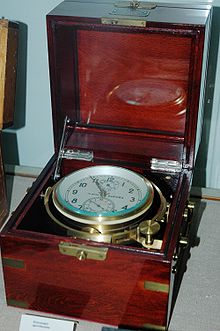
The chronometer (from the ancient Greek. Χρόνος - “time” and μετρέω - “measured”) is a clock with a particularly accurate course (mechanical or quartz) [1] .
For the first time the English inventor, watchmaker Garrison invented the exact marine chronometer in 1731, in 1734 he brought it to practical use. In his invention, he was able to compensate for the two main errors of the chronometer stroke - the change in the mechanical moment on the balancer trigger as the winding spring unwinds and applied thermal compensation for the length and elasticity of the balancer thread by changing the external temperature using bimetallic curving elements.
After improving and reducing the cost, the chronometer became an integral part of the navigation equipment of ships and ships.
On the floating equipment, aircraft served to determine the longitude . The longitude is calculated from the difference between the local time of an astronomical event (for example, sunrise or sunset), and the time of the same astronomical event at the longitude of one of the observatories, the geographical coordinates (in particular, longitude) of which are known, for example, Greenwich , whose longitude is worldwide is taken as zero. (For more, see Problem of determining longitude .)
Over the past centuries, the design of the Garrison's chronometer has remained virtually unchanged (except for manufacturing technology and materials). Currently such a chronometer is produced by the First Moscow Watch Factory under the 6МХ brand.
As of 2015, chronometers are rarely used and only as a backup navigation tool in case of failure of all others, since they are superseded by more accurate clocks with stabilization of the quartz resonators , accurate radio signals from radio stations and the global positioning system (GPS, GLONASS).
Content
See also
- Chronometry
Notes
- ↑ Chronometer // Brockhaus and Efron Small Encyclopedic Dictionary : 4 tons. - SPb. , 1907-1909.
Literature
- Serafimov V.V. , Lermantov V.V. , -. Hours // Encyclopedic dictionary of Brockhaus and Efron : in 86 tons (82 tons and 4 extra). - SPb. , 1890-1907.