Kund culture is a Mesolithic culture of the VIII - V millennia BC, spread over the territory of the eastern Baltic from Poland to the Leningrad region and southern Finland [1] . Named after the city of Kunda in Estonia.
| Kund culture Mesolithic | ||||
|---|---|---|---|---|
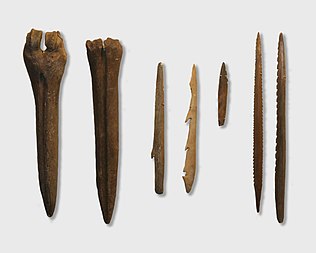 Kunda culture items from the Estonian History Museum | ||||
| Localization | The Baltic states | |||
| Dating | VIII - V thousand BC e. | |||
| Continuity | ||||
| ||||
It evolved on the basis of a witness culture . The Pulli settlement of Kund culture is considered to be the result of the oldest human stay in the territory that now belongs to Estonia . Three settlements are known on the territory of Belarus, two in the Polotsk region and one in Verkhnedvinsky [2] .
Representatives of the culture often used horns and bones for the production of tools and weapons, which was caused by rare flint deposits in the region [2] . The dead were buried in an erect position, alone or in groups (sometimes in several tiers), often they were sprinkled with ocher and put tools on them [2] .
The representative of the Kundian culture from Zvejnieki (Latvia), who lived approx. 8.3 thousand liters n., the mitochondrial haplogroup U5a1c was determined [3] . The mitochondrial haplogroup U4a2 was determined in the Spiginas4 sample from Lithuania [4] .
See also
- Pull settlement
Notes
- ↑ EDUCATIONAL MATERIALS OF THE HISTORICAL FACULTY of St. Petersburg State University (January 13, 2004). Date of appeal September 20, 2018.
- ↑ 1 2 3 Syrenna stone age (mesalite). Saying to the edge of the dance, fishing, and hunting // Gistoryya Belarus: at 6 tons - T. 1: Elderly Belarus. - Minsk: Ekaperspektiva, 2007 .-- S. 32-33.
- ↑ Eppie R. Jones et al. The Neolithic Transition in the Baltic Was Not Driven by Admixture with Early European Farmers , Current Biology, Published Online: February 02, 2017
- ↑ Alissa Mittnik et al. The Genetic History of Northern Europe , 03.03.2017