Estonian mythology is a complex of myths , legends and beliefs of the Estonian people .
Ancient Estonian beliefs can be restored on the basis of folklore material collected mainly in the 19th century , as well as ancient chronicles and chronicles . Estonian mythology is closely related to Finnish mythology, combining elements of the Ural and Finno-Ugric heritage with the influences of Baltic and German mythology.
The basis of the worldview of the ancient Estonians was the harmony of man with nature. People believed that every animal, tree and stone has a soul ; believed in guardian spirits who lived in stones, streams and trees. According to the most ancient myths, traces of which are preserved only in folk songs, the ancestors of the Estonians believed that the world arose from an egg. The Milky Way was considered the trunk of a world tree ( Est. Ilmapuu ) or the road ( Linnutee ), along which migratory birds carried the souls of the deceased to another world. Ursa Major is a cart with the owner, in which a wolf is harnessed along with the bull. The wolf drags a cart as a punishment for having once eaten one of the bulls harnessed to the cart. [one]
In connection with the development of agriculture in the mythological worldview of the Estonians, heavenly deities became more important. The supreme deity of the ancient Estonians was Uku , akin to the Karelian-Finnish Uku [1] , he was also called Vanaisa - Old Father, Vanataat - Old Grandfather, Tevataat - Heavenly Grandfather [1] . Like the Lithuanian Pirkunas, he was a thunderer. It is possible that there was another god of thunder ( Kõu , Pikker , Pikne, Pikker, Eike ("Elder"), Tuu [1] ). Henry of Latvia in the Chronicle Livonian writes about the war god of the Ezelians (inhabitants of the island of Saaremaa) with the name Tarapita . This historians interpreted the name in different ways. Most often it was believed that Tarapita is a distortion from the words Taara avita! (" Taara , help!"). From this, it was concluded that Taara (cf. Scandinavian Thor ) was the god of the Ezelians. According to reports, the Torah evenings were celebrated on Thursdays . Taara , Tooru and Torah's connections are still vague. In myths and on personification of heavenly bodies — the sun , the moon , and stars — is also found in native songs.
Earth gods included Rõugutaja (patron of pregnant women and women in childbirth), Tuule-ema (mother wind), Metsaisa (forest spirit similar to the Slavic goblin ), Metsik (fertility deity, patron of fields and livestock) and others.
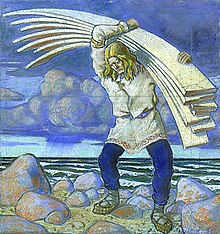
The Estonian world of spirits completes a number of minor creatures: mermaids ( näkk ), which entice those who bathe in a whirlpool; underground spirits ( maa-alused ), chained the crown to the serpentine king; brownies ; wandering souls, etc. In Estonian mythology there were also giants - Kalev , Suur Tull and others.
The views on the afterlife are more developed among Estonians than among Finns. The kingdom of death, Manala or Toonela - a place similar to the earth, with forests, fields and mountains. The ruler of the afterlife is neither good nor evil Tooni . All the dead were remembered in late autumn: they believed that the souls of the dead visit their former homes. Separate tables were set for the spirits and a bath was heated, and peace and quiet were observed.
The Estonian poet Kristjan Jaak Peterson in 1821 published a translation into German of a work on Finnish mythology of the Finnish folklorist Kristfried Ganander . Based on examples from the Finnish folk heritage, Friedrich Robert Felmann published a collection of quasi-folklore Estonian mythological legends in German in 1844. The result was the so-called “Estonian pseudo-mythology” with a pantheon of gods ( Vanemuine and others), which, through school books and newspapers, quickly took root in the popular consciousness and was considered authentic by many subsequent researchers.
See also
- Taarausk
Notes
- ↑ 1 2 3 4 Petrukhin V. Ya. Myths of the Finno-Ugric peoples. - Astrel: AST: Transitbook, 2005.
Literature
- A piece of chalk.,. Estonian mythology // Brockhaus and Efron Encyclopedic Dictionary : in 86 volumes (82 volumes and 4 additional). - SPb. , 1890-1907.