USS Chicago (CA-136) - the Baltimore- type American heavy cruiser , the third ship named after the city of Chicago , was launched at the Philadelphia Naval Shipyard on August 20, 1944 , baptized by Mrs. E. J. Kelly; commissioned January 10, 1945, commander - Captain R. R. Hartung ( born RR Hartung ).
| "Chicago" | |
|---|---|
| USS Chicago (CA-136) | |
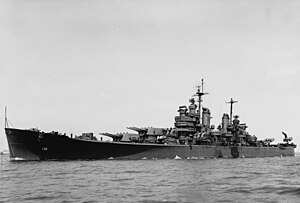 USS Chicago (CA-136) leaves the shipyard on May 7, 1945 | |
| Service | |
 USA USA | |
| Class and type of vessel | Baltimore |
| Organization | US Navy |
| Manufacturer | Philadelphia Naval Shipyard |
| Construction started | July 28, 1943 |
| Launched | August 20, 1944 |
| Commissioned | January 10, 1945 , again May 2, 1964 (after conversion) |
| Status | Sold for scrapping on December 9, 1991 |
| Main characteristics | |
| Displacement | standard - 13 880 t , full - 17 031 t |
| Length | 202.4 m / 205.26 m |
| Width | 21.6 m |
| Draft | 7.3 m |
| Reservation | belt - 152 ... 102 mm, cellars - 76 ... 51 mm, traverses - 152 ... 127 mm, deck - 65 mm towers - 203 ... 95 mm, barbets - 160 ... 152 mm, cutting - 165 mm |
| Engines | 4 TZ General Electric |
| Power | 120,000 liters from. |
| Mover | 4 screws |
| Speed | 33 knots |
| Sailing range | 10,000 nautical miles in 15 knots |
| Crew | 1142 people |
| Armament | |
| Artillery | 3 × 3 - 203 mm / 55 |
| Flak | 6 × 2 - 127 mm / 38, 11 × 4, 2 × 2 - 40 mm / 56 , 24 ÷ 28 - 20 mm / 70 |
| Aviation group | 2 catapults, 2–4 seaplanes [1] |
Content
- 1 World War II
- 2 Post-war service
- 3 Missile cruiser
- 4 Vietnam
- 5 After Vietnam
- 6 Disposal and disposal
- 7 Notes
- 8 References
World War II
The cruiser left Philadelphia on May 7, 1945, and arrived at Pearl Harbor on May 30. On June 28, after additional training off the Hawaiian Islands, Chicago and the North Carolina battleship (BB-55) left Pearl Harbor and headed for the Far East, where on July 8 they became part of the Third Fleet . Chicago supported aircraft carriers during raids on the Japanese islands and carried out shelling of the coast until the cease-fire on August 15.
For its service during World War II, Chicago was awarded one Battle Star.
Post-War Service
The ship remained in Japan until November 1945, participating in the demilitarization of Japanese bases. Having transferred 47 crew members and the attached marine detachment to the Yokosuka naval base, on October 23, the ship headed for the Izu Islands . There, the team helped the garrisons of Oshima and Niyishima blow up the positions of coastal artillery, destroy military equipment and ammunition. On November 7, he left Tokyo for an appointment in San Pedro , California , where he arrived on November 23. After the repair and preparation period, on February 18, 1946 he arrived in Shanghai for the occupation service. He remained in Shanghai until March 28 as the flagship of the Yangtze Patrol Force. Then he headed to Sasebo , Japan, where he became the flagship of the Squadron supporting Japanese imperial waters. He visited various cities in the north and south of Japan, and on January 14, 1947 left Japan, heading for the West Coast. Withdrew from active personnel to the reserve on June 6, 1947 at the Puget Sound Naval Shipyard ( Washington State ). On November 1, 1958, Chicago was reclassified to CG-11 , and in early 1959 began conversion to a missile cruiser , planned before 1962.
Missile Cruiser
Starting July 1, 1959, the add-in was completely cut off, and a new duralumin was installed instead, the electronics were updated and the NTDS data display system was installed. The main armament was the Talos launchers in the bow and stern, the Tartar side-by-side in the bridge area, and the ASROC in the middle section. Two 127 mm / 38 gun mounts were added at the insistence of President Kennedy , after an anti-aircraft missile had not intercepted an air target before his eyes.
In 1968 [2] three-pipe torpedo tubes for anti-submarine torpedoes were installed.
The ship returned to service at the San Francisco Naval Shipyard on May 2, 1964. It became part of the Ninth Cruising and Mines of the Pacific Fleet . Acceptance tests continued until September 2 , after which the ship officially entered the active composition of the First Fleet . After calibrating the sonar and destroying the permanent deviation at Puget Sound, he arrived at the permanent base in San Diego , where he began practicing the use of weapons. After successful tests at a rocket range off the coast of California, December 2 evaluation of missile systems completed.
January 4, 1965 and the cruiser moved to Long Beach for a series of explosive tests of the hull off the island of San Clemente . Testing of equipment and development of the struggle for survivability ended by mid-January. Then the ship headed to San Francisco for rework, installation of improved Tartar systems, and advanced electronics. He returned to San Diego on April 17th .
The next two months, the ship continued to prepare. Since mid-June, he conducted, together with the Naval Electronics Laboratory ( English Naval Electronics Laboratory ) experimental tests of the Talos missile fire control system, and experimented with replenishing the stock of missiles at sea.
During the naval exercises "Hot Stov" in August-September, the ship trained in air defense and anti-aircraft defense, including firing ASROC and torpedoes underwater targets. After the exercises, EW Chicago participated in missile shooting competitions and won the E gold medal for the operation of the Tartar complex. In the first week of October, during the next air defense exercise, rockets shot down two high-speed high-altitude targets.
After going to Hawaii from October 19 to November 3, the ship continued to test and exercise in the San Diego area. Upon returning to the base on March 4, 1966 , he underwent a series of inspections on operational readiness, acceptance of boilers, electronics and operations in the conditions of ZOMP. In April, he participated in the exercises of the "Gray Guest" under the flag of the commander of an air defense unit, Rear Admiral Elmo Zumwalt ( Eng. Elmo R. Zumwalt, Jr. ).
Vietnam
May 12, 1966 "Chicago" went on his first Vietnamese campaign. After entering Pearl Harbor and Yokosuka and installing a new radar, he arrived in Subic Bay on June 12 . Taking on board a helicopter and an aviation team, the next day he went to the Gulf of Tonkin to join the 77th Operations Connection at the northern position ( English Yankee Station ).
On June 15, the ship began evaluating the concept of - complete radar control of air operations over a specific area.
Anti-radiation variants of Talos missiles ( RGM-8H ) were used by Chicago, as well as Oklahoma (CLG-5) and Long Beach (CGN-9) against North Vietnamese radars. The cruiser served as the base of the air defense compound during the mining of Haiphong Harbor in 1972 . Together with other URO ships, he was primarily responsible for air defense. Steadier sea carriers provided support and reinforcement. At least one case was recorded when the radar detected a MiG bound for slow, low-flying airplanes engaged in mines. The cruiser shot him down with a Talos missile at a distance of 48 miles. The rest of the MiGs retreated.
In total, the ship made five trips to Southeast Asia. The last of them ended on July 9, 1972 .
On August 25, at the Long Beach naval shipyard, the ship embarked on an average repair and modernization.
After Vietnam
The ship made the following campaigns:
- May 21 - December 14, 1974: Southeast Asia and the Indian Ocean
- July 4 - September 9, 1975: Seattle and Vancouver
- April 13 - October 16, 1976: Southeast Asia
- September 6, 1977 - April 7, 1978: Southeast Asia and Japan
- May 30 - December 17, 1979: Southeast Asia, Japan, Korea , Australia, and Oceania
For post-war service, the ship received the following awards:
- Encouragement in the order for the development of the PIRAZ concept during the campaigns of 1966 and 1967-68 to Southeast Asia
- Mentioned by order of the Navy, 1972, for service in Vietnam
- Arly Burke Prize
- Seven consecutive times the ship was awarded the E award for the excellent use of missiles
Conclusion and disposal
The ship was withdrawn from active service on March 1, 1980 and was removed from the fleet lists on January 31, 1984 .
December 9, 1991 "Chicago" was sold for scrap.
Notes
- ↑ Data at the time of construction
- ↑ So in the source: Convay's ...
Links
- DANFS: Dictionary of American Naval Fighting Ships, (1963) Vol. 2, p. 103. (eng.)
- K. Jack Bauer and Stephen S. Roberts, Register of Ships of the US Navy, 1775-1990, p. 155. (eng.)
- Conway's All The World's Fighting Ships, 1947-1995, pp. 577-578. (eng.)