The 6-pound fast-firing gun ( Ordnance Quick Firing 6-pounder 7cwt or just “6-pound” ) is a 57 mm British anti-tank gun from World War II . The name comes from the approximate mass of armor-piercing shell. It was used both independently on a wheeled carriage , and for arming a number of British tanks and armored vehicles . First applied at the North African theater of operations in April 1942 . Replaced the 2-pound anti-tank gun and allowed the 25-pound howitzers to return to their usual job of shooting from closed positions (due to the insufficient power of the 2-pound cannon, a 25-pound howitzer had to be used to fight tanks). The U.S. Army also adopted the 6-pound slightly modified form as the main anti-tank gun under the designation 57-mm anti-tank gun M1 ( eng. 57 mm Gun M1 ).
| anti-tank gun QF 6-pounder 7 cwt | |
|---|---|
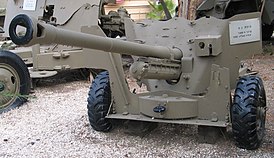 QF 6 pdr at the Batey ha-Osef Museum | |
| Caliber mm | 57 |
| Calculation, people | 6 |
| Rate of fire , rds / min | fifteen |
| Effective range, m | 1510 |
| Maximum range, m | 4600 |
| Trunk | |
| Barrel length, mm / klb | Mk II, III: 2450 (43) Mk IV, V, and M1: 2820 (50) |
| Weight | |
| Weight in combat position, kg | Mk II: 1140 Mk IV and M1: 1215 |
| Dimensions in the stowed position | |
| Width mm | 1800 |
| Height mm | 1280 |
| Firing angles | |
| AngleVN , hail | −5 ° - + 15 ° |
| Angle GN , hail | 90 ° |
Content
- 1 History of creation and development
- 2 57 mm anti-tank gun M1
- 3 Production
- 4 Lend-Lease
- 5 Modifications
- 6 performance characteristics
- 7 Ammunition
- 8 Project Evaluation
- 9 notes
- 10 Literature
- 11 Links
History of Creation and Development
The limited capabilities of the existing 2-pound anti-tank guns were obvious immediately after their adoption. Therefore, efforts were aimed at replacing them with a much more powerful weapon, the work on the creation of which began in 1938 . The construction of the 6-pound gun receiver group was completed in 1940 , but the development of the carriage for it was not yet completed. This part of the work was completed in 1941 . At the same time, the military urgently needed a new tank gun, they were asked to consider the option of installing a 6-pound gun, although the department objectively wanted to get a slightly different gun, primarily in terms of the possibility of using high-explosive ammunition, since the 6-pound armor penetration completely suited them There was no time left to wait for its development and release. After testing, the barrel had to be shortened to 43 calibers with a slight drop in ballistics and a 6-pound was adopted as the main tank gun. Having an acute need for anti-tank guns, the British could not stop the established production of 2 pounds. The new line was completed, but with its launch, the release of two options for 6-pound barrels of 50 calibers for mounting on a carriage and 43 calibers for tanks was difficult due to the lack of capacity involved in the production of 2-pounds. A compromise was made to begin the production of a tank version of the barrel for both versions of the gun since the armored forces could not remain without weapons. Thus, in the beginning of 1942, shortened versions of the guns, delayed in production, began to arrive in the troops.
The shortened 6-pound was quite effective on all German tanks, but already in the next year the Germans appeared tanks "Tiger I" and "Panther" . The standard 6-pound armor - piercing shell did not penetrate their frontal armor. Also, he did not hit the side armor of the Tiger [1] .
By the end of the summer of 1942, the production of 2-pounds was discontinued and in August it was decided to switch to the production of a 50-caliber barrel with an additional muzzle brake. Also after adoption, the power of 6 pounds was strengthened by increasing the charge power and the introduction of improved types of armor-piercing ammunition (as a result, this significantly extended the life of the gun). The first of these was the armor-piercing armor-piercing projectile with a composite core that was adopted in 1943. In 1944, it was followed by an armor-piercing projectile with a detachable pallet , which sharply increased the penetration ability of the gun. In addition, the gun had a high-explosive fragmentation projectile to destroy unarmored targets.
Despite maintaining the fighting capabilities of the 6-pound during the war at a high level, the British army led the development of a more powerful weapon since 1942. The goal was to create a gun with the same weight and size characteristics as the 6-pound, but with improved armor-piercing ability. The first attempt was an 8-pound gun with a barrel length of 59 calibres, but it was recognized too heavy compared to a 6-pound. The second attempt was to shorten the barrel of an 8-pound to 48 calibers, but the improvement in combat qualities compared to a 6-pound was not significant. Therefore, the development program was discontinued in January 1943 .
Since a 6-pound leap was required, a next-generation 76.2 mm anti-tank gun was followed, the Ordnance QF 17 pounder , which began to be widely used in 1943 (a small batch of 17-pounds was tested in the case against the Tigers in February 1943 in Tunisia ) However, the adoption of a significantly more powerful 17-pound did not lead to the removal of 6-pounder guns. So for example, in 1942, a special airborne mount was developed for it, for the possibility of delivering guns to the glider , which significantly strengthened the landing units of the British and Allied forces giving them the opportunity to withstand the enemy’s armored vehicles, waiting for the main forces to approach. 6 pounds, as lighter and more maneuverable, were used not only until the end of World War II, but also for 20 years after it .
The American version of the 6-pound called M1 was used on the Eastern Front in the amount of several hundred towed guns and 650 self-propelled guns T48 based on the American semi-tracked armored personnel carrier. It is interesting that the Germans immediately noted the appearance of this weapon - the reports of the summer of 1943 report its successful use against the Tiger 503 heavy tanks of the heavy tank battalion. [2] [3]
M1 57 mm anti-tank gun
The idea of producing a British six pound gun in the United States was voiced by the artillery and technical service of the US Army in February 1941. At that time, the U.S. Army preferred to use the 37 mm M3 cannon and the British cannon was to be made exclusively for Lend-Lease. The American version, designated 57 mm M1 gun, was based on the QF 6 pounder Mk 2. For production, the United Kingdom transferred two such guns to the United States. Unlike the UK, in the United States there were lathes of the right length and production was immediately started from long shafts. Production began in 1942 and continued until 1945. In total, more than 15,000 cannons were produced.
The M1A1 model had Combat pneumatic tires. In September 1942, the M1A2 model appeared - it had horizontal aiming without a rotary mechanism - aiming was carried out by a calculation moving the breech (as was customary in the British army). Later, a more stable carriage was developed, but it was never adopted.
As soon as the 57 mm gun entered service with the US Army, an improved towing unit was developed and introduced (model M1A3). This model was used exclusively by the US Army.
A third of all M1s produced were shipped to the UK.
Like the British Army, the US Army experimented with a nozzle to turn the barrel into a conical (57/40 mm T10), but the program was closed.
The development and production of American shells for the new gun was far behind schedule and, therefore, at first only solid armor-piercing shells were made for the gun. American high-explosive shells appeared only after landing in Normandy, and British high-explosive shells were used to cover their shortage.
Production
| Production of QF 6 pounder guns and carriages for them, pcs. (UK data) | |||||||||||
| 1941 | 1942 | 1943 | 1944 | 1945 | Total | ||||||
| Guns 6pdr | 201 | 17 854 | 16,586 | 1 964 | - | 36,605 | |||||
| Carriages 6pdr | 419 | 4,666 | 6 945 | 405 | - | 12,435 | |||||
| 6pdr airborne mounts | - | 37 | 390 | 655 | 286 | 1,368 | |||||
| 6pdr self-propelled gun carriages | - | 166 | 19 | - | - | 185 | |||||
| Production of American 57 mm anti-tank guns M1, pcs. | |||||||||||
| Year | 1942 | 1943 | 1944 | 1945 | Total | ||||||
| Issued, pcs. | 3,877 | 5 856 | 3 902 | 2 002 | 15 637 | ||||||
Lend-Lease
| Supply of American 57 mm M1 anti-tank guns according to Lend-Lease, pcs. | |||||||||||
| A country | United Kingdom | France | the USSR | Latin America | Total | ||||||
| Delivered, pcs. | 4,242 | 653 | 400 | 57 | 5 352 | ||||||
Modifications
Gun barrel:
- Mk I - limited edition with a barrel of 50 calibers
- Mk II - version with a barrel shortened to 43 calibres for technological reasons
- Mk III - tank modification of the Mk II
- Mk IV - 50-caliber barrel returned and a single-chamber muzzle brake introduced
- Mk V - tank modification of the Mk IV
- 57 mm M1 - US Made Mk I
- Molins gun - A 6-pounder gun mount with an automatic loading mechanism built by Molins, it was equipped with the De Havilland Mosquito assault aircraft and torpedo boats.
Carriage:
- Mk I - basic version
- Mk II - simplified design
- Mk III - Airborne version with a modified axis, for placement in the Horsa airframe
Performance Specifications
- Indicated for Mk II
- Caliber, mm: 57 (2.24 inches)
- Weight, kg: 1140
- Carriage: with extendable beds and shield cover
- Horizontal firing angle, degrees: 90
- Ammunition Types:
- armor-piercing:
- gauge (from the moment the gun was adopted)
- sub-caliber (since September 1942)
- armored with ballistic tip (since January 1943)
- subcaliber with composite core (since October 1943)
- sabot with detachable pallet (from March 1944)
- high-explosive fragmentation
- armor-piercing:
- Maximum firing range, m: 4600
- Calculation, people: 6
Armor Penetration Table [4]
| Modification | Type of ammunition | Initial speed m / s | 450 m | 900 m | 1800 m | at an angle to the normal |
| Mk II / III | AP | 853 | 79 | 66 | 44 | 30 ° |
| Mk IV / V | AP | 884 | 82 | 71 | 48 | 30 ° |
| Mk IV / V | APCBC | 847 | 86 | 80 | 68 | 30 ° |
| Mk IV / V | APDS | 1220 | 138 | 123 | 95 | 30 ° |
Ammunition
| Ammunition nomenclature | ||||||
| Type of | Projectile mark | Projectile weight, kg | Initial speed for 43-klb guns, m / s | Muzzle velocity for 50-klb guns, m / s | ||
| British shells | ||||||
| Pointed armor-piercing tracer | AP Mk.I-VIII T | 2.85-2.86 | 808–853 | 884 | ||
| Pointed armor-piercing with an armor-piercing tip, tracing (since 1943) | APC Mk.VIII T | 2.88 | 853 | 884 | ||
| Armor-piercing with a ballistic and armor-piercing tip, tracing (since 1943) | APCBC Mk.XT | 3.23 | 808 | 847 | ||
| Armor-piercing subcaliber composite rigid (since 1943) | APCR Mk.IT | 1.9 | n / a | 1082 | ||
| Armor-piercing subcaliber with a detachable pallet (since 1944) | APDS Mk.I BT | 1.5 | 1151 | 1219 | ||
| High explosive | HE Mk.XT | 2.97 | n / a | 820 | ||
Project Evaluation
By 1941, anti-tank guns of 50–57 mm caliber were developed in the USSR, Germany, and Great Britain, the characteristics of which are presented in the table. The American M1 gun was a licensed British 6-pound, the Americans used less powerful ammunition. Also, for comparison, the characteristics of the most popular anti-tank guns in Germany - 75-mm Pak 40.
| The performance characteristics of anti-tank guns of caliber 50-75 mm | ||||||
| Characteristic | ZIS-2 | Pak 38 | 6-pdr Mk.I, IV | 6-pdr Mk.II | M1 [5] [6] [7] | Pak 40 |
|---|---|---|---|---|---|---|
| A country | ||||||
| Caliber, mm / barrel length, klb. | 57/73 | 50/60 | 57/50 | 57/43 | 57/50 | 75/46 |
| Weight in combat position, kg | 1050 [8] | 930 | 1215 | 1140 | 1215 | 1425 |
| Horizontal guidance angle, ° | 57 | 65 | 90 | 90 | 90 | 65 |
| Mass of caliber armor-piercing projectile, kg | 3.19 | 2.05 | 2.85 | 2.85 | 2.85 | 6.8 |
| The initial velocity of the caliber armor-piercing projectile, m / s | 990 | 823 | 884 | 808 | 853 | 792 |
| Penetration with a caliber armor-piercing projectile at an angle to the armor at a distance of 500 m | 84 (60 °) | 61 (60 °) 59 mm (30 °) | 79 (60 °) | 73 (60 °) | 78 (60 °) | 96 (60 °) |
It should be borne in mind that in the USSR, before and in the first years of the war, tests were carried out according to the Jacob de Marr formula on paper, real shooting was carried out only after revealing significant differences from the declared characteristics [9] . The original Mk.II did not differ in high armor penetration: 68.6 mm (2.7 inches) by 915 m (1000 yards) [1] . But the 6-pound had a rotation angle of 90 °, which had a very positive effect on the convenience and speed of aiming without the need to move the gun, and a higher production culture. All this affected the fact that 6 pounds for a long time after the war was in service with a number of countries [3] [10] . By 1944, the QF 6 pounder proved ineffective in the fight against the German Tigers and Panthers at regular distances. If possible, six-pounders were replaced with more powerful 17-pound guns (towed and self-propelled ), but still they continued their service in many regiments of anti-tank artillery of British divisions until the end of the war. Armored divisions were equipped mainly with 17 pound guns and self-propelled guns [11] .
Notes
- ↑ 1 2 WEAPONS, 1998 , p. 181.
- ↑ Henry, Chris. British Anti-tank Artillery 1939-45.
- ↑ 1 2 Peter Chamberlain, Terry Gander. Anti-Tank Weapons. WW2 Fact Files.
- ↑ WWII Equipment.com
- ↑ 57 mm M1 anti-tank gun on Lovettartillery.com . Archived January 27, 2011.
- ↑ 57-mm anti-tank gun M1 on the website Tarrif.net . Archived January 27, 2011.
- ↑ The propellant charge in American ammunition corresponded to the reduced British.
- ↑ 1050 kg - the mass of guns of the 1941 release, the release of 1943 had a mass of 200 kg more. Ministry of Defense of the USSR. 57 mm anti-tank gun mod. 1943 Service Manual. 1955 from. 3
- ↑ Alexander Shirokorad. Artillery in the Great Patriotic War.
- ↑ P. Chamberlain, C. Ellis. British and American Tanks of WW II
- ↑ M. Braille of the British Army. 1939-1945. Northwest Europe
Literature
- P. Chamberlain, T. Gander. Anti-Tank Weapons. - Arco Publishing, Inc., 1974. - 64 p. - (World War II Fact Files). - ISBN 0-668-03607-9 .
- P. Chamberlain, C. Ellis. British and American Tanks of WW II. - Arco Publishing, Inc., 1984. - 222 p. - ISBN 0-668-01867-4 .
- Shirokorad A. B. Encyclopedia of Russian artillery. - Minsk: Harvest, 2000 .-- 1156 p. - ISBN 985-433-703-0 .
- THE ENCYCLOPEDIA OF WEAPONS OF WORLD WAR II / Chris Bishop. - London: Barnes £ Noble Books, 1998 .-- 544 p. - ISBN 0-7607-1022-8 .
Links
- 6 pounds at LemaireSoft (in English)
- 6-pound at wwiiequipment.com (in English)