The Umov effect ( Umov law ) is the relationship between the albedo of an astronomical object and the degree of polarization of the light reflected from it. Discovered by physicist N. A. Umov in 1905 [1] .
The degree of polarization of light P is defined as
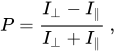
Where and - light intensity in directions perpendicular and parallel to the plane of the polarizer (plane of the reflecting surface). The degree of polarization P is equal to zero for unpolarized light and equal to ± 1 for linearly polarized light.


Umov’s law states that

where α is the albedo of the object. Thus, highly reflective surfaces reflect mostly unpolarized light, weakly reflective surfaces reflect polarized light. Umov’s law is valid only for large phase angles (angles between incident and reflected light).
Notes
- ↑ N. Umov. Chromatische depolarisation durch Lichtzerstreuung (German) // Physik. Z .: magazin. - 1905. - Bd. 6 . - S. 674–676 .