Makino Tomitaro ( Jap. 牧野 太郎 太郎 Makino Tomitaro:, 1862 - 1957 ) - Japanese botanist , known for his work in the field of taxonomy . He is often called the "father of Japanese botany" - he was one of the first Japanese botanists who began to actively use the Linnaeus system in their work on the classification of Japanese plants. [one]
| Makino Tomitaro | |
|---|---|
| 牧野 富 太郎 | |
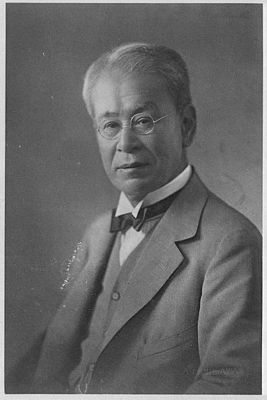 Makino Tomitaro | |
| Date of Birth | |
| Place of Birth | Sakawa , Koshi Prefecture , Japan |
| Date of death | |
| A place of death | Tokyo Japan |
| A country | |
| Scientific field | botany , taxonomy |
| Place of work | |
| Alma mater | |
| supervisor | |
| Known as | "Father of Japanese botany" |
| Awards and prizes | Asahi Prize (1936) (1951)  |
| Taxonomy of wildlife | |
|---|---|
Author of a number of botanical taxa . In the botanical ( binary ) nomenclature, these names are supplemented by the abbreviation " Makino " . List of such taxa on the IPNI website Personal page on IPNI website |
The result of his research was a description of almost 50,000 plants, many of which are presented in his work, Illustrated Flora of Japan ( Eng. Makino's Illustrated Flora of Japan ).
Without even graduating from school, he eventually reached the doctoral degree , and his birthday is celebrated in Japan as Botany Day.
Content
Life Path
Makino Tomitaro was born in the city of Sakawa ( Koti Prefecture ) in the family of a brewer, early left an orphan and raised by his grandmother. At 10, he was forced to drop out of school after two years of elementary schooling , but his abilities helped him gain good knowledge of English , geography, and especially botany . In 1880, at the age of 18, he began to work as a teacher in an elementary school in his hometown. There he published his first botanical study. In 1881, he first made a trip to Tokyo . Her goal was to buy a microscope and some botanical books.
In 1884, Makino moved to Tokyo to continue his botanical studies at the university , Professor , subdued by the young man’s knowledge, granted him access to university research facilities.
In 1888, Makino began to publish a botany magazine - Nippon Shokubutsu-shi Zu-hen ( English Natural History of Japanese Plants with Illustrations ), taking on all the costs and expenses.
He married in 1890 and subsequently had 13 children.
In 1893, he was appointed assistant professor, and in 1912 he began to teach botany at the University of Tokyo on his own. A doctorate was awarded to Makino in 1927.
In 1936, he published the Book of Botany ( English Makino Book of Botany ) in six volumes, in which he described 6,000 species of plants, 1,000 of which he discovered.
Most of all he is known as the author of the Illustrated Flora of Japan ( English Makino's Illustrated Flora of Japan ), published in 1940, which to this day is used as a botanical encyclopedia of Japan.
His scientific fame was so great that in 1948 he was invited to the Imperial Palace to give a lecture on botany for Emperor Hirohito .
In 1950, Makino became an academician of the Japanese Academy .
After his death in 1957 (he was 94 years old), his botanical collection , consisting of approximately 400,000 plant samples, was transferred to the University of Tokyo; The house and land in Tokyo where he lived became . He was awarded the title of Honorary Citizen of Tokyo; posthumously he was awarded the Order of Culture .
Herbarium of Makino in Tokyo and the on Mount Godai in his native Koti Prefecture are named after him.
Makino's work on taxonomy
In total, Makino scientifically described and named about 2,500 plants, including 1,000 new species and 1,500 new species . In addition, he has the honor of discovering nearly 600 new species.
Printed Works
- Makino shokubutsugaku zenshū (Makino's Book of Botany) Sōsakuin, 1936
- Makino shin Nihon shokubutsu zukan (Makino's New Illustrated Flora of Japan), Hokuryūkan, 1989, ISBN 4-8326-0010-9
Literature
- Rou Hikawa: Makino Tomitaro. - Popura Publishing, 1980.
Notes
- ↑ ペ ー ジ が 見 つ か り ま せ ん で し た : 高 知 県 ホ ー ム ペ ー ジ (link not available) . Date of treatment December 13, 2008. Archived on February 8, 2007.
Links
- Makino Portraits at the National Diet Library, Japan (Retrieved December 13, 2008)