The Vandal War is an armed conflict of 533-534 between the Byzantine Empire and the kingdom of the Vandals and Alans , as a result of which the commanders of the emperor Justinian destroyed the kingdom located in North Africa and included the conquered lands in the empire.
| Vandal war | |||
|---|---|---|---|
 The course of the war on the map | |||
| date | 533 - 534 | ||
| A place | North Africa | ||
| Total | The elimination of the kingdom of vandals and Alans | ||
| Opponents | |||
| |||
| Commanders | |||
| |||
| Forces of the parties | |||
| |||
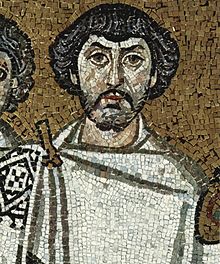


A detailed description of the war was compiled by a contemporary and one of the participants in the events, Procopius of Caesarea , secretary of the imperial commander Belisarius , in the work On Wars ( Ὑπέρ τῶν πολέμων ). Books 3 and 4 of this work are published under the title “War with the Vandals.”
Background
Troubles in the kingdom of vandals
The Kingdom of Vandals and Alans was created by Geiserich , the leader of the German Vandals and the Alans who joined them, as a result of the conquests in northern Africa in the territory of modern Tunisia , northern Algeria , northwestern Libya , the islands of Sardinia and Corsica . Vandals moved from Spain to Africa in 429 , after which they defeated the troops of the Western Roman Empire in a number of battles and captured Carthage in 439 , which became the date of the founding of the Vandal kingdom - one of the first created by the Germans .
The kingdom became famous under its founder Geiserich by the capture and plunder of Rome in 455 . The vandal king Hilderich (523-530) was the son of Hunerich from the Roman princess Eudokia, captured by the vandals during the ruin of Rome. Hilderich was friends with Justinian , who actually ruled the Byzantine Empire with his uncle, Emperor Justin, even before he became emperor. Hilderich broke off relations with the ruler of Italy, the leader is ready Theodoric , imprisoning his sister Amalafrid (widow of the deceased vandal king Trazamund ) on charges of conspiracy and having killed a thousand Goths who arrived with her. The innocence of the elderly Hilderich, his good relations with Justinian, and another defeat from the wild Berber tribes, who raided the Vandal lands, provoked the displeasure of the Vandal nobility. Relying on her, the nephew of Hilderich Gelimer (reigned 530-534) made a coup. He imprisoned Hilderich in 530 , and 3 years later, immediately after the onset of the Byzantine invasion, ordered him killed.
Emperor Justinian took advantage of the turmoil to start the war against the Vandal kingdom. The formal pretexts were the overthrow of the usurper Gelimer , which was supposed to split among the vandals, as well as the liberation of Orthodox Christians from the religious oppression of the Vandals- Arians .
Byzantine Empire
Most of Justinian's entourage feared getting involved in an overseas war in North Africa. There were fresh memories of the defeats of the vandals in the reign of King Geiserich . The eparch of the court, John of Cappadocia , expressed the emperor the difficulties of the upcoming campaign:
“ You intend to fight with Carthage, to which, if you walk the dry route along the mainland, you have one hundred and forty days, and if you sail along the sea, you need to go to the very edge of it, crossing the entire body of water. Therefore, if something happens to the army, it will take a messenger with lime a whole year to get here. Let’s say that you will defeat the enemies, but you won’t be able to secure the possession of Libya while Sicily and Italy are under the rule of others [ready] ... In a word, you will not benefit from victory, and any change of fate for the worse will bring disaster to the present happy situation. " [1]
The decision to start a war against Justinian vandals was prompted by a number of favorable circumstances:
- After the death of the king, Theodoric was prepared by Italy and Sicily to rule on behalf of the infant son the daughter of Theodoric Amalasunta . She entered into an alliance with Justinian, allowing his army to purchase food in Sicily.
- Against the vandal king Gelimer, his viceroy in Garda of the Year revolted in Sardinia. Declaring himself king, he turned to Justinian for help.
- The long war between Byzantium and the Persians ended in 532 with the conclusion of a peace treaty. Thus, from west and east, Byzantium might not have expected a surprise attack. [2]
- Procopius announced the meeting of Justinian with a certain bishop who persuaded the emperor to start a war, referred to his dream in which God called for the release of Roman Catholic Christians from Africa under the authority of the Arian vandals, for which he promised to make Justinian the ruler of Libya.
War Description
Start of Campaign
Emperor Justinian appointed his commander Belisarius the leader of the campaign with unlimited powers. In the summer of 533, the Byzantine naval expedition, consisting of 500 transport and 92 military vessels, headed for Carthage. Ships carried 10 thousand infantry and 5 thousand cavalry, crews totaled 32 thousand sailors. [3] Rounding the Peloponnese, the Byzantine fleet crossed the Adriatic Sea and lingered on Sicily. After replenishing the reserves and clarifying the situation, Belisarius with a fair wind headed for Africa.
For the king of vandals Gelimer, an unfavorable situation developed. One of his commanders, the Goth of the Year, seized power in Sardinia and proclaimed himself king. To displace him, Helimer sent to Sardinia 5 thousand soldiers in 120 ships under the command of his brother Zazon. In the east of the kingdom of vandals, the inhabitants of Tripolis came under the rule of Byzantium, for their submission the vandals no longer had the strength.
3 months after the start of the campaign, the Byzantine army landed on the African coast 5 days' journey east of Carthage . From there, the soldiers moved towards Carthage along the coast, the Byzantine fleet accompanied them.
The Battle of Decimus
When the army approached the town of Decim, 13 km from Carthage, the first battle with the vandals occurred. Gelimer 's plan was to simultaneously attack Belisarius from 3 sides. Gelimer himself with cavalry attacks from the rear, his brother Ammata attacks from the front (from Carthage), his nephew Gibamund attacks from 2,000 soldiers from the south, pushing the Byzantines to the sea. However, the inconsistency of the vandal warlords led to their defeat.
In mid-September 533, the army of Helimer was defeated in parts at the battle of Decimus. Ammata was the first to enter the battle, attacking with a small group a forward detachment of Byzantines from 300 shield-bearers (heavily armed horsemen). After the death of Ammata, his warriors, only approaching the place of battle, panicked. Assuming that before them the main Byzantine forces, they fled, pursued on their heels to Carthage. A few kilometers from the scene of this battle another battle took place, a detachment of " Huns " exterminated the vandals of Gibamund.
Helimer, who had come up with the main forces, managed to overthrow the Byzantines, but lingered for the burial of his brother Ammata. Meanwhile, Belisarius tidied up his retreating troops and unexpectedly counterattacked the vandals scattered for the mourning ceremony. Helimer fled to the deep regions of Numidia . Belisarius occupied Carthage without a fight, which remained without troops.
The Battle of Tricamar
While Belisarius strengthened Carthage as his strong fortress city in the country of vandals, Gelimer launched a guerrilla war, paying a reward for the enemy’s head. His attempt to call for help from the Visigoths from Spain failed because they learned about the fall of Carthage. The leaders of the Berber tribes decided to wait, remaining neutral, backed by money and gifts from Belisarius. Some of the Moors nevertheless joined Helimer. To help the king of Vandal, his brother Zazon from Sardinia hastily returned.
Joining forces, Helimer with the army approached Carthage, but did not take anything decisive, hoping for blockade actions. When the fortification of Carthage was completed, Belisarius stepped out of the city.
The second battle in the Vandal war took place in mid-December 533 near the village of Trikamar, 24 km from Carthage. The Byzantine infantry lagged behind, the cavalry of the opponents lined up against each other on the banks of a small nameless river. For a long time no one dared to start the battle, then the Byzantines successfully attacked. They managed to drive the vandals back to their fortified camp. Zazon and another 800 vandals were killed, the Byzantines lost about 50 people.
When Helimer found out about the approach to his camp on the evening of the same day of the Byzantine infantry, then unexpectedly for all he secretly fled. Learning about this, the remaining vandals began to scatter with their families. A camp with rich supplies and slaves fell into the hands of the Byzantines without a fight. The warriors of Belisarius scattered in search of prey in the surrounding places, no longer thinking of the enemy, and Belisarius with great difficulty managed to assemble a detachment of 200 soldiers to pursue Gelimer.
The fall of the vandal kingdom
After the defeat at Tricamar, the vandals nowhere again showed organized resistance, but took refuge in temples. All of them (combat-ready men) were taken under guard to Carthage, and then sent to the eastern provinces of Byzantium. North Africa from Gibraltar to Tripolis came under the control of Byzantium.
As Procopius noted, the war, the success of which Justinian's circle did not believe, was won by only 5 thousand horsemen:
“ That which seemed impossible in words was actually accomplished, and that which until then often seemed unattainable, then, having ended with success, seemed surprising. [...] The descendant of Giserich in the fourth generation and his kingdom, blooming with wealth and military strength, were destroyed in such a short time by five thousand aliens who did not know where to stick. Such was the number of horsemen who followed Belisarius, who then endured the entire war against the vandals. " [4]
The total number of vandal warriors remains unknown. Procopius mentioned that when Helimer sent 5 thousand soldiers to Sardinia, it was all the fighting forces of the vandals. At the disposal of Helimer in Africa remained a comparable number of soldiers, judging by the description of the course of the battle of Decimus.
Helimer took refuge on Mount Papua under the protection of friendly Moors. All winter he was besieged there by a detachment of Heruls . After 3 months of deprivation in early spring of 534, the last king of the Vandals and Alans surrendered, after which he was sent to Constantinople . 2 thousand captured vandals were included in the Byzantine forces and sent to war with the Persians. After these events, the Kingdom of Vandals and Alans ceased to exist. The battles of Byzantium with the Berber tribes soon unfolded on its lands, and all references to historical documents disappeared about the vandals themselves.
Notes
- ↑ Procopius of Caesarea , “The War with the Vandals”, Prince 1, 10.14-16
- ↑ Procopius (War with the Persians, pr. 2, 26.8) noted that after the defeat of the vandals, the Persian king “ Khosrov said that he, together with Vasilevs Justinian, was happy and, of course, jokingly demanded part of the spoils from Libya, saying that he never I could not have defeated the vandals in this war if the Persians had not made peace with him. "
- ↑ The composition of the forces and the names of the military leaders were listed in detail by Procopius. "War with the Vandals", Prince. 1.11
- ↑ Procopius, War on the Vandals, Prince 2.7
Sources
- Isidore of Seville. History of Vandals
- Procopius of Caesarea. War with vandals
- JB Bury. History of the Later Roman Empire, ch. XVII (Eng.) . Date of treatment December 14, 2008.