The phase integral is one of the fundamental integrals of quantum mechanics , first proposed by Feynman in the early 1960s . Like the path integral, this integral allows you to find the phase shift due to the influence of a field . For example, the influence of a magnetic field on the motion of a quantum particle [1] leads to a phase shift:
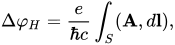
Where Is the charge of an electron , Is the speed of light in vacuum , Is the reduced Planck constant , Is the vector potential of the magnetic field (in the SI system it is measured in volts ) and - an element of the particle trajectory .


Differential Phase Change
In practice, the case of non- integral phase change , when the absolute value of the vector potential is taken into account, is more interesting. 



Where 
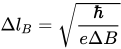

Of course, we are more interested in the dimensionless number , or the so-called phase factor, bypassing the contour created by the periodicity of the magnetic field
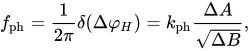
Where T 1/2 V −1 is a phase constant that depends only on fundamental constants. The main problem that remains is that in practice it is easy enough to measure only the magnetic field , and the potential found only by calculation under certain assumptions.
Phase change in a quantum antidot
The situation has radically changed with the experimental development of “quantum antidots” by Goldman and the construction of “quantum interferometers” on their basis. The fact is that in all experiments on the study of the quantum Hall effect, not only a magnetic field is always present but also an electric field , but it was practically not taken into account. And only in Godman's experiments did the first start of accounting for the electric field and control of its quantization. Of course, the electric field itself, directed along the magnetic field, is not directly measured. Commonly measured control voltage at the heterojunction and knowing the thickness of the heterojunction, we can calculate the electric field and electric induction (taking into account the dielectric constant of the semiconductor ). The main result of Goldman's experiments is that the magnetic field , and electric field quantized correlated with one another (see figures in Goldman's publications).
Equally obvious is the magnetic potential. must correlate in a certain way with a change in the electric field . The dimensions of the magnetic potential coincide with the dimensions of the gate voltage (volts!), Therefore it is quite fair to assume that they are equal in magnitude:
The results of processing several articles by Goldman on quantum interferometers are presented in the following table:
| T | , AT | T / B | picture | a source | |||
|---|---|---|---|---|---|---|---|
| 0.882 | 0.788 | 4/5 | 2/5 | Fig. ten | Goldman [1] | ||
| 0.325 | 0,800 | 4/5 | one | Fig. 2.a, c | Goldman [2] | ||
| 0.3421 | 1,177 | 6/5 | 2 | Fig. 2.b, d | Goldman [2] | ||
| 0.882 | 0.811 | 4/5 | 2/5 | Fig. 3 | Goldman [2] | ||
| 0.882 | 0.811 | 4/5 | 2/5 | Fig. 2 | Goldman [3] | ||
| 0.1154 | 0.289 | 1/3 | 1/3 | Fig. 3.b | Goldman [4] | ||
| 0.3143 | 0.841 | 4/5 | one | Fig. 3.a | Goldman [4] | ||
| 0,1308 | 0.328 | 1/3 | 1/3 | Fig. 5.b | Goldman [5] | ||
| 0.3214 | 0.861 | 4/5 | one | Fig. 5.a | Goldman [5] | ||
| 0,1308 | 0.328 | 1/3 | 1/3 | Fig. 4.b | Goldman [6] | ||
| 0.314 | 0.861 | 4/5 | one | Fig. 4.a | Goldman [6] | ||
| 0,11154 | 0.293 | 1/3 | 1/3 | Fig. 3.b | Goldman [7] | ||
| 0.314 | 0.861 | 4/5 | one | Fig. 3.a | Goldman [7] | ||
| 0.3846 | 1,871 | 9/5 | four | Fig. 4 (5) | Goldman [8] | ||
| 0.35 | 1,058 | one | 2 | Fig. 4 (5) | Goldman [8] | ||
| 0.2077 | 0.496 | 1/2 | one | Fig. 4 (5) | Goldman [8] |
Of course, the result obtained is impressive, since the same fractional phase values are obtained as the so-called fractional values of Goldman charges . It should be noted that in calculating the charges, the error increases due to taking into account the thickness of the heterojunction and its dielectric constant. [2]
See also
- Aaronov-Bohm effect
Literature
- Davydov A.S. Quantum mechanics. - 2nd ed. - M .: Nauka, 1973.- 704 p.
- Landau L.D. , Lifshits E.M. Field Theory. - 5th edition, revised and supplemented. - M .: Nauka , 1967 .-- 460 p. - (“ Theoretical Physics ”, Volume II).
- Feynman R., Leighton R., Sands M. Feynman Lectures in Physics. - T. 6. Electrodynamics. - M .: Mir, 1966 .-- 344 p.
- Feynman R., Hibs A. Quantum mechanics and path integrals. - M.: Mir, 1968 .-- 382 p.
- Camino FE, Wei Zhou and Goldman VJ Realization of a Laughlin quasiparticle interferometer: Observation of fractional statistics. Preprint (2005).
- Camino FE, Wei Zhou and Goldman VJ Aharonov-Bohm Superperiod in a Laughlin Quasiparticle Interferometer // Phys. Rev. Lett. 95, 246802 (2005). Preprint (2005).
- Goldman VJ, Camino FE and Wei Zhou Realization of a Laughlin Quasiparticle Interferometer: Observation of Anyonic Statistics. CP 850, Low Temperature Physics: 24 International Conference on Low Temperature Physics; edited by Y. Takano, SP Herschfeld, and AM Goldman. 2006 American Institute of Physics. 0-7354-0347-3 / 06.
- Camino FE, Wei Zhou and Goldman VJ Primary-Filling e / 3 Quasiparticle Interferometer. Preprint (2006).
- Camino FE, Wei Zhou and Goldman VJ Experimental implementation of a primary-filling e / 3 quasiparticle interferometer. Preprint (2006).
- Camino FE, Wei Zhou and Goldman VJ Experimental implementation of Laughlin quasiparticle interferometers. Physica E 40 (2008), 949-953
- Camino FE, Wei Zhou and Goldman VJ e / 3 Laughlin Quasiparticle Primary-Filling 1/3 Interferometer // Phys. Rev. Lett. 98, 076805 (2007).
- Camino FE, Wei Zhou and Goldman VJ Quantum transport in electron Fabry-Perot interferometers. " Preprint (2007).
Notes
- ↑ Feynman even mistakenly calls it the equation of quantum motion under the influence of the Lorentz force . In fact, this role is played by the Ehrenfest theorem .
- ↑ At first glance, it may seem that the result obtained does not depend on the properties of the material from which the anti-point is made. But this is not so. Indeed, the magnetic induction period ( ) measured in air (and not in a heterojunction). And although the relative permeability of air is close to unity, it can be different in the heterojunction itself.