Gourde ( Haiti Creole. Gourde , ISO code 4217 - HTG) is the currency of Haiti . Divided into 100 centimes ( santim ). 38 gourdes = 1 US dollar (May 2006).
| Gourde (Russian) | |||
|---|---|---|---|
Gourde (Haiti) | |||
| |||
| Codes and Symbols | |||
| ISO 4217 Codes | HTG (332) | ||
| Characters | G | ||
| Territory of circulation | |||
| Issuing country |  Haiti Haiti | ||
| Derivative and parallel units | |||
| Fractional | Centime ( 1 ⁄ 100 ) | ||
| Parallel | US Dollar (USD) | ||
| Coins and banknotes in circulation | |||
| Coins | 5, 10, 20, 50 centimes, 1 and 5 gourdes | ||
| Banknotes | 10, 20, 50, 100, 250, 500, 1000 gourdes | ||
| Currency history | |||
| Introduced | 1814 year | ||
| Issue and production of coins and banknotes | |||
| Emission Center (Regulator) | Bank of the Republic of Haiti | ||
| www.brh.net | |||

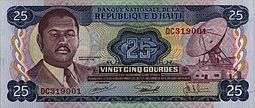

Origin
The name gourde ( gourde ) comes from the Spanish gordo - thick, bold. So the French colonialists called the peso or circles (sectors) cut from it, which made up 1/5 of the whole coin. Such money was in circulation in all the French colonies of the West Indies . The word "gourde" comes from the Spanish expression peso gordo, that is, "heavy peso." So the Spaniards called the money minted for circulation in colonies throughout the West Indies [1] .
Coins
Coins of Haiti, despite their primitiveness, still have a rather interesting design. So, on the obverse of coins in denominations of up to 50 centimes inclusive, a portrait of the country's national hero during the American invasion of 1915 - Charlemagne Peralta is depicted. On the obverse of a coin with a denomination of 1 gourde, a drawing of the Laferrier fortress is minted, and in 5 gourdes there are portraits of four leaders of the Haitian state at different periods of history: General Toussin-Louverture , Henri Christophe , Jean-Jacques Dessalin and Alexander Petion . The name of the state is minted in the upper part of the obverse of the coin, and a series of coins issue in the lower part. The national emblem of the country, the digital face value of the coin and the national motto of the country are minted on the reverse of Haiti's coins of all merits. Coins with a nominal value of up to 50 centimeters inclusive have a regular round radial shape and are made of nickel-plated steel, and coins of 1 and 5 gourde denominations are made in the form of a regular heptagon and are made of steel coated with bronze. All Haiti coins are minted at the factories of the American Mint Franklin Mint, USA
Minor tourists arriving in Haiti can only exchange their currency for local currency in the capital of the country, Port-au-Prince, and even then only at state exchange offices registered with the Bank of the Republic of Haiti. Changing money from private money changers is categorically not recommended due to the high probability of fraud. It is worth noting that in the country, due to the crisis, the American currency has a parallel circulation. By decision of the Haitian government, the US dollar is officially recognized as the second currency, which has the status of national.
The Age of Duvalier
Duvalier in Bonistics
| Papa Doc at 1 Haitian Gourde, 1979 | Papa Doc on the 5th Hills, 1979 | ||
Captures of Unwanted Portraits in 1986
The “seals” on the Haitian gourds were made immediately after the fall of the pro-American regime of baby Doc Duvallier taunton -makut . The overprint consisted of a red circle with a cross that crosses it diagonally and the date printed below for the end of the Duvalier regime ( February 7, 1986 ) is red.
The overprint covered the images of Baby Dock and his father Papa Doc , who were subsequently replaced by images of historical figures who left the best memory in the history of the Republic of Haiti - for example, Tussen-Louverture .
Banknotes of the main circulation of the 1989 and 2004 series
In circulation are banknotes in denominations of 1 , 2 , 5 , 10 , 25 , 50 , 100 , 250 , 500 and 1000 gourdes of various series and years of issue. However, small denominations of 1, 2, 5 gourdes denominations are extremely rare.
| 1989 series | |||||||
|---|---|---|---|---|---|---|---|
| Picture | Face value (gourdes) | Dimensions (mm) | The main colors | Description | Year | ||
| Obverse | Reverse | Obverse | Reverse | ||||
Collectible Banknote Editions
| 2004 Commemorative Series | |||||||
|---|---|---|---|---|---|---|---|
| Picture | Face value (gourdes) | Dimensions (mm) | The main colors | Description | Year | ||
| Obverse | Reverse | Obverse | Reverse | ||||
Exchange Rate Mode
| Market rate | ||||||||
|---|---|---|---|---|---|---|---|---|
| ||||||||
Notes
- ↑ CH, 1993 , Gourde .
Sources
- Dictionary of numismatists / [Authors: Fengler H., Girow G., Unger V.] / Per. with him. M. G. Arsenyeva / Resp. ed. V.M. Potin. - 2nd ed., Revised. and additional .. - M .: Radio and communications, 1993. - ISBN 5-256-00317-8 .
See also
- Economy of the Republic of Haiti