Boleslaw I the Brave ( Polish Bolesław I Chrobry , also Boleslaw I the Great ( Polish Bolesław I Wielki ); 965 , 966 or 967 [1] - June 17, 1025 ) - Prince (992-1025) and the first king of Poland (1025), Prince of the Czech Republic in 1003-1004 (under the name Boleslav IV ; Czech. Boleslav IV ). Representative of the Piast Dynasty.
| Boleslav I the Brave | |||||||
|---|---|---|---|---|---|---|---|
| Bolesław i chrobry | |||||||
 Boleslav I the Brave, king of Poland. Rules 33 years. Painting by (1828) | |||||||
| |||||||
| Predecessor | Bag I | ||||||
| Successor | he himself as king of Poland | ||||||
| |||||||
| Predecessor | he himself as prince of Poland | ||||||
| Successor | Bag II | ||||||
| |||||||
| Predecessor | Boleslav III | ||||||
| Successor | Jaromir I | ||||||
| Birth | 965/966/967 is unknown | ||||||
| Death | June 17, 1025 is unknown | ||||||
| Burial place | Cathedral of Saints Peter and Paul , Poznan , Poland | ||||||
| Kind | Pasterns | ||||||
| Father | Bag I | ||||||
| Mother | Dubravka | ||||||
| Spouse | 1st: the unknown daughter of Rikdag, Margrave of Meissen; 2nd: ; 3rd: ; 4th: Oda Meissen | ||||||
| Children | From the 2nd marriage: Bezprim From the 3rd marriage: sons: Sack II , Otto daughters: NN, From the 4th marriage: | ||||||


Content
- 1 Biography
- 1.1 Youth
- 1.2 Management Board
- 1.2.1 The First Years (992–999)
- 1.2.2 Gniezno Congress and its consequences (999-1002)
- 1.2.3 Expansion (1002-1019)
- 1.2.4 Recent years (1019-1025)
- 1.3 Family
- 1.3.1 Marriage and children
- 1.3.2 Ancestors
- 1.4 Characteristic
- 2 Boleslav I the Brave in Art
- 3 notes
- 4 Sources and literature
- 4.1 Sources
- 4.2 Literature
Biography
Youth
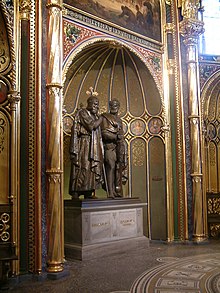
Boleslav was born into the family of the Polish prince Meshko I and the daughter of the Czech prince Boleslav I of Dubravka Bohemian [2] . His Epitaph, written presumably during the reign of Meshko II , emphasizes that Boleslav was born before his father’s baptism [3] [4] . On the contrary, in other historical monuments, such as, for example, the Chronicle of Titmar of Merseburg or the chronicle and acts of princes or rulers of Poland , it is clearly stated that Boleslav was born after the baptism of his father [5] . Boleslav himself, according to the epitaph, was baptized shortly after birth [6] . The question of the exact date of birth of Boleslav is also not resolved. In the Little Poland annals it is indicated that Boleslav was born in 967 [7] . If you believe the epitaph, it turns out that Boleslav was born in 965/966 [comm. 1] . It is also said in the epitaph that Boleslav underwent a tonsure ceremony and a lock of his hair was sent to Rome [6] . Meshko probably wanted to protect his son with the help of the Holy See [6] [8] . The historian Tadeusz Manteifel wrote that this was due to the fact that Boleslav appeared at the court of the Holy Roman Emperor Otto I as a sign of devotion to the Emperor [8] , but this statement is disputed [9] . There is also an assumption that Boleslav was sent to the court of the emperor and did as a hostage, guaranteeing the payment of debt for Pomerania .
In 977, Boleslav’s mother, Dubravka, died [10] . and soon Meshko I married Ode Dietrichovna , daughter of Margrave of the Northern Mark [11] . Around the same time, Boleslav became the ruler of Lesser Poland . Historian Jerzy Strzelszczzyk wrote that Boleslav received this region from his father, but Manteifel Tadeusz believed that Boleslav captured the province with the support of local aristocrats. Henryk Lovmyansky wrote that the Czech prince Boleslav II presented this region to his nephew [12] .
Board
The early years (992–999)
On May 25, 992, Meshko I died [13] . Titmar of Merseburg wrote that "he moved away from this foreign land to heaven, leaving his state divided into a number of destinies," but Boleslav united the country with "fox cunning" and expelled his half-brothers and stepmother from the country. Two Polish aristocrats, Odlilen and Przibiva, who supported the opponents of Boleslav, were blinded by his order [13] . It is assumed that Boleslav established full control over Poland either in 992 [14] or only at the end of 995 [15] .
The first coins under Boleslav were minted in 995 [16] . Some of them had the inscription VENCIEZLAVUS, which suggests that Boleslav considered his mother’s uncle, Vaclav I , as the patron saint of Poland [17] . In 992, Boleslav sent reinforcements in her struggle against the Slavic Slavs [18] . Three years later, he personally stood at the head of the army and came to the aid of the Germans, who invaded the territory with Lutich and encouraged [19] . During the campaign, he met with the young German emperor, Otton III [20] .
, the head of the Czech Slavnikovich dynasty, also took part in a campaign against the Lutichs and the encouragement [21] . Taking advantage of the absence of Sobeslav, the Czech prince Boleslav II seized the territory of the Slavnikovichi and destroyed most of the family members [22] . Having learned about the fate of his relatives, Sobeslav fled to Poland [23] [15] . Boleslav also gave shelter to his brother Sobeslav, the former Prague archbishop Adalbert , who came to Poland in 996, since Boleslav was peacefully disposed towards him [24] . Adalbert's biographers suggest that he was closely acquainted with Boleslav [25] . In the spring of 997, he went to preach Christianity among the Prussians who plundered the eastern lands of Poland [26] [25] . On April 23, Adalbert died at the hands of the Prussian pagans near modern Kaliningrad [25] . After some time, Boleslav bought the remains of the bishop, and the weight of the gold paid for the body was equal to the weight of the body, and reburied it in the Cathedral of the Assumption of the Blessed Virgin Mary in Gniezno [9] [25] [27] .
Gniezno Congress and its consequences (999-1002)
On July 29, 999, Saint Adalbert was canonized at the request of Emperor Otto III [25] [28] . At the beginning of the year 1000, Otton, together with the papal legate Robert, made a pilgrimage to Gniezno, where Adalbert was buried. Titmar of Merseburg wrote in his chronicle that “they would not believe who they were told” how Boleslav received the German emperor in Gniezno [29] .
Boleslav greatly benefited from the visit of the emperor [30] . Gall Anonymous emphasized in his chronicle that Otton called Boleslav “his friend and partner” , as well as “friend and ally of the Roman people” [5] . Thus, the Polish state turned out to be an independent state equal to the Holy Roman Empire when, as neighboring Moravia, by that time it was in vassal dependence on Germany. Gall also writes that:
Seeing his [Boleslaw] fame, power and wealth, the Roman emperor exclaimed with admiration: "I swear by the crown of my empire, everything that I see is superior to what I heard." On the advice of his magnates, in the presence of all, he added: “It is not appropriate to call such a great husband a prince or count as one of the dignitaries, but he must elevate him to the royal throne and crown it with glory.” And, having removed the imperial crown from his head, he laid it on the head of Boleslav as a sign of friendship and presented him with a nail from the cross of the Lord and the peak of St. Mauritius, for which Boleslav, for his part, gave him the hand of St. Adalberta
Chronicle of Gall Anonymous [5] .
During his stay in Poland, Otton created an archbishopric in Gniezno, the first archbishop of which was the brother of the murdered Adalbert, . At the same time, bishoprics were created in Wroclaw , Krakow and Kolobrzeg . However, for the sake of all this, Boleslav was forced to agree to pay St. Peter's denarius [30] . However, one of the hierarchs, , the bishop of Poznan, was directly subordinate to the archbishop of Magdeburg. Otton received rich gifts from Boleslav, including 300 knights. After the congress, Boleslav escorted the Emperor all the way to Magdeburg, where they celebrated Palm Sunday on March 24th [29] .
Expansion (1002-1019)
At the end of January 1002, Emperor Otton III died in the castle of Paterno (Italy). The emperor was childless, and therefore with his death the question of a successor arose sharply. One of them, Henry IV of Bavaria, promised Boleslav the Brave the Margraine of Meissen in exchange for help in the fight against Eckhard I Meissen , who was one of the most serious opponents of the Bavarian duke [31] . However, on April 30, 1002, Eckhard was killed [32] , shortly after which Henry was chosen king of Germany [33] . At the same time, Boleslav decided to use the chaos created in Meissen after the death of a relative, and already in April invaded Luzitsa and Meissen and seized all these lands [34] . At the end of July, Boleslav attended [35] a meeting of Saxon aristocrats in Merseburg , where the new emperor Heinrich, contrary to Boleslaw’s wishes, gave Meissen to Eckhard’s brother, Gunzelin [36] , and Boleslav received the Luzhitsa and lands in flax. Stay in Merseburg was overshadowed by a conspiracy - some of the German knights decided to attack the retinue of the Prince of Poland and only with the help of Bernhard the Saxon bloodshed was avoided. Boleslav accused Henry of conspiracy, and on the way home he ordered the Strela fortress to be burned [36] .
In 1003, the radar and the Lutichs, who were very afraid of Boleslav, sent an embassy to the King of Germany to Quedlinburg and entered into an alliance with the Germans against the Polish prince [37] . At the same time, Boleslav was able to take possession of the Bohemian throne. In 1002, the Bohemian prince Boleslav III was expelled from the country and came to power in Vladiva [38] , whose origin is not entirely clear. It is assumed that he captured the Czech throne with the help of Boleslav the Brave [39] . However, Vladiva soon died [40] and the brother of Boleslav III, Jaromir , appeared on the throne. The ousted Czech prince himself found help and support from Boleslav the Brave, who in 1003 invaded Bohemia and returned Boleslav III to the throne [40] . The prince returned to the throne began brutally cracking down on his opponents. The surviving nobles sent ambassadors to Boleslaw the Brave with a request to rid them of such a ruler [41] . The Polish prince willingly agreed and soon invaded Bohemia, and in March 1003 entered Prague and proclaimed himself prince of the Czech Republic. Boleslav III, by order of the new prince, was blinded [41] . Henry II, king of Germany, had no opportunity to fight Boleslav, because at that time he suppressed the rebellion raised by his brother Bruno and Margrave Heinrich Schweinfurt in Bavaria, and therefore he sent an embassy to him with a proposal of friendship and approval of the title of Prince of the Czech Republic [37] . However, Boleslav decided to support the opponents of Henry and soon invaded Meissen, captured all Margrave, except for the capital held by Gunselin [42] . At the same time, Upper Hungary (present-day Slovakia) was probably annexed to Poland [43] .
In February, the combined forces of the Germans and Germans, under the command of Henry II, invaded the Puddle and captured it, but heavy snowfall forced the Allies to retreat [44] . However, after this, Henry was able to deceive Boleslav, who concentrated his forces in the Puddles, while Henry invaded Bohemia in August 1004 [45] . Along with this, an anti-Polish uprising began in all of Bohemia. Prague was surrendered without resistance; On September 8, the blinded brother of Boleslav III, Jaromir, was proclaimed prince of Bohemia. During this company, Boleslav’s ally, Sobeslav from the Slavnikovich dynasty, died [44] . Thus, Boleslav, who used enormous funds to conquer Bohemia, was able to hold her for no more than a year. Since that time, the Principality of Bohemia has become a faithful ally of Germany in all its wars with Poland [46] .
In August of the following year, Henry re-assembled the army (the army was assembled in Leska, near Magdeburg) and led it to Poland. In Luzitsa, near Dobroług, he was joined by the Bohemian army led by Jaromir and the Bavarian troops led by Henry V of Bavaria [47] . The Polish army, led by Boleslav, was located in Krosno (now Krosno-Odzhansk ), near the confluence of the Bubr and Oder rivers, and the enemy army was on the other side of the Oder, where they were also joined by the Lutichs [47] . For 7 days, the Germans tried to cross the river and only on the eighth day did they find a ford and transferred the entire army across the river. Having learned about this, Boleslav began a quick retreat [48] . Henry led the army to Poznan [49] , the Polish prince was forced to ask for peace. The terms of the peace treaty are unknown, but, apparently, Boleslav lost Luzitsa and Meissen, and also refused the rights to the throne of Bohemia, but Moravia remained with Poland [50] .
However, Boleslav did not intend to stop the fight. Gathering new forces, he also began to send his people to the buttercups, Czechs and Luzhans, trying to attract them to the union. However, all his attempts were in vain - all of them sent an embassy to the German king in Regensburg, which informed Heinrich about the machinations of Boleslav the Brave [51] . They also said that they would not obey him [Henry] if he remained at peace with Boleslav [51] . After conferring with the princes, Henry sent to Boleslav German , the groom of his daughter, , in order to inform about the termination of the peace treaty of 1005. Having learned in advance about the embassy, Boleslav badly received his son-in-law. According to the Chronicle of Titmar of Merseburg, Boleslav:
... having received a tale from him [from Herman], he rather verbally tried to justify himself: “Let,” he says, “Christ, the witness of everything, knows that I will do everything that I will do against my will” [51]
Soon after, Boleslav invaded the territory between the Elbe and Oder rivers and ravaged the lands of the Magdeburg Archbishopric. Boleslav took away the inhabitants of the city of Zerbst [51] . The German army commander here was the Archbishop of Magdeburg Tagino, according to the chronicles of Titmar Merseburgsky, he prepared poorly for the campaign, and, having reached the town of Uterbog, he returned completely, fearing to pursue “enemies with so few [warriors]” [51] . After this raid, Boleslav again occupied Lauzits, Sorau and Selpouli (modern Nieder-Lauzits, East-Nieder-Lauzits and Beeskov), and then besieged Bauzen, who belonged to his son-in-law [52] . Boleslav ordered to inform via ambassadors that he would not like bloodshed and was ready to accept the fortress without a fight. Thus, Margrave German Meissensky won a seven-day truce. He himself broke out of the encirclement to ask for help from Magdeburg and Saxony. He unsuccessfully sent messengers in all directions, while the situation around the fortress, despite the truce, was getting worse. In the end, the garrison of the fortress asked Boleslav to give them the opportunity to calmly leave and handed the fortress into his hands [52] .
Only three years later, after Easter 1010, Henry II announces a campaign against Poland. However, the German king tried to settle the matter peacefully - the Duke Bernhard and Archbishop were sent to Boleslav, however, having achieved nothing, they returned back [53] . During the campaign, the king fell ill and as a result a decision was made - Henry returned with the sick, and Bishops Arnulf and Meinwerk , with Prince Jaromir, Margraves of Hero and German, as well as many others, would devastate Schlesiergau and Diadesi [54] . The Polish prince himself, observing what was happening from the walls of the Glogau castle, decided not to get involved in the battle:
The army that you see is small in number, but great in valor and is the most selected among other units. If I attack him, whether I win or be defeated, I will still become weaker than now. The king has the opportunity to immediately assemble another army. It will be much better if we miss it, and another time, when there is an opportunity, we will harm these proud people without big losses for us.
Chronicle of Titmar of Merseburg [54] .
Even despite the rains, the Germans and Czechs inflicted great damage to the enemy, safely returning [54] . In July 1012, Valtard again set off for negotiations with Boleslav, initiated by the Polish prince himself. After staying with him for two days, Valtard left, albeit richly gifted, but did not achieve any results [55] . On August 12, 1012, Valtard died [56] , and Boleslav, learning about this, and also knowing that no one could help his enemies due to the spill of the Elbe, gathered an army, invaded Luzhitsa and besieged the Lebuz fortress. On August 20, the fortress was taken, almost the entire population was exterminated or taken prisoner, the fortress itself was looted and burned. After this, Boleslav returned back [57] .
Queen Kunigunda, who was then in Merseburg, immediately ordered the royal army to prepare for the eastern borders. Henry II, after receiving disturbing news, returned from the western borders [58] .
In January 1013, ambassadors from Boleslav arrived at Heinrich, proposing to make peace [59] . Shortly afterwards, the son of Boleslav, Meshko [60] , who apparently conducted preliminary negotiations on peace [61], arrived at the king. On the eve of the Trinity, Boleslav arrived in Magdeburg, where Henry was, [62] . On May 24, 1013, he swore an oath to the German king. According to the terms of the world, Boleslav received Lausitz and the Milzenov region as imperial linen, and also undertook to accompany him on a campaign to Rome for the imperial crown, while Henry undertook to provide Boleslav with 500 knights for the campaign to Kiev [62] [61] . New kinship relations were called upon to guarantee a peace: the daughter of the Palatinate of the Lorraine Ryks entered into marriage with the son of Boleslav Meshko [63] . The success of the negotiations was greatly facilitated by the fact that the attention of Boleslav was attracted by Russian affairs, and Henry was preparing to march on Rome [61] .
In the same year, the daughter of Boleslav the Brave (the name was not preserved) married the Turov prince Svyatopolk Vladimirovich . Together with her, the former Kolobrezh bishop Rainburn went to the groom. However, in the same year, Svyatopolk, his wife and Rainburn, who were preparing an uprising against Prince Vladimir Svyatoslavich , were arrested. Svyatopolk was also removed from the inheritance of the Kiev throne [64] . The joint campaign of Boleslav and the Pechenegs was a response to Vladimir’s step, however, the Allies quarreled and Boleslav ordered the Pechenegs to be killed, after which he returned to Poland [62] [65] .
It is important to note that 500 German knights took part in the campaign against Russia, however, despite this, Boleslav did not fulfill his promises to take part in the campaign against Rome. In 1014, Boleslav sent his son Meshko to the Czech prince Oldřich for negotiations. Boleslav wanted to conclude an alliance against the Empire with Oldrich, but Meshko failed to achieve success - part of his retinue was killed, the son of the Polish prince himself, along with another part of the retinue, was captured [66] . However, soon Meshko fell into the hands of the German emperor, who freed him for a small ransom and invited Boleslav to a meeting of the princes in Merseburg [67] , however, the Polish prince did not appear there, sending there as representatives of Margrave German Meissensky and ambassador Stoynef [68] . On April 10, 1015 in Merseburg, the emperor confiscated the Polish prince of the Misnensky and Luzhitsky regions and in July 1015 he again opposed him [69] .
In July, Henry launched an invasion of Polish lands. The allies of the emperor were the tribes of “godless” Lutichs and the Czech Republic [70] . It was assumed that the emperor would come from Magdeburg through Puddle to Crossen, where the other two armies, Bernhard of Saxony and Prince Oldrich, were to unite. On August 3, 1015, the emperor crossed the Oder near Krossen and defeated a Polish detachment led by the son of Boleslaw Mieszko: “Six hundred Poles were killed, while the imperial forces suffered only minor losses,” Titmar Merseburgsky writes [71] . At the same time, the troops of Bernhard of Saxony with their allies (including the Lutichs) attacked the army of Boleslaw under Küstrin , and therefore the Polish prince could not come to the aid of his son. However, neither the northern army, together with the Lutches under the command of the duke, nor the southern army of Bohemians and Bavarians under the command of Prince Oldrich, who invaded Silesia and seized the royal fortress and castle at Gerlitz, could not connect with the emperor, so that the rearguard of the army was utterly impaired broken. One of the groups of the main forces of the German army was surrounded and lost about two hundred people killed [72] . After the retreat of the German knights, Meshko managed to capture the Meissen Unterburg, and only at the cost of great efforts did he keep the fortress of Oberburg. Pursuing the randomly retreating troops of Henry II, the Poles, led by Meshko, again crossed the Elbe and burned the lower city of Meissen [73] .
The situation in Poland was complicated when, in 1017, hostilities against him began Yaroslav the Wise , who expelled Svyatopolk Vladimirovich from Kiev, however, the actions of Yaroslav were not particularly vigorous [74] . In the summer of 1017, Henry decided on a new campaign against Poland. After gathering at Leitzkau on the Elbe, Emperor Heinrich sent Heinrich of Bavaria to Boleslav with an intermediary mission, but Boleslav rejected all the emperor's proposals [75] . Henry II stood with the army in front of the Glogau fortress, where Boleslav the Brave was entrenched. Meanwhile, Boleslav’s son, Meshko, raided the Czech Republic [76] , which remained defenseless, since the Duke of Oldrich with his army was next to the emperor. The emperor refused the open battle proposed by Boleslav and withdrew his forces at the end of July to the Nimpch fortress, southeast of Zobten , in Silesia [76] . But since the besiegers could not break the resistance of the defenders of the fortress supported by Boleslav, the siege soon had to be lifted. As a result, the emperor returned to Saxony and again the campaign against Boleslav did not succeed. During the retreat, the German army suffered significant losses [77] .
Finally, the Saxon princes assisted the emperor in concluding peace with Boleslaw on January 30, 1018 in Bautzen (on the territory of the Polish Principality [74] ). Both sides were tired of a long and futile struggle [74] . The representative delegation sent with the diplomatic mission to negotiate with Boleslav was headed by Archbishop Hero of Magdeburg . The negotiating partners agreed to the terms accepted as far back as Trinity 1013 in Merseburg. Boleslav retained the Puddle and land of the inhabitants of Milan, however, the nature of ownership of these lands (whether they were imperial flax or were directly included in Poland) is controversial. Judging by the fact that Titmar of Merseburg wrote that the world was concluded “not as it should, but as it was then possible” [78] , for the emperor it was a necessary step that did not fully meet the goals of his policy. As guarantees of peace, Boleslav took the fourth wife, Oda , daughter of Margrave Ekkehard Meissenski [78] . The Reich also committed to supporting the military campaign against Russia. Around the same time, peace was concluded with Germany's ally, Hungary. The conditions of the world are controversial - some authors argue that, according to the conditions of the world, Boleslav lost Upper Hungary (modern Slovakia) [79] , while others argue that this happened much later - under Meshko II [80] .
After that, Boleslav again turned his eyes to the east - to Kievan Rus. В его планы входило восстановление на Киевском престоле Святополка Владимировича, потерпевшего поражение в борьбе за власть со своим братом — Ярославом, а также захват Червенских городов , чрез который проходил важнейший торговый путь восточной Европы, связывавший Киев с Краковом и Прагой [63] . Также в походе участвовали 300 немецких рыцарей, 500 венгерских воинов и 1000 печенегов [81] . Ярослав же, собрав свой войско, двинулся навстречу Болеславу. Два войска встретились на Западном Буге и в результате сражения войско киевского князя было разбито. Ярослав бежал, а дорога на Киев была открыта. 14 августа 1018 года Болеслав и Святополк вступили в столицу Киевской Руси, поразившую поляков и немцев [82] . Взятию Киева предшествовали набеги на город печенегов [81] . Во время своего пребывания в Киеве Болеслав отправил Генриху II посольство с сообщением о благополучном завершении войны и желании и впредь сотрудничать. Также посольство было отправлено и византийскому императору Василию II [83] .
Обстоятельства возвращения Болеслава из похода туманны. В Повести временных лет говорится об изгнании поляков в результате восстания киевлян, однако в Хронике Титмара Мерзебургского, напротив, говорится об успешном возвращении Болеслава из похода [84] . Титмару Мерзебургскому вторит Галл Аноним, который пишет, что « [Болеслав] поставил там в Киеве на свое место одного русского, породнившегося с ним [комм. 2] , а сам с оставшимися сокровищами стал собираться в Польшу.» [5] С собой Болеслав увёз богатую добычу и множество пленных, а также, согласно Хронике Титмара Мерзебургского, Предславу Владимировну , любимую сестру Ярослава, которую он взял в наложницы [85] . Также по пути в Польшу Болеслав захватил Червенские города. Захват этих городов стал последним крупным военным успехом Болеслава [86] .
Последние годы (1019—1025)
Последние 6 лет правления Болеслава Храброго описаны в источниках крайне скудно [87] , что резко контрастирует с предыдущими периодами правления этого князя. Эти годы отмечены рядом внутри политических и внешнеполитических неудач, которые при Мешко II, Безприме и Болеславе Забытом обратятся в мощный кризис, едва не приведший к падению польского государства [87] .
В 1025 году состоялась коронация Болеслава — он стал первым польским королём. Однако дата коронации до сих пор вызывает споры.
Family
Marriage and children
Первой женой Болеслава была дочь маркграфа Мейсена Рикдага . Историк Тадеуш Мантейфель писал, что свадьба была инициирована отцом Болеслава и произошла в первой половине 980-х годов [88] . Впрочем, вскоре Болеслав отослал её назад, согласно хронике Титмара Мерзебургского [13] . Историк Марек Казимеж связывал это со смертью её отца в 985 году [89] .
Затем он женился на «венгерке» по выражению Титмара Мерзебургского [13] , которую большинство историков отождествляют с , дочерью великого князя мадьяр . Она родила Болеславу сына, наречённого Безпримом , впрочем, брак также был расторгнут [13] .
Третьей женой Болеслава стала , дочь лужицкого князя Добромира . Свадьба произошла приблизительно в 988 году [90] . Эмнильда оказала на мужа благотворное влияние, как свидетельствует Титмар Мерзебургский [13] . Старшая дочь Болеслава стала аббатисой, вторая дочь — , вышла замуж за графа Германа Мейсенского, а третья дочь, имя которой неизвестно, стала женой Святополка Окаянного [комм. 3] . В 990 году Эмнильда родила сына, которого назвали Мешко. Спустя 10 лет Эмнильда родила ещё одного сына, которого назвали Отто [комм. 4] [13] .
В качестве гарантий условий Будишинского мира, заключённого 30 января 1018 года, Болеслав взял в жёны Оду , дочку маркграфа Мейсенского [78] . К этому времени третья жена Болеслава, Эмнильда, по всей видимости уже умерла [91] . От этого брака была рождена . Кроме того, захватив Киев 14 августа 1018 года , Болеслав насильно взял в наложницы Предславу Владимировну , любимую сестру Ярослава Мудрого , к которой ранее сватался и получил отказ, а затем, покидая Киев, увёз её в Польшу. Согласно Титмару Мерзебургскому , Болеслав придал этому союзу видимость очередного брака (хотя уже был женат) [92] [85] .
Предки
Feature
Современники, даже противники, единогласно характеризуют Болеслава как умного, хитрого и искушённого политика. Русский летописец говорит, что Болеслав «бяше смысленъ», очень не любивший его Титмар Мерзебургский подчёркивает «лисью изворотливость» польского князя. В молодости Болеслав прославился доблестью в сражениях и получил прозвище Храброго; смелость и выдержка не изменила ему и в поздние годы, когда он, будучи очень тучен, уже не мог седлать коня и лично вести войска в бой. Начала польской государственности, заложенные при Болеславе, пережили временную анархию после его смерти и оказались долговечными.
Болеслав I Храбрый в искусстве
- В литературе
Молодой князь Болеслав является одним из героев романа Александра Мазина «Золото старых богов» (2017).
Морозоустойчивый фиолетовый рододендрон назван в честь Bolesław Chrobry.
Имя Болеслав I Храбрый встречается в игре «Age of empires 2 The forgotten».
Notes
- Comments
- ↑ Дубравка, мать Болеслава, прибыла в Польшу именно в 965 году (согласно Малопольской Хронике).
- ↑ Речь, по-видимому, идёт о Святополке Владимировиче, который был женат на дочери Болеслава
- ↑ Титмар Мерзебурский пишет о ней (книга IV, 58) следующее: «а третья [дочь] стала женой короля Владимира» , что очевидно является ошибкой.
- ↑ Титмар Мерзебурский пишет о нём (книга IV, 58), что он был назван именем любимого господина Болеслава. По всей видимости, под «любимым господином» Титмар имеет в виду Оттона, императора Священной Римской Империи.
- Notes
- ↑ А. В. Назаренко. Болеслав I Храбрый // Православная энциклопедия . — М. : Церковно-научный центр «Православная энциклопедия» , 2002. — Т. V. — С. 647—648. - 752 s. - 39,000 copies. — ISBN 5-89572-010-2 .
- ↑ Tymieniecki, 1936 , p. 248.
- ↑ Vlasto, 1970 , p. 115.
- ↑ Wiszewski, 2010 , p. 57, 60.
- ↑ 1 2 3 4 Галл Аноним. Хроника или деяния князей или правителей польских. — М.: АН СССР , 1961. Книга 1 . Архивировано 8 февраля 2012 года.
- ↑ 1 2 3 Wiszewski, 2010 , p. 63.
- ↑ Малопольские анналы // Переводы А. С. Досаева на сайте Восточная литература :
- ↑ 1 2 Manteuffel, 1982 , p. 51.
- ↑ 1 2 Barański, 2008 , p. 51, 60–68.
- ↑ Козьма Пражский . Чешская хроника . — М.: АН СССР , 1962. Книга 1 . Архивировано 8 февраля 2012 года.
- ↑ Титмар Мерзебургский. Хроника, кн. IV, 57.
- ↑ Wiszewski, 2010 , p. 8-9.
- ↑ 1 2 3 4 5 6 7 Титмар Мерзебургский. Хроника, кн. IV, 58.
- ↑ Wiszewski, 2010 , p. 47.
- ↑ 1 2 Pleszczyński, 2001 , p. 417.
- ↑ Berend, Urbańczyk, Wiszewski, 2013 , p. 145.
- ↑ Berend, Urbańczyk, Wiszewski, 2013 , p. 144—145.
- ↑ Хильдесхаймские анналы // Полный перевод по изданию в MGH 1878 года: от сотворения мира до 994 года
- ↑ Хильдесхаймские анналы // Полный перевод по изданию в MGH 1878 года: 995—999 годы
- ↑ Vlasto, 1970 , p. 124—125.
- ↑ Manteuffel, 1982 , p. 57.
- ↑ Manteuffel, 1982 , p. 57—58.
- ↑ Manteuffel, 1982 , p. 58.
- ↑ Wiszewski, 2010 , p. 13.
- ↑ 1 2 3 4 5 Manteuffel, 1982 , p. 60.
- ↑ Vlasto, 1970 , p. 125.
- ↑ Vlasto, 1970 , p. 104—105.
- ↑ Vlasto, 1970 , p. 105.
- ↑ 1 2 Титмар Мерзебургский. Хроника, кн. V, 45.
- ↑ 1 2 Thompson, 2012 , p. 21.
- ↑ Manteuffel, 1982 , p. 64.
- ↑ Титмар Мерзебургский. Хроника, кн. V, 6. — С. 77.
- ↑ Титмар Мерзебургский. Хроника, кн. V, 11. — С. 79.
- ↑ Титмар Мерзебургский. Хроника, кн. V, 9. — С. 78.
- ↑ Титмар Мерзебургский. Хроника, кн. V, 15. — С. 80.
- ↑ 1 2 Титмар Мерзебургский. Хроника, кн. V, 18. — С. 81-82.
- ↑ 1 2 Титмар Мерзебургский. Хроника, кн. V, 31. — С. 86-87.
- ↑ Титмар Мерзебургский. Хроника, кн. V, 23.
- ↑ Třeštík, 2011 , p. 78.
- ↑ 1 2 Титмар Мерзебургский. Хроника, кн. V, 29.
- ↑ 1 2 Титмар Мерзебургский. Хроника, кн. V, 30.
- ↑ Титмар Мерзебургский. Хроника, кн. V, 36.
- ↑ Makk, Ferenc. Magyar külpolitika (896–1196) ("The Hungarian External Politics (896–1196)") . — Szeged : Szegedi Középkorász Műhely, 1993. — P. 48–49. — ISBN 963-04-2913-6 .
- ↑ 1 2 Титмар Мерзебургский. Хроника, кн. VI, 2.
- ↑ Титмар Мерзебургский. Хроника, кн. VI, 10.
- ↑ Гильфердинг, 2013 , p. 516.
- ↑ 1 2 Титмар Мерзебургский. Хроника, кн. VI, 22. — С. 102.
- ↑ Титмар Мерзебургский. Хроника, кн. VI, 26.
- ↑ Титмар Мерзебургский. Хроника, кн. VI, 27.
- ↑ Королюк, 1957 , p. 156.
- ↑ 1 2 3 4 5 Титмар Мерзебургский. Хроника, кн. VI, 33.
- ↑ 1 2 Титмар Мерзебургский. Хроника, кн. VI, 34.
- ↑ Титмар Мерзебургский. Хроника, кн. VI, 56.
- ↑ 1 2 3 Титмар Мерзебургский. Хроника, кн. VI, 57.
- ↑ Титмар Мерзебургский. Хроника, кн. VI, 69.
- ↑ Титмар Мерзебургский. Хроника, кн. VI, 72.
- ↑ Титмар Мерзебургский. Хроника, кн. VI, 80.
- ↑ Титмар Мерзебургский. Хроника, кн. VI, 81.
- ↑ Титмар Мерзебургский. Хроника, кн. VI, 89.
- ↑ Титмар Мерзебургский. Хроника, кн. VI, 90.
- ↑ 1 2 3 Королюк, 1957 , p. 157.
- ↑ 1 2 3 Титмар Мерзебургский. Хроника, кн. VI, 91.
- ↑ 1 2 История Польши, 1954 , p. 49.
- ↑ Королюк, 1957 , p. 158.
- ↑ Королюк, 1957 , p. 159.
- ↑ Титмар Мерзебургский. Хроника, кн. VII, 10.
- ↑ Титмар Мерзебургский. Хроника, кн. VII, 11.
- ↑ Титмар Мерзебургский. Хроника, кн. VII, 9.
- ↑ Титмар Мерзебургский. Хроника, кн. VII, 12.
- ↑ Титмар Мерзебургский. Хроника, кн. VII, 17.
- ↑ Титмар Мерзебургский. Хроника, кн. VII, 18.
- ↑ Титмар Мерзебургский. Хроника, кн. VII, 21.
- ↑ Титмар Мерзебургский. Хроника, кн. VII, 23.
- ↑ 1 2 3 Королюк, 1957 , p. 160.
- ↑ Титмар Мерзебургский. Хроника, кн. VII, 57.
- ↑ 1 2 Титмар Мерзебургский. Хроника, кн. VII, 59.
- ↑ Титмар Мерзебургский. Хроника, кн. VII, 63.
- ↑ 1 2 3 Титмар Мерзебургский. Хроника, кн. VIII, 1.
- ↑ Клеванский, А. Х. и др. Краткая история Чехословакии. — М. : Наука, 1988. — 576 с.
- ↑ История Польши, 1954 , p. 51.
- ↑ 1 2 Титмар Мерзебургский. Хроника, кн. VIII, 32.
- ↑ Титмар Мерзебургский. Хроника, кн. VIII, 31.
- ↑ Титмар Мерзебургский. Хроника, кн. VIII, 33.
- ↑ Титмар Мерзебургский. Хроника, кн. VI, 65. — С. 160.
- ↑ 1 2 Назаренко А. В. Древняя Русь на международных путях. — С. 457—458.
- ↑ Королюк, 1957 , p. 164.
- ↑ 1 2 Королюк, 1957 , p. 165.
- ↑ Manteuffel, 1982 , p. 53.
- ↑ Barański, 2008 , p. 51, 60—68.
- ↑ Wiszewski, 2010 , p. 39.
- ↑ Назаренко А. В. Древняя Русь на международных путях. — С. 458—459.
- ↑ Титмар Мерзебургский. Хроника, кн. VIII, 32.
Sources and Literature
Sources
- Козьма Пражский . Чешская хроника . — М.: АН СССР , 1962. Книга 1 . Архивировано 8 февраля 2012 года.
- Титмар Мерзебургский . Хроника / Пер. с лат. И. В. Дьяконова. — 2-е издание, исправленное. — М. : SPSL — «Русская панорама», 2009. — 254 с. — (MEDIÆVALIA: средневековые литературные памятники и источники). — 1 500 экз. — ISBN 978-5-93165-222-1 .
- Галл Аноним . Хроника или деяния князей или правителей польских . — М.: АН СССР , 1961. Книга 1 . Архивировано 8 февраля 2012 года.
Literature
На русском языке:
- История Польши. Т. I / Под ред. В. Д. Королюка, И. С. Миллера и П. Н. Третьякова. — М. : Изд-во АН СССР , 1954.
- Назаренко А. В. . Древняя Русь на международных путях: Междисциплинарные очерки, культурных, торговых, политических отношений IX—XII веков. — М. : Языки Русской Культуры, 2001. — 784 с. — (Studia Historica). - 1000 copies. — ISBN 5-7859-0085-8 .
- Королюк В. Д. Древнепольское государство . — М. : Изд-во АН СССР , 1957. — 211 с.
- Королюк В. Д. О последнем периоде правления Болеслава Храброго // Славяне и восточные романцы в эпоху раннего средневековья . — М. : Наука , 1985. — 240 с.
- Гильфердинг А. Ф. История балтийских славян. Борьба славян с немцами на балтийском Поморье в средние века. — М. : Русская панорама, 2013. — 704 с. — (Возвращенное наследие). — ISBN 978-5-9316-5227-6 .
На иностранных языках:
- Barański, Marek Kazimierz. Dynastia Piastów w Polsce. — Wydawnictwo Naukowe PWN, 2008. — ISBN 978-83-01-14816-4 .
- Barford P. M. The Early Slavs: Culture and Society in Early Medieval Eastern Europe. — Cornell University Press, 2001. — ISBN 0-8014-3977-9 .
- Berend, Nora; Urbańczyk, Przemysław; Wiszewski, Przemysław. Central Europe in the High Middle Ages: Bohemia, Hungary and Poland, c. 900 — c. 1300. — Cambridge University Press, 2013. — ISBN 978-0-521-78156-5 .
- Davies, Norman. God's Playground: A History of Poland. Vol. I: The Origins to 1795 (Revised Edition) . — Columbia University Press, 2005. — ISBN 978-0-231-12817-9 .
- Manteuffel, Tadeusz. The Formation of the Polish State: The Period of Ducal Rule, 963–1194 (Translated and with an Introduction by Andrew Gorski) . — Wayne State University Press, 1982. — ISBN 0-8143-1682-4 .
- Pleszczyński, Andrzej. Poland as an Ally of the Holy Ottonian Empire // Europe around the Year 1000 / Ed. by P. Urbańczyk. — Wydawnictwo DIG, 2001. — ISBN 83-7181-211-6 . — P. 409—425.
- Reuter, Timothy. Germany in the Early Middle Ages, c. 800—1056. — Routledge, 2013. — ISBN 978-0-582-49034-5 .
- Rosik, Stanisław. Bolesław Chrobry i jego czasy [Bolesław the Brave and his Times] . — Wydawnictwo Dolnośląskie, 2001. — ISBN 978-83-70-23888-9 .
- Strzelczyk, Jerzy. Die Anfänge Polens und Deutschlands // Deutsche und Polen: Geschichte-Kultur-Politik / Ed. by A. Lawaty, H. Orłowski. — Verlag C. H. Beck, 2003. — ISBN 978-3-406-49436-9 . — P. 16—25.
- Tymieniecki, Kazimierz. Bolesław Chrobry // Konopczyński, Władysław. Polski słownik biograficzny. II: Beyzym Jan. — Kraków: Nakładem Polskiej Akademii Umiejętności, 1936. — ISBN 83-04-00148-9 .
- Thompson, James Westfall. Medieval German expansion in Bohemia and Poland // The Expansion of Central Europe in the Middle Ages / Ed. by N. Berend. — Ashgate Variorum, 2012. — ISBN 978-1-4094-2245-7 . — P. 1—38.
- Třeštík, Dušan. Great Moravia and the beginnings of the state (9th and 10th centuries) // A History of the Czech Lands / Ed. by J. Pánek, O. Tůma. — Charles University in Prague, 2011. — ISBN 978-80-246-1645-2 . — P. 65—79.
- Vlasto AP The Entry of the Slavs into Christendom: An Introduction to the Medieval History of the Slavs (англ.) . — Cambridge University Press , 1970. — 435 p. — ISBN 978-0-521-07459-9 .
- Wiszewski, Przemysław. Domus Bolezlai: Values and Social Identity in Dynastic Traditions of Medieval Poland (c. 966—1138). — Brill, 2010. — ISBN 978-90-04-18142-7 .
- Zamoyski, Adam. The Polish Way: A Thousand-year History of the Poles and their Culture. - Hippocrene Book, 1987. - ISBN 0-7818-0200-8 .