Mars-5 is the Soviet automatic interplanetary station of the M-73 series under the Mars program launched on July 25, 1973 at 18:55:48 UTC . The M-73 series consisted of four fourth-generation AWSs designed to study the planet Mars. The Mars-4 and Mars-5 spacecraft (modification M-73C) were supposed to enter orbit around the planet and provide communication with automatic Martian stations intended for operation on the surface. The descent vehicles with automatic Martian stations were delivered by the Mars-6 and Mars-7 spacecraft (modification M-73P). [one]
| Mars 5 | |
|---|---|
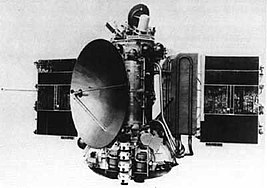
| Automatic interplanetary station "Mars-5" M-73C No. 53 | |
 | |
| Customer |  Soviet space program Soviet space program |
| Manufacturer | Machine-building plant named after S. A. Lavochkin |
| Operator | |
| Tasks | research from the orbit of the artificial satellite of Mars |
| Satellite | Mars |
| Launch pad | Baikonur 81/24 |
| Launch vehicle | Proton UR-500K / RB (SL-12) |
| Launch | July 25, 1973 18:55:48 UTC |
| Entry into orbit | February 12, 1974 15:45 UTC |
| Flight duration | 202 days |
| NSSDC ID | 1973-049A |
| SCN | 06754 |
| Specifications | |
| Weight | 2270 kg |
| Elements of the orbit | |
| Eccentricity | 0.7493 |
| Mood | 35.33 ° |
| Circulation period | 24.88 h |
| Apocenter | 32555 km |
| Pericenter | 1755 km |
The Mars-5 station, in contrast to the identical design of the Mars-4 AMS, successfully entered orbit around the planet, but immediately there was a violation of the tightness of the instrument compartment, as a result of which the station lasted only about two weeks. [2]
Content
Machine Design
The main structural element to which the units are attached, including the propulsion system, solar panels, parabolic pointed and unidirectional antennas, radiators of the cold and hot loops of the thermal management system and the instrument part, is the fuel tank unit of the propulsion system.
An important difference between the M-73C and M-73P modifications is the placement of scientific equipment on the orbital vehicle: in the satellite version, the scientific equipment is installed in the upper part of the tank unit, in the variant with the descent device, on a conical transition element connecting the instrument compartment and the tank unit.
For the expedition vehicles of 1973, KTDU is modified. Instead of the 11D425.000 main engine, 11D425A is installed, the thrust of which in the low-thrust mode is 1105 kg (specific impulse 293 seconds), and in the high-thrust mode - 1926 kg (specific impulse 315 seconds). The tank block has been replaced with a new one, of large dimensions and volume due to the cylindrical insert, while increased fuel consumable tanks have also been used. Additional helium cylinders for boosting fuel tanks were installed. Otherwise, the orbital vehicles of the M-73 series, with the exception of the layout and composition of the on-board equipment, repeated the M-71 series.
Mass
The total mass of the Mars-5 spacecraft was 4000 kg. The mass of the scientific equipment of the orbital apparatus (with FTU) is 117.8 kg. Corrective propulsion system is filled with 1705.2 kg of fuel: 594.9 kg of fuel and 1110.3 kg of oxidizer.
Scientific Instruments
The scientific instruments located at the Mars-5 station were intended primarily to study a number of the most important characteristics of the planet's surface and near-planet space from orbit.
The device was equipped with a Lyman alpha photometer, designed jointly by Soviet and French scientists, and designed to search for hydrogen in the upper atmosphere of Mars. A magnetometer mounted on board made measurements of the planet's magnetic field . An infrared radiometer , operating in the range of 8–40 microns , was intended to measure surface temperature . Surface texture characteristics were studied using two polarimeters .
Also, four photometers were installed onboard the Mars-5 AMS. The first analyzed the carbon dioxide bands of the infrared spectrum to determine the relief of Mars. The second worked in the range of 0.35-0.7 microns and was intended to study color and albedo . The third photometer, using a wavelength of 1.38 microns, analyzed the presence of water vapor in the atmosphere of Mars. The last, ultraviolet photometer in the range of 0.26-0.28 microns, was intended to search for ozone .
"Mars-5" was equipped with a photo-television image processing system, consisting of two cameras. One of them, called "Vega-3MSA" [2] , had a focal length of 52 mm and a viewing angle of 35.7 °. Another, Zufar-2CA, had a focal length of 350 mm and a viewing angle of 5.67 °. Images were taken through blue, red, green and optional special orange filters . The cameras provided a resolution of 100 m to 1 km.
Technological novelty of the project
For the first time in the practice of Russian cosmonautics, four automatic spacecraft simultaneously participated in one interplanetary expedition.
During the preparation of the expedition, the modernization of the ground experimental and test bases and the command-measuring ground complex, which began for the M-71 series vehicles, was continued. [3]
So, to check and clarify thermal calculations, special vacuum units equipped with simulators of solar radiation were created. An analogue of automatic spacecraft passed in them the full scope of complex thermal vacuum tests, the task of which was to test the ability of the temperature control system to maintain the temperature regime within specified limits at all stages of operation. [3]
Project Implementation
All spacecraft of the M-73 series have successfully passed the entire cycle of ground tests. Launches of these automatic spacecraft in accordance with the Soviet program for the study of outer space and planets of the solar system were carried out in July - August 1973. [3]
Booster
To launch the spacecraft of the M-73 series, a four-stage Proton -K launch vehicle with a launch mass of 690 tons, equipped with the same components as when launching the spacecraft of the M-71 series, was used.
Flight
Flight Control
To work with the spacecraft of the M-73 series, the Pluton ground-based radio complex located at NIP-16 near Yevpatoriya was used. When receiving information from spacecraft at long distances, to increase the potential of the radio link, the summation of signals from two ADU 1000 antennas (K2 and K3) and one KTNA-200 antenna (K-6) was used. The issuance of commands is carried out through antennas ADU 1000 (K1) and P 400P (K8) on the second site of NIP-16. Both antennas are equipped with Harpoon-4 decimetric transmitters capable of radiating power up to 200 kW. [3]
From the point of view of the spacecraft’s session control, some changes have been made to the logic of the onboard systems functioning: for the M-73P vehicles, the standard 6T session is designed to slow down and enter the orbit of the Mars satellite.
Flight program execution
The AMS “Mars-5” flight plan provided for three path corrections, braking near Mars and access to an elliptical orbit.
In 1971, the launch window of vehicles on Mars was more favorable. At that time, the Soviet Mars-2 and Mars-3 stations, as well as the American Mariner-9, were launched. Two years later, the relative position of the Earth and Mars required a higher flight speed. To ensure the required speed, the Soviet AMS needed to reduce the payload mass.
For the AMS, which started in 1973, the so-called two-start flight scheme was adopted, according to which the tasks of removing the artificial satellite and the descent vehicle were assigned to different types of stations. The mission of the Mars-5 AMC was to enter the orbit of Mars.
Mars-5 was launched on July 25, 1973 from the Baikonur Cosmodrome using the Proton UR-500K / RB (SL-12) launch vehicle . [1] [4] Start to Mars was carried out by the second turning on of the propulsion system of the upper stage D after ~ 1 hour and 20 minutes of passive flight in an intermediate low Earth orbit with a height of 177.5 × 163.3 km. At 23 hours 14 minutes 52.2 seconds, the spacecraft separated from the upper stage.
Having made three trajectory corrections and braking near Mars, the AMS entered orbit around Mars on February 12, 1974 . However, immediately after this, depressurization of the instrument compartment of the orbital block was discovered, in which electronic blocks of office systems and scientific equipment were located. The developers suggested that during the braking phase or immediately after it, the apparatus collided with a micrometeor. Calculations showed that the AMS will be able to work no more than three weeks.
In connection with a significant reduction in the life of the station in orbit, the hasty implementation of a scientific program was begun. The photo telemetry cameras managed to use up 108 frames out of the available 960. Due to the rush, many frames were not successful. In total, 43 images of normal quality were obtained with the Mars-5 AMS, including 15 using the short-focus Vega-3MSA and 28 using the long-focus Zufar-2CA. The last communication session was carried out on February 28, 1974 . [2]
Results
The Mars-5 spacecraft flight program has not been fully implemented.
However, despite the short period of active existence of the Mars-5 spacecraft, during the interplanetary flight and from the ISM’s orbit, the following observations and measurements were carried out with its help:
- during the flight along the Earth – Mars route with the help of ion and electron spectrometers, measurements were made of the energy of solar wind particles, particle composition, temperature and speed of individual components of the solar plasma;
- two-frequency radio illumination of the Martian atmosphere was carried out, estimates of the pressure in the lower atmosphere, as well as the characteristics of the planet's ionosphere, were obtained;
- shooting of the surface of Mars using FTU (108 frames) and telephotometers (4 panoramas);
- studies of surface and soil properties by their radiation characteristics were carried out, gamma radiation spectra of Martian rocks were obtained;
- Using an infrared radiometer, the brightness temperature of the soil was measured along the satellite flight path;
- using an infrared spectrophotometer, several hundred spectra were obtained in the range from 2 to 5 μm, with the help of which the composition of the Martian soil and its structure were determined;
- measured the content of water vapor in the atmosphere of Mars;
- Using a photometer, the presence of ozone in the atmosphere of Mars was detected;
- detailed data on the temperature of the upper atmosphere of the planet were obtained;
- The parameters of interplanetary magnetic fields and the magnetic field of Mars were measured.
See also
- Mars-4 is a Soviet automatic interplanetary station from the M-73 series.
- Mars-6 is a Soviet automatic interplanetary station from the M-73 series.
- Mars-7 is a Soviet automatic interplanetary station from the M-73 series.
- List of spacecraft with x-ray and gamma detectors on board
Notes
- ↑ 1 2 Mars 5 (NSSDC ) . Date of treatment October 14, 2011. Archived March 22, 2012.
- ↑ 1 2 3 Project for movement and development. Appendix to the "Bulletin of the Far Eastern Federal District" . Date of treatment December 6, 2008. Archived on August 21, 2011.
- ↑ 1 2 3 4 Spacecraft of the Mars-71 series NPO named after S. A. Lavochkina (unavailable link) . Date of treatment August 20, 2012. Archived July 23, 2015.
- ↑ Launch vehicle “Proton-K” UR-500K . Date of treatment December 7, 2008. Archived March 22, 2012.
Links
- AMC series M-73 on the website of the NGO named after Lavochkina (inaccessible link) . Date of treatment August 20, 2012. Archived July 23, 2015.
- VG Perminov The Difficult Road to Mars AMC Developer Memories Mars and Venus
- TSB Yearbook 1975
- Mars 5 on NASA
- Mars 5 at NASA's Solar System Exploration