Amiga is a family of home personal computers and their operating systems , developed by Amiga Corporation .
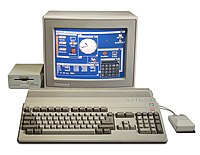
Content
- 1 History
- 2 Model range
- 3 See also
- 4 notes
- 5 Literature
- 6 References
- 6.1 Russian-speaking
- 6.2 International
History
Computer development began in 1982 , in the city of Los Gatos ( California , USA ). In addition to the $ 7 million that it was decided to spend on self-financing, the developers had considerable experience in designing both hardware and software: one of them, Jay Miner , was a developer of specialized microchips for home computers, the other, Erji Mikel, was a well-known programmer Williams companies; Dave Morse and Carl Sasenres were also not newcomers. The goal was to create a computer that would far surpass any computer systems that existed at that time, designed primarily for home use. Initially, the project was called Hi-Toro (Hi-Toro), then it was decided to change the name to a more concise and attractive - Amiga (from the Spanish - “girlfriend”). The development took place in an atmosphere of strictest secrecy and was covered by the parallel development of the “surfboard” manipulator with feedback.
On January 4, 1984, Ergie Michael and Dave Morse first held a demonstration of Amiga's capabilities, featuring the famous voiced Boeing animation, where a ball, painted in red and white squares, flew across the screen, crashing against its edges.
July 23, 1985 the first Amiga 1000 was demonstrated at the Lincoln Center (New York). Commodore International introduced the car on the market. Along the way, she had to buy out Amiga Corp , which by that time had turned out to be Atari's financial hostage. The Amiga 1000 was ahead of its time, with great graphics and sound capabilities, as well as a sophisticated operating system that displaced multitasking (currently known as AmigaOS ). To develop the platform, a subsidiary of Commodore Amiga was organized and further funding for promising development was secured. The creation of OC took Metacomco from the city of Bristol. The young (then still) company Electronic Arts developed standards for files containing various types of data (text, sound, graphics, animation, etc.) - Interchange File Format (IFF).
Based on the 32-bit MC68000 processor, Amiga was a significant step forward compared to the then existing computer platforms. Amiga's popularity among computer enthusiasts has grown rapidly, especially in Europe . Commodore quickly occupied an increasing market share until it became a leader in personal computer sales in the world and became the Commodore Semiconductor Group Corporation . The lineup of computers for 1985 - 1995 can be seen in the table below.
By September 1993, financial problems were clearly identified. Commodore earned big profits (especially in Europe) and sold the best among home (and not just home) computers available in the US and Europe. Owning the rights to the best products does not mean that the marketing policy will be at the level of the products sold. The corporation conducted an absolutely closed policy of supporting its own developments, an insolvent pricing policy (refusing to introduce the development of its own engineers), cultivated an inferiority complex in relation to weaker, but gaining momentum, platforms (primarily PC and Atari ). At the same time, the corporation was fighting for the market for peripherals for Amiga (users preferred to connect cheaper peripherals to other companies), but did not take a single step towards open architecture. Little justified throwing between the market of servers, home personal computers and game consoles have become a byword.
In March 1994, Commodore officially announced financial difficulties that could lead to bankruptcy or liquidation of the company. Losses since the beginning of the year amounted to 8.2 million dollars. The stock price fell to 75 cents; The New York Stock Exchange suspended the sale of Commodore shares. The collapse of the corporation coincided with the depreciation of the dollar in European markets, where the main sales of Amig took place (we should not forget that Commodore's financial flows were controlled from America).
The concepts implemented by Amiga developers were subsequently copied to other platforms, often under different names ( intuition - multimedia , autoconfig - plug and play , genlock , alpha channel , chipset , blitter , copper and others). Commodore patents were bought out in a short time by competitors and interested companies.
The logo of the AMIGA OS system was created by the American furist artist Eric Schwartz , an avid fan of AMIGA computers. The animated videos created by him on these computers in the 90s are now used to demonstrate their capabilities, which at that time were colossal.
Lineup
| Model | Years of release | CPU | RAM | OS version | Notes |
|---|---|---|---|---|---|
| Original Chipset ( OCS ) | |||||
| Amiga 1000 | 1985 - 1987 | 68000 | 256 kb | AOS 1.0—1.3 | Later Amiga 1000s came with 512 KB of memory |
| Amiga 500 | 1987 - 1991 | 68000 | 512 kb | AOS 1.2—1.3 | The first "budget" Amiga; later Amiga 500 came with 1 MB of memory |
| Amiga 2000 | 1987 - 1990 | 68000 | 512 kb | AOS 1.2—1.3 | First Amiga desktop with Zorro II, ISA expansion slots and CPU socket |
| Amiga 2500UX | 1989 - 1990 | 68020 | 1 MB | AT&T Unix V rel. 4 | Interestingly, this computer appeared before the Amiga 2500 |
| Amiga 2500 | 1989 - 1990 | 68020, 68030 | 1 MB | AOS 2.0—2.04 | The first Amiga sold with a pre-installed accelerator (A2630) |
| Amiga 1500 | 1990 | 68000 | 512 KB Chip, 512 KB Fast | AOS 1.3 | Exclusive British version from Commodore UK |
| Amiga CDTV | 1991 - 1992 | 68000 | 1 MB | AOS 1.3 | CD drive multimedia device |
| MiniMig | not issued | Freescale MC68SEC000 | 1 MB | AOS 1.3 | reincarnation of classic Amiga rolled up in FPGAs download Kickstart, AmigaOS and MMC Flash programs, 90% OCS emulation |
| Enhanced Chipset ( ECS ) | |||||
| Amiga 1500+ | 1991 | 68000 | 1MB | AOS 2.04 | Exclusive British version from Commodore UK |
| Amiga 2000+ | 1991 | 68000 | 1MB | AOS 2.0—2.04 | Possessed a Kickstart V34 / V37 switch and a memory slot |
| Amiga 3000 | 1990 - 1992 | 68030 | 1 MB Chip, 1 MB Fast | AOS 2.0—2.04 | First system with Zorro III slot |
| Amiga 3000ux | 1990 - 1992 | 68030 | 1 MB Chip, 1 MB Fast | AT&T Unix V rel. 4 | Amix 3000 based Unix system |
| Amiga 3000t | 1991 - 1992 | 68030 | 1-2 MB Chip, 1-4 MB Fast | AOS 2.04 | The first Amiga in the tower building |
| Amiga 500+ | 1991 - 1992 | 68000 | 1 MB | AOS 2.04—2.1 | Built-in watches appeared in the low-end Amiga series |
| Amiga 600 | 1992 - 1996 | 68000 | 1 MB | AOS 2.04—2.1 | The smallest of all classic Amiga (size Suzanne) |
| Mini-ITX MiniMig 1.0 | 2007 - 2008 | Freescale MC68SEC000 | 2 MB | AOS 2.04—2.1 | Mini-ITX motherboard, downloads Kickstart, AmigaOS and programs with MMC Flash, 99% OCS emulation and partly ECS |
| Mini-ITX MiniMig 2.0 | 2009 | Freescale MC68SEC000 | 2 MB | AOS 3.1 | Motherboard size Mini-ITX, hardware emulates the classic Amiga hard drive controller. Separate AGA applications are launched and AmigaOS 3.1 works |
| Advanced Graphics Architecture ( AGA ) | |||||
| Amiga 1200 | 1992 - 1996 | 68020 | 2 MB | AOS 3.0-3.5 | The most popular low-end Amiga |
| Amiga 4000 | 1992 - 1994 | 68030, 68040 | 2 MB Chip, 2-4 MB Fast | AOS 3.0-3.1 | SIMM memory and ISA bus are natively supported |
| Amiga 4000t | 1994 - 1996 | 68040, 68060 | 2 MB Chip, 4 MB Fast | AOS 3.1—3.9 | The most popular high-end Amiga |
| Amiga CD 32 | 1993 - 1994 | 68020 | 2 MB | AOS 3.1 | CD drive multimedia device |
| PowerPC based | |||||
| AmigaONE SE | 2002 - 2004 | Powerpc | varies | AOS 4.0 | The first new generation Amiga board on the G3 / 600MHz processor |
| Pegasos | 2003 | Powerpc | varies | MOS 1.4 | G3 600 / MHz, the concept of a fully open architecture |
| AmigaONE XE | 2003 - 2004 | Powerpc | varies | AOS 4.0 | CPU module, XE can integrate with A1200 via PCI |
| Pegasos ii | 2003 - 2006 | Powerpc | varies | MOS 1.4 , AOS 4.1 | Processor module (nominally G4 / 1 GHz), ODW and OSW concepts |
| AmigaONE µA1 — C | 2004 - 2005 | Powerpc | 256 MB | AOS 4.0 | New Amiga in MiniITX frame size, supports MegArray module |
| AmigaONE µA1 — I | not issued | Powerpc | 256 MB | AOS 4.0 | Analogue µA1-C, in the prototype the G4 / 800MHz processor and 256MB memory are not replaceable |
| Efika 5k2 | 2005 — today | Powerpc | 32-512MB | MOS 1.4 , OpenSUSE 10.3 | Super-cheap new Amiga in MiniITX size |
| Efika 5200b | 2007 — today | Powerpc | 32-512MB | MOS 1.4 , OpenSUSE 10.3 | The first $ 99 Amiga in MiniITX size |
| SAM 440ep | 2007 — today | Powerpc | 512MB | AOS 4.1, CRUX PPC | Finished Samantha project, AMCC 440ep 533MHz or 667MHz processor |
| SAM 440ep-flex | 2009 | Powerpc | 512MB | AOS 4.1, CRUX PPC | SAM 440ep frame size FlexATX , has a ZigBee module for remote monitoring and control, Soc AMCC 440ep processor 667MHz or 800MHz |
| AmigaOne X1000 | 2012 | Powerpc | varies up to 8GB | AOS 4.1 | A-Eon project, based on the Dual-core PowerISA ™ v2.04 + processor and the Xena co-processor XMOS XS1-L1 128 SDS |
See also
- Computer hardware platform
- Autoconfig
- Zorro ii
- Zorro iii
Notes
Literature
- Pavel Shubsky. Hey, Amigo! History of Amiga computers // Gambling . - 2009. - No. 1 (136) . - S. 134-137 .
- Dmitry Mikhailov. AMiGA # 1 . - CJSC Syntex. - 1996.
Links
Russian-speaking
- AiC - Russian-language portal of users of Amiga
- AmiRUS development team materials
- “Dogma” popular Ukrainian on-line edition ( alternative link )
- Amiga in the Northern Urals
- Amiga through the eyes of the Spectrum
International
- Tout pour la ti89
- Amiga Inc. (eng.)
- Genesi
- Eyetech - AmigaONE manufacturer
- AmigaOS 4.0 - official site (English)
- Aminet - International P / O Archive for Amiga
- OS4 Depot - International P / O Archive for AmigaOS 4.0
- Amiga Network News - Amiga News on the Internet
- Amiga Link Directory - Internet Link Archive
- Jeux Amiga - a list of all games for AmigaOS / MorphOS (fr.)
- amiga.org - English Amiga user portal
- Amiga History Guide - Amiga History Articles Archive
- Intuition Base - AmigaOS 4.0 article archive
- Official AROS website - OpenSource implementations of AmigaOS (Russian)
- Hall of Light - an archive of computer games (English) .
- Amiga Magazines Rack - an archive of the computer press.