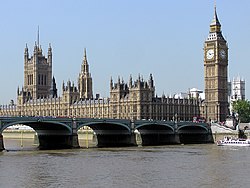
The Parliament of the United Kingdom of Great Britain and Northern Ireland is the highest legislative body in the United Kingdom and the Royal Overseas Territories . He is not led by the British monarch , but he is part of it. The bicameral parliament includes the upper house, called the House of Lords , and the lower house, called the House of Commons . The House of Lords is not elected, it includes spiritual lords (the highest clergy of the Anglican church ), secular lords ( peers ) and appeal lords ( English List of Lords of Appeal ), many of whom inherited their power. The House of Commons, in contrast, is a democratically elected house of 650 members elected in majoritarian districts. The House of Lords and the House of Commons gather in different rooms of the Palace of Westminster in London . As usual, all ministers , including the prime minister , are elected exclusively from the parliament.
| Parliament of the United Kingdom of Great Britain and Northern Ireland | |
|---|---|
| Parliament of the United Kingdom of Great Britain and Northern Ireland | |
| LVI Parliament of Great Britain | |
 | |
| Type of | |
| Type of | bicameral parliament |
| Chambers | House of Lords The House of Commons |
| Guide | |
| Lord speaker | Elizabeth Truss , Conservative Party since July 14, 2016 |
| Speaker | John Birkow , Conservative Party since June 22, 2009 |
| Structure | |
| Of members | 800 peers + 650 deputies |
 | |
| House of Lords of the Faction | Government
Opposition
Other opposition
|
 | |
| House of Commons Factions | Government
(314)
Speaker
|
| House of Commons Recent Elections | June 8, 2017 |
| Conference hall | |
 | |
| Palace of Westminster | |
| Site | |
| www.parliament.uk | |
Parliament evolved from the ancient royal council. In theory, power does not come from the Parliament, but from the Queen-in-Parliament . It is often said that only the Queen-in-Parliament is the supreme authority, although this is a rather controversial statement. Currently, power also comes from the democratically elected House of Commons; in society it is believed that the Monarch acts as a representative figure, and the power of the House of Lords is significantly limited.
The British Parliament is often popularly called the “mother of all parliaments,” since the legislatures of many countries, and especially the member countries of the British Commonwealth , are modeled after him. But the British Parliament is not the oldest, yielding, at a minimum, to the Parliament of Iceland .
History
In the Middle Ages , there were three kingdoms on the British Isles : England , Scotland and Ireland , each with its own parliament. According to the Union Act of 1707 , England and Scotland were united under the control of the Parliament of Great Britain, and the Union Act of 1800 [Note. 1] included representatives of Ireland in the Parliament of the United Kingdom.
Parliament of England
The Parliament of England traces its origin from the Anglo - Saxon Withenhemoth . Under William the Conqueror , who ruled England since 1066, there was a council of large landowners and church hierarchs . In 1215, large landowners got John Landless to sign the Magna Carta , according to which the king could not impose new taxes (except for some old feudal taxes) without the consent of the royal council ( English royal court ), which gradually evolved into parliament. In 1265, Simon de Montfort, 6th Earl of Leicester , assembled the first elected Parliament. The property qualifications for the parliamentary elections in the counties were the same throughout the country: those who owned the polling station, which brought in an annual rent of 40 shillings, could vote. In cities, the property qualification varied, different cities had different rules. This paved the way for the so-called 1295 Model Parliament , adopted by Edward I. By the reign of Edward III, the Parliament was divided into two chambers: one, where the highest aristocracy and the high clergy sat, and the other, where the knights and the townspeople sat. No law could be passed without the consent of both houses and the sovereign.
When, after Elizabeth I , the kingdom of Scotland, James VI , who also became James I of England, succeeded power in the country in 1603 , both countries were under his personal control, but each retained its own parliament. The heir to James I, Charles I, had a conflict with Parliament, which after the wars of the three kingdoms grew into the English Civil War . Charles was executed in 1649 , and during the reign of Oliver Cromwell, the House of Lords was abolished, and the House of Commons was subordinate to Cromwell. After the death of Cromwell, the monarchy and the House of Lords were restored.
In 1688, during the Glorious Revolution , King James II was overthrown, and the joint rule of Mary II and William III was established . Their agreement with the English Bill of Rights meant the creation of elements of a constitutional monarchy .
Parliament of Scotland
Since the time of Kenneth I in Scotland, all posts have been filled according to a system of dance that combines elements of inheritance and election. After in 1057, Macbeth I was overthrown by Malcolm III in Scotland under the influence of the Norman conquest, the feudal birthright system was introduced.
In the Middle Ages, the Royal Council of Bishops and Counts gradually evolved into parliament, first becoming the “colloquium” of 1235 , which already had political and legal significance. Since 1326, the unicameral assembly of three estates, which was attended by priests, landowners, and city representatives, had tax authority and a serious influence on legislation, the judiciary, foreign policy, and military affairs. The three estates elected a committee of articles to draft laws, which were then submitted to the chamber for approval.
After the Reformation in 1567, the Catholic clergy was expelled from parliament under the pressure of the Church of Scotland , and after the abolition of the episcopate in 1638, the parliament became a completely secular assembly. During the reign of James VI and Charles I, the parliament came under the strong influence of the Crown, its convocations became episodic, the royal power, manipulating the election system and order of meetings, tried to turn the chamber into an obedient tool of the king’s absolutist policy. But the uprising in Scotland in 1637 and the victory of the Scots over the royal troops in the Episcopal Wars of 1639 - 1640 . allowed parliament to concentrate in its hands the full power in Scotland. After the troops of Oliver Cromwell invaded the country, his republican government in 1657 established a short Anglo-Scottish parliamentary union.
The Scottish Parliament was restored after Charles II returned to the throne in 1660 . The glorious revolution of 1688 abolished the system of royal patronage over parliament and ensured freedom of elections and discussion of draft laws. In 1707, the parliaments of Scotland and England adopted the Union Act , according to which both British states united into the kingdom of Great Britain and a single parliament was created. As a result, the Scottish Parliament was dissolved, new common British titles were created for the Scottish peers, and the British Parliament merged with the new Parliament of the United Kingdom.
In 1998, as part of the decentralization of the country's governance system, the Labor Government of Tony Blair reinstated the Scottish Parliament. He was delegated certain powers in the field of local government, education, healthcare, environmental protection, agriculture and transport. In 2016, taxation issues were additionally delegated in the areas of income tax and other local taxes and fees, social security, elections to the national parliament, management of the transport police and the Crown’s lands [1] .
Parliament of Wales
The Wales Assembly has 60 members, elected by direct vote every four years. It performs the functions previously performed by the Ministry of Wales, and has the right to amend the bills passed by the British Parliament , which directly relate to this region. [2]
Parliament of Ireland
The Irish Parliament was created to represent the British in Irish possession, while the indigenous or Gaelic Irish did not have the right to elect or be elected. It was first convened in 1264 . Then the British lived only in the area around Dublin , known as the Devil.
In 1541, Henry VIII announced the creation of the Kingdom of Ireland and landed in Ireland with an army. Gaelic Irish leaders were given the right to sit in the Irish Parliament on an equal footing with people of English descent. The introduction of Protestantism as the state religion (while most of the population remained Catholic) was controversial, and in 1613 - 1615 the composition of the voters was fixed so that the majority in the Irish Parliament belonged to Protestant settlers. After the Irish uprising of 1641, Irish Catholics were stripped of their suffrage under the Cromwellian Settlement Act of 1652 .
During the reign of Jacob II, Catholics regained some of their positions, and during the Jacobite war in Ireland, he agreed with the demands of the Irish Parliament on autonomy and return of land, but after the victory of William III of Orange, these acquisitions were again taken away under punitive laws . The Poining Act subordinated Irish law to the British Parliament, but the Constitution Act of 1782 removed these restrictions, and ten years after that, Catholics could again elect, although they still did not have the right to be elected to Parliament.
UK Parliament
After the unification treaty of 1707 , the parliaments of England and Scotland adopted the same Acts of unification , which created the new Kingdom of Great Britain . According to these acts, both parliaments were dissolved and the Parliament of the Kingdom of Great Britain was created, which was placed in the former seat of the English parliament. Although Scotland retained its laws, the new parliament now worked with them.
After George I of the Hanover dynasty ascended the throne in 1714 , power began to gradually transfer from the monarch to parliament, and by the end of his reign, the position of ministers was established, which in turn relied on the support of the Parliament. By the end of the 18th century, the monarch still had a significant influence on the parliament, in which the English aristocracy dominated. In the Elections, only the land nobility had the right to vote, with such a distribution of polling stations that in many rotten places it was possible to buy a seat in parliament, while large cities did not have their representatives. Reformers and radicals sought parliamentary reform, but with the start of the Napoleonic Wars, the government became more repressive, and progress toward reform was halted.
United Kingdom Parliament
The United Kingdom of Great Britain and Ireland was created in 1801 by the merger of the Kingdom of Great Britain and the Kingdom of Ireland .
The principle of responsibility of ministers to the lower house was developed only in the 19th century . The House of Lords was superior to the House of Commons both in theory and in practice. Members of the House of Commons were elected by an outdated electoral system, in which the size of polling stations varied greatly. So in Gatton, seven voters elected two members of parliament, as well as in Danwich , which completely went under water due to land erosion. In many cases, members of the House of Lords controlled small polling stations, known as “ pocket towns ” and “ rotten towns, ” and could ensure the election of their relatives or supporters. Many seats in the House of Commons were the property of the Lords. Also at that time, bribery and intimidation of voters were widespread in the elections.
In 1832, it was finally possible not only to gather a majority in the House of Commons in favor of the electoral reform project, but also to suppress the resistance of the House of Lords. The electoral reform of 1832 eliminated the most glaring shortcomings of the electoral system. In England, 515 "rotten towns" completely lost the right to send deputies; in 32 settlements, the number of deputies was reduced. But 42 urban districts, including some quarters of London, received the right to send two or one deputy each. The number of county deputies was increased from 94 to 159. The very foundations of suffrage were revised. Instead of the diverse qualifications that existed in cities, there was mainly one introduced - occupation (by the owner or tenant) of a house or shop, the rental price of which was set at £ 10 per year. In counties, old voters ( freeholders ) with at least 40 shillings of income from their own land were joined by copyholders , hereditary tenants who received at least 10 pounds of income, and tenants for a period of at least 50 pounds of income. The consequence of the reform of the English constituencies was that the number of voters increased from 400 thousand to 800 thousand. In Scotland and Ireland, similar transformations were made, and in connection with them the number of Scottish deputies of the House of Commons was brought to 53, Irish - to 105. The total number of members the House of Commons remained, as before - 658.
In 1867, city suffrage was extended to all homeowners and tenants who were required to pay tax in favor of the poor, and to tenants occupying unfurnished premises for 10 fn. per year and above. In counties, the qualifications of copy holders and hereditary tenants were reduced from 10 pounds to 5, and the qualifications of tenants for a term from 50 pounds to 12. Similar transformations were made in Scotland and Ireland in 1868. The suffrage of lodgers was introduced, thanks to which in the cities the most affluent workers got access to the elections. In 1884, this form of qualification was also extended to counties, and a high qualification of 10 pounds was retained when applied to them. In connection with this measure, many minor changes were made and the electoral districts were redistributed, according to the population. The redistribution was based on the consideration that there should be approximately one deputy for 54,000 voters. The exception was universities that also sent deputies to parliament: voters who received academic degrees were voters. The total number of members of the House of Commons was increased from 658 to 670. In 1872, a closed ballot was introduced for parliamentary elections.
Modern era
The supremacy of the House of Commons was clearly established at the beginning of the 20th century . In 1909, the House of Commons adopted a budget, which in the liberal press was called “popular” which provided for tax changes unprofitable for wealthy landowners. The House of Lords, consisting of a powerful land aristocracy , rejected this budget. Using the popularity of this budget and the unpopularity of the Lords, in 1910 the Liberal Party won the election. Using the election results, liberal Prime Minister Herbert Henry Asquith proposed parliamentary law, which was to limit the powers of the House of Lords. When the Lords refused to pass this law, Asquith asked the king to create several hundred liberal peers to erode the majority of the Conservative Party in the House of Lords. In the face of such a threat, the House of Lords adopted a bill that significantly limited the rights of the upper house . He allowed the Lords to only delay the adoption of the law for three sessions (shortened to two sessions in 1949 ), after which he entered into force, despite their objections.
In mid-1918, Parliament passed the Law on People's Representation , which significantly democratized the British electoral system. Now all men over the age of 21 have received the right to vote. In addition, for the first time in British history, women (over the age of 30) were given the right to vote. But for women there were not only age restrictions: to participate in the elections, they had to have real estate with an income of at least 5 pounds. Art.per year or married to a man who had a specified income. As a result of the electoral reform of 1918, the number of voters increased almost three times.
The Irish Free State gained independence in 1922 , and in 1927 the United Kingdom was renamed the United Kingdom of Great Britain and Northern Ireland.
В 1928 г. был принят закон, по которому женщины были уравнены в политических правах с мужчинами, получив возможность участвовать в выборах наравне с мужчинами с 21 года.
В XX веке были проведены дальнейшие реформы: в 1958 году акт о пожизненных пэрах разрешил периодическое создание пожизненных пэров . В 1960-е , создание наследуемых пэров было прекращено, и с тех пор почти все новые пэры были только пожизненными. Акт о палате лордов 1999 года отменил автоматическое право наследственных пэров на место в высшей палате, за исключением 92 пэров.
До 2005 года в палату лордов входили и так называемые судебные лорды ( англ. Lords of Appeal in Ordinary ), или лорды-юристы ( англ. Law Lords ), назначаемые монархом по представлению премьер-министра для осуществления судебных полномочий в связи с тем, что палата лордов играла роль высшей апелляционной инстанции. Актом о конституционной реформе 2005 года, вступившим в силу лишь в 2009 году , был учреждён Верховный суд ( англ. Supreme Court ), состоящий из 12 судей, на который отныне возлагалась эта функция. Первыми судьями были назначены действующие судебные лорды.
Организация деятельности
Composition
Парламент Великобритании является бикамеральным, то есть основан на двухпалатной системе, и состоит из Палаты общин и Палаты лордов. Однако, как общенациональный представительный орган парламент являет собой триединое учреждение, включающее в себя не только обе палаты, но и монарха , «Королеву-в-Парламенте» ( англ. Crown-in-Parliament ), поскольку только наличие всех трёх элементов образует в правовом смысле то, что называют британским парламентом. Эта связь обусловлена особенностью принципа разделения властей , которая состоит в том, что в системе государственных органов Великобритании такое разделение и фактически, и формально отсутствует: монарх является неотъемлемой частью каждой из ветвей власти . Так, одной из политических прерогатив монарха является его право созывать и распускать парламент. Кроме того, ни один закон не может обрести юридическую силу до тех пор, пока не будет получена королевская санкция, то есть пока он не будет одобрен монархом. Королева возглавляет парламент, однако, её роль носит в основном церемониальный характер: на практике она традиционно действует согласно рекомендациям премьер-министра и других членов правительства.
Термин «парламент» обычно используется для обозначения обеих палат, но иногда под парламентом подразумевают его основную часть — Палату общин. Так, только члены Палаты общин именуются «членами парламента». Правительство несёт ответственность только перед Палатой общин, и эта ответственность называется «парламентской». Именно Палата общин осуществляет то, что называют «парламентским контролем».
Палата общин
Палата лордов
Общая парламентская процедура
Вопросам процедуры в британском Парламенте придаётся чрезвычайно большое значение, но в отличие от большинства государств единого писаного документа, в котором были бы зафиксированы правила внутренней организации палат, не существует, — его заменяют постоянные правила ( англ. Standing Orders ), выработанные многовековой практикой, в том числе сессионные правила, утверждаемые в начале каждой сессии. Следует отметить, что эти правила, действуя в обеих палатах и выступая в качестве аналога парламентского регламента в других странах, не образуют единого правового акта, а представляют собой собрание разнообразных норм, принятых каждой палатой раздельно и в разное время [Прим. 2] . Кроме того, парламентская процедура регулируется различными неписаными правилами — обычаями ( англ. custom and practice ) [Прим. 3] .
Созыв и роспуск парламента
Созыв Парламента является прерогативой монарха, реализуемой по предложению премьер-министра в течение 40 дней после окончания парламентских выборов посредством издания королевской прокламации ( англ. Royal Proclamation ). Парламентские сессии созываются ежегодно, обычно в конце ноября — начале декабря, и продолжаются большую часть года с перерывами на каникулы. Каждая сессия начинается тронной речью монарха ( англ. Speech from the Throne ), которая по обычаю составляется премьер-министром и содержит программу деятельности правительства на предстоящий год. Во время произнесения тронной речи парламент заседает в полном составе.
После завершения работы парламента проводятся очередные выборы, на которых избираются новые члены Палаты общин. Состав Палаты лордов с роспуском парламента не изменяется. Каждый парламент, собирающийся после новых выборов, имеет свой порядковый номер, при этом отсчёт ведётся с момента объединения Великобритании и Северной Ирландии в Соединённое королевство, то есть с 1801 года . Действующий парламент является уже пятьдесят пятым по счёту.
Внеочередные выборы проводятся по решению парламента либо в случае потери правительством Великобритании доверия нижней палаты парламента.
Церемониал
Парламентские заседания
Порядок проведения парламентских заседаний строго регламентирован. Начинаются они с так называемого «часа вопросов» ( англ. Question Time ) премьер-министру и членам правительства. Далее парламентарии переходят к рассмотрению наиболее срочных дел, а также правительственных и частных заявлений, и затем — к основной повестке дня, то есть законотворчеству, которое включает дебаты и голосование.
Правительственное заявление ( англ. ministerial statement ) — устное заявление члена кабинета министров по вопросам внутренней и внешней политики правительства — как текущей (устное заявление), так и планируемой (письменное заявление). По окончании выступления парламентарии могут ответить на заявление или добавить к нему свои комментарии, а также задать министру соответствующие вопросы.
Частное заявление ( англ. personal statement ) — заявление члена палаты по частному делу, то есть в связи с каким-либо событием или для пояснения своей позиции по какому-либо вопросу, который обсуждался ранее.
Законотворчество представляет собой строго последовательный процесс рассмотрения законопроектов — биллей, сначала в нижней, а затем в верхней палате. Обсуждение законопроекта — парламентские прения, или дебаты, происходят путём внесения предложений. Предложения ( англ. motions ) — проекты резолюций, в которых формулируется позиция палаты по определённому вопросу. Таким образом, посредством предложений парламентарии ставят на обсуждение какой-либо вопрос, предлагая вынести по нему решение. Правом на внесение предложений наиболее активно пользуется оппозиция, поскольку это даёт возможность широкого обсуждения политики правительства. Предложения от оппозиции вносятся её представителем, от правящей партии — членом правительства. Депутаты могут вносить поправки в предложение: если предложение внесено оппозицией, поправки предлагает правительство, и наоборот. По вопросам, инициированным правительством, сначала выступает министр, затем соответствующий член «теневого правительства». Потом слово предоставляется рядовым депутатам фракции большинства и меньшинства. По предложениям оппозиции, наоборот, первым выступает её представитель, потом член правительства, далее слово получают другие депутаты. Чтобы получить слово депутат Палаты общин должен «перехватить взгляд спикера» ( англ. catch the speaker's eye ), то есть привлечь его внимание — встать или приподняться со своего места. Депутаты выступают в прениях только один раз, однако они вправе комментировать выступления других членов палаты — при этом они всегда обращаются к спикеру. Продолжительность выступлений не регламентирована, однако спикер может её ограничить. Члены Палаты лордов независимо от фракционной принадлежности имеют право выступить в любое время, причём не один раз, при этом они обращаются не к лорду-спикеру, а к другим членам палаты. Правила сворачивания дебатов в верхней палате не используются.
После окончания дебатов происходит голосование. Следует отметить, что его процедура весьма специфична. Во-первых, голосование — открытое и устное, а во-вторых, своеобразны его способы. Сначала спикер предлагает высказаться тем, кто «за», затем — тем, кто «против». При этом парламентарии выкрикивают, соответственно, «Да» ( англ. «Aye» ) или «Нет» ( англ. «Nay» ) — в Палате общин, а в Палате лордов — «Согласен» ( англ. «Content» ) или «Не согласен» ( англ. «Not-Content» ). Спикер принимает решение в зависимости от распределения голосов. Если голоса разделились примерно поровну или у спикера возникли сомнения, то проводится повторное голосование, во время которого депутаты, в зависимости от занимаемой ими позиции по рассматриваемому вопросу, собираются по правую и левую руку от спикера. Кворум для принятия решений в палате лордов составляет 30, а в палате общин — 40 парламентариев.
Также в парламенте планируют ввести голосование в формате видеоконференции, в поддержку которого активно высказываются либеральные политики. Английский законодатель Пол Лаксон считает, что такая инновация будет иметь успех и избавит политиков от ненужных переездов в случаях, когда ситуацию можно решить довольно быстро с помощью видеосвязи.
Заседания палат в большинстве случаев проходят открыто, но спикер вправе распорядиться и о проведении заседания при закрытых дверях. Для проведения заседания Палате лордов необходимо соблюсти кворум в 3 человека, в то время как в Палате общин он формально отсутствует.
Заседания парламентских комитетов проводятся при кворуме от 5 до 15 членов в зависимости от их численности. По окончании работы над каким-либо вопросом комитет составляет отчёт, который представляется соответствующей палате.
Срок полномочий
Изначально не существовало ограничений на продолжительность работы Парламента, но Трёхгодичный акт 1694 года ( англ. Triennial Acts ) установил максимальный срок его полномочий в три года. Семигодичный акт 1716 года ( англ. Septennial Act 1715 ) продлил этот срок до семи лет, однако Парламентский акт 1911 года ( англ. Parliament Act 1911 ) [3] сократил его до пяти лет. Во время Второй мировой войны продолжительность работы парламента была временно увеличена до десяти лет, а после её окончания в 1945 году снова определена равной пяти годам.
Earlier, the death of the monarch automatically meant the dissolution of the parliament, since it was considered caput, principium, et finis (beginning, foundation and end) of the latter. However, it was inconvenient not to have Parliament at a time when inheritance of the throne could be challenged. During the reign of William III and Mary II , a statute was adopted that Parliament should continue to work for six months after the death of the sovereign, if it is not dissolved earlier. The Act of People's Representation of 1867 ( English Reform Act 1867 ) canceled this establishment. Now the death of the sovereign does not affect the duration of the Parliament.
Privileges
Each house of Parliament retains its ancient privileges. The House of Lords relies on inherited rights. In the case of the House of Commons, the speaker at the beginning of the work of each Parliament goes to the House of Lords and asks the representatives of the sovereign to confirm the “undoubted” privileges and rights of the lower house. This ceremony dates back to the time of Henry VIII . Each chamber protects its privileges and can punish their violators. The content of parliamentary privileges is determined by law and custom. These privileges cannot be determined by anyone other than the chambers of parliament themselves.
The main privilege of both chambers is freedom of speech in disputes: none of the above in the Parliament can be the reason for the investigation or court case in any organization other than the Parliament itself. Another privilege is protection against arrest , except in cases of high treason , serious criminal offenses or breach of order (“breach of the peace”). It is valid during the session of Parliament, as well as for forty days before and after it. Members of Parliament also have the privilege of not performing jury duties in court.
Both houses may punish violations of their privileges. Disrespect for Parliament, such as disobeying a witness call issued by a parliamentary committee, can also be punished. The House of Lords can imprison a person for any term, the House of Commons can also imprison a person, but only until the end of the session of parliament. The punishment imposed by any of the chambers cannot be challenged in any court.
On December 4, 2018, the Government of Great Britain was punished for the first time in history for contempt of Parliament as a result of a decision issued by 311 against 293 deputies, in connection with the refusal of the Government of T. May to provide the House of Commons with details of legal advice on a draft agreement on the UK withdrawal from the European Union [4] [5] .
Authority
Legislative process
The Parliament of the United Kingdom may establish laws by its acts. Some acts are valid throughout the kingdom, including Scotland, but since Scotland has its own legal system (the so-called Scottish law ), many acts are not valid in Scotland and are accompanied by the same acts, but are valid only in Scotland. , or (since 1999 ) laws passed by the Scottish Parliament .
The new law, called draft in its draft form, can be proposed by any member of the upper or lower house. Typically, bills are tabled by royal ministers. The bill introduced by the minister is called the “Government Bill”, and the bill introduced by an ordinary member is called the “Private Member's Bill”. Billy is also distinguished by their content. Most of the bills affecting the whole of society are called “Public Bills”. Bills that give special rights to a private person or a small group of people are called “Private Bills”. A private bill affecting a wider community is called the Hybrid Bill.
Private members' bills make up only one eighth of all bills, and they are much less likely to accept them than government bills, since the time to discuss such bills is very limited. A member of parliament has three ways to deposit his bill to a private member of the house.
- The first way is to put it to the vote on the list of bills proposed for discussion. Usually, about four hundred bills are added to this list, then these bills are voted on, and the twenty bills with the highest number of votes receive time for discussion.
- Another way is the “ten minutes rule”. According to this rule, members of parliament receive ten minutes to propose their bill. If the house agrees to accept it for discussion, it goes into the first reading, otherwise the bill is eliminated.
- The third way - according to order 57, having warned the speaker for a day, formally add the bill to the list for discussion. Such bills are extremely rare.
The “parliamentary filibusterism” poses a great danger to the bills, when opponents of the bill deliberately drag out time to achieve the end of the time allotted for its discussion. Billy private members of the House have no chance of being accepted if they are opposed by the current government, but they are introduced to raise moral issues. Bills to legalize homosexual relations or abortion were private bills. The government can sometimes use the bills of private members of the chamber to pass unpopular laws with which it would not want to be associated. Such bills are called "bill-handouts."
Each bill goes through several stages of discussion. The first reading is pure formality. In the second reading, the general principles of the bill are discussed. In a second reading, the House may vote to reject the bill (refusing to vote for the proposal “That the Bill be now read a second time”), but government bills are rejected very rarely.
After the second reading, the bill is sent to the committee. In the House of Lords, this is a committee of the whole house or a large committee. Both of them consist of all members of the chamber, but a large committee acts according to a special procedure and is used only for non-controversial bills. In the House of Commons, the bill is usually passed on to an existing committee of 16-50 members, but the committee of the whole house is used for important laws. Several other types of committees, such as an elected committee, are rarely used in practice. The committee reviews the bill item by article, and reports the proposed amendments to the entire chamber, where further details are discussed. A device called a kangaroo (Effective Order 31) allows the speaker to select amendments for discussion. Typically, this device is used by the chairman of the committee to limit discussion on the committee.
After the chamber has considered the bill, the third reading follows. The House of Commons is no longer amended, and the adoption of the proposal “That the Bill be now read a third time” means the adoption of the entire bill. However, amendments may still be made to the House of Lords. After passing the third reading, the House of Lords should vote for the proposal “That the Bill do now pass”. After passing in one chamber, the bill is sent to another chamber. If it is adopted by both houses in the same edition, it can be submitted to the sovereign for approval. If one of the chambers does not agree with the amendments of the other chamber, and they cannot resolve their differences, the bill fails.
The 1911 parliamentary act limited the power of the House of Lords to reject bills passed by the House of Commons. The restrictions were strengthened by the 1949 Parliamentary Act. According to this act, if the House of Commons passed the bill in two consecutive sessions and was rejected by the House of Lords both times, the House of Commons can send the bill to the sovereign for approval, despite the House of Lords refusing to accept it. In each case, the bill must be passed by the House of Commons at least one month before the end of the session. This decree does not apply to bills proposed by the House of Lords, bills designed to extend the term of parliament, and to private bills. A special procedure applies to bills recognized by the Speaker of the House of Commons as “Money Bills”. The money bill applies only to taxation issues or government money. If the House of Lords does not accept a monetary bill within one month after its adoption by the House of Commons, the lower house may forward it to the sovereign for approval.
Even before the adoption of the Parliamentary Acts, the House of Commons had more power in financial matters. According to ancient custom, the House of Lords cannot introduce bills related to taxation or the budget, or to amend the taxation or budget. The House of Commons may temporarily grant the House of Lords the privilege of considering financial matters in order to allow the House of Lords to adopt amendments concerning financial matters. The House of Lords may refuse to pass bills regarding the budget and taxation, although this refusal can be easily circumvented in the case of “cash bills”.
The final step in adopting the bill is to obtain the Royal Assent . Theoretically, a sovereign can agree (that is, pass a law) or not (that is, veto a bill). According to modern concepts, the sovereign always agrees to the enactment of the adopted law. The last refusal to give consent occurred in 1708 , when Queen Anne did not approve the bill "on the creation of the Scottish militia."
The bill, before becoming law, receives the consent of all three parts of Parliament. Thus, all laws are established by the sovereign, with the consent of the House of Lords and the House of Commons. All parliamentary acts begin with the words “BE IT ENACTED by the Queen's [King's] most Excellent Majesty, by and with the advice and consent of the Lords Spiritual and Temporal, and Commons, in this present Parliament assembled, and by the authority of the same , as follows. "
Judicial functions
In addition to legislative functions, until 2005 the Parliament also performed some judicial functions.
The Queen-in-Parliament was the final court of appeal in criminal and civil matters, although some appeals were heard by the Judicial Committee of the Privy Council (for example, appeals from church courts). The judicial powers of Parliament derive from the ancient custom of submitting petitions to the House for the correction of injustice and the administration of justice. The House of Commons stopped considering applications for the annulment of court decisions in 1399, essentially turning the House of Lords into the highest judicial authority in the country. The judicial functions of the House of Lords were performed not by the whole house, but by a group of 12 judges - the “ Lords of Appeal in Ordinary ”, who were granted life-long peerings under . These Lords, also called Law Lords , and collectively called the House of Lords Appeal Committee , usually did not vote or speak out on political issues.
At the end of the 19th century , the appointment of Scottish Lords of Appeal in Ordinary was allowed, which stopped appeals in Scottish criminal cases to the House of Lords, making the Scottish High Criminal Court the highest criminal court in Scotland . Later, at least two Scottish judges began to be included in the House of Lords legal committee in order to provide the Scottish law experience necessary to hear appeals from the High Civil Court of Scotland .
Historically, the House of Lords has performed some other judicial functions. Until 1948, it was a court hearing cases of peers accused of high treason . Now peers are subject to ordinary jury trials. In addition, when the House of Commons proceeds with the impeachment procedure, the trial is conducted by the House of Lords. Impeachment, however, is now very rare; the latter was in 1806 .
Following the 2005 reform, the UK Supreme Court was formed. Members of the legal committee were appointed by the judges of the Supreme Court, after which the House of Lords terminated its judicial functions.
Government Relations
The UK government is accountable to Parliament. However, neither the Prime Minister nor members of the government are elected by the House of Commons. Instead, the Queen asks the person who enjoys the maximum support from the House (usually the leader of the party with the most seats in the House of Commons) to form a government. So that they are accountable to the lower house, the Prime Minister and most of the cabinet members are selected from the members of the House of Commons, and not the House of Lords. The last Prime Minister from the House of Lords was Alex Douglas-Hume in 1963. However, in order to comply with the custom, Lord Hume renounced his peers and was elected to the House of Commons after becoming Prime Minister.
Using its original majority in the House of Commons, the government usually dominates the legislative work of parliament, and sometimes uses its patronage power to appoint peers supporting them to the House of Lords. In practice, the government can achieve the adoption of any legislation that it wants, except in cases of a big split in the ruling party. But even in such a situation, it is unlikely that the bill proposed by the government will not be adopted, although dissenting members of parliament can make concessions from the government. In 1976, Lord Helsham came up with the name that is now widely used for such a system, naming it “ elective dictatorship ” in a scientific article.
Parliament controls the executive branch by accepting or rejecting its bills and forcing crown ministers to report on their actions either during the “Time for Questions” or during meetings of parliamentary committees . In both cases, the ministers are asked questions by members of both houses, and they are required to answer.
Although the House of Lords can study the actions of the executive branch through the “time of questions” and the work of its committees, it cannot put an end to the work of the government. However, the government should always maintain the support of the House of Commons. The lower house may express its distrust of the government either by rejecting the Confidence Ordinance or by adopting the No Confidence Ordinance . Trust orders are usually put to a vote by the government in order to receive support from the chamber, while a no-confidence order is submitted by the opposition. Provisions are usually expressed in the words “That this House has [no] confidence in Her Majesty's Government”, but other expressions may be used, especially indicating a specific policy, supported or not supported by Parliament. For example, the 1992 Government Trust Act used the expression "That this House expresses the support for the economic policy of Her Majesty's Government." Such a decision could theoretically be adopted by the House of Lords, but since the government does not need the support of this house, it does not have the same consequences. The only modern case occurred in 1993 , when a decree of no confidence in the government was submitted to the House of Lords and then rejected.
Many votes are considered a vote of confidence, although formally they are not. Important bills, which form part of the government's legislative agenda, show a level of trust in the government. Кроме того, то же самое происходит, если Палата Общин отказывается утвердить бюджет.
В случае выражение правительству недоверия у Премьер-министра есть 14 дней на то, что бы восстановить доверие. Также Кабинет Министров может уйти в отставку, после чего Суверен может назначить нового Премьер-министра, готового обеспечить своему Кабинету поддержку большинства нижней палаты. В случае, если по истечении 14 дней правительство не получило вотум доверия - парламент распускается и назначаются досрочные выборы, по итогам которых формируется новый состав правительства.
На практике Палата общин очень слабо контролирует правительство. Так как используется мажоритарная система выборов, правящая партия обычно обладает значительным большинством в Палате общин и не нуждается в компромиссе с другими партиями. Современные политические партии Британии жёстко организованы, так что остаётся мало свободы для действий их членов. Нередко членов парламента исключают из их партий за голосование, не соответствующее указаниям их партийных лидеров. В течение двадцатого века Палата общин только два раза выражала недоверие правительству — дважды в 1924 году и один раз в 1979 году .
Notes
- Comments
- ↑ Вступил в силу 1 января 1801 года
- ↑ Всего насчитывается около 400 писанных процедурных правил.
- ↑ Например, неписаное правило, в соответствии с которым законопроект должен пройти три чтения.
- Sources
- ↑ What powers does the Scotland Act 2016 devolve to the Scottish Parliament? (англ.) (неопр.) ? . Scottish National Party (25 ноября 2015). Дата обращения 9 апреля 2019.
- ↑ McAllister L. The Welsh Devolution referendum: definitely, maybe? // Parliamentary Affairs. 1998. Vol. 51. No. 2. P. 149—165
- ↑ Парламентский акт 1911 года // Сборник документов по истории нового времени. Экономическое развитие и внутренняя политика стран Европы и Америки. 1870—1914 / Сост. П. И. Остриков , П. П. Вандель . — М.: Высшая школа , 1989.
- ↑ Спикер Палаты общин заявил, что правительство Мэй могло проявить неуважение к парламенту . TASS. Дата обращения 3 апреля 2019.
- ↑ Ирина Александрова. Тереза Мэй: испытания в парламенте . euronews (4 декабря 2018). Дата обращения 3 апреля 2019.
Literature
- In Russian
- Айзенштат М. П. Власть и общество Британии, 1750–1850 гг.. — М. , 2009.
- Баглай М. В. Конституционное право зарубежных стран: Учебник для вузов. — М. : Норма, 2010. — 1088 с. — ISBN 978-5-91768-080-4 .
- Виноградов П. Г. , Водовозов В. В. ,. Парламент английский // Энциклопедический словарь Брокгауза и Ефрона : в 86 т. (82 т. и 4 доп.). - SPb. , 1890-1907.
- Гутнова Е. В. Возникновение английского парламента (из истории английского общества и государства XIII в.). — М. : Издательство МГУ , 1960. — 582 с.
- Дайси А. В. Основы государственного права Англии. — М. : Издание Товарищества И. Д. Сытина, 1907. — 710 с.
- Избранные конституции зарубежных стран: Сб. док / сост. Б. А. Страшун . — М. : Юрайт, 2011. — 795 с. — ISBN 978-5-9916-0962-3 .
- Крашенинникова Н. А. История государства и права зарубежных стран: Учебник для вузов: в 2 т. — М. : Норма, 2007. — Т. 2. — 816 с. — ISBN 978-5-89123-943-2 .
- Парламент английский / Мереминский С. Г. // П — Пертурбационная функция [Электронный ресурс]. — 2014. — С. 357—358. — ( Большая российская энциклопедия : [в 35 т.] / гл. ред. Ю. С. Осипов ; 2004—2017, т. 25). — ISBN 978-5-85270-362-0 .
- Мереминский С. Г. Парламент английский // Большая российская энциклопедия : электронная версия. — 2016. — Дата обращения: 06.11.2018.
- Семёнов С. Б. Радикальное движение и борьба за парламентскую реформу в Англии во второй половине XVIII в. {{{заглавие}}}. — Самара: Изд-во Самарского научного центра РАН , 2008. — 360 с.
- Страшун Б. А. Конституционное (государственное) право зарубежных стран. Особенная часть: Учебник для вузов. — М. : Норма, 2008. — 1136 с. — ISBN 978-5-468-00214-8 .
- Узнародов И. М. Политические партии Великобритании и рабочие избиратели (50-е – начало 80-х гг. XIX в.). — Ростов н/Д., 1992.
- In other languages
- Blackstone, Sir William. Commentaries on the Laws of England. — Oxford : Clarendon Press, 1765.
- Brown, KM The History of the Scottish Parliament / KM Brown, RJ Tanner. — Edinburgh, 2004. — Vol. vol. 1: Parliament and Politics, 1235–1560.
- Companion to the Standing Orders and guide to the Proceedings of the House of Lords . Parliament of the United Kingdom (2007).
- May, Thomas Erskine, 1st Baron Farnborough. Constitutional History of England since the Accession of George the Third. — 11th. — London : Longmans, Green and Co., 1896.
- May, Erskine & Chisholm, Hugh (1911), " Parliament ", in Chisholm, Hugh, Encyclopædia Britannica , vol. 20 (11th ed.), Cambridge University Press
- Kelly, Richard (2007), The Parliament Acts (SN/PO/675) , House of Commons Library
- Rait, R. The Parliaments of Scotland. — Glasgow, 1924.
- Tanner, RJ The Lords of the Articles before 1540: a reassesment (англ.) // Scottish Historical Review : journal. — 2000. — October ( no. LXXIX ).
- Wasson, EA Born to Rule: British Political Elites. — 2000.
- Wasson, EA The British and Irish Ruling Class 1660-1945. — 2017.
Links
- Official website
- The Parliament of the United Kingdom. Parliament Live TV
- A—Z of Parliament Би-би-си , 2005
- Британский парламент (с 1935) на Политическом атласе
- Special Report: House of Commons The Guardian, 2005
- Special Report: House of Lords The Guardian, 2005
- Parliamentary procedure site at Leeds University
- Работы the Parliament of the United Kingdom в проекте «Гутенберг»
- British House of Commons people (C-SPAN)