"Schlesien" ( German: Schlesien ) - squadron battleship ( battleship pre-dreadnought type ) of the German Navy in 1908 - 1945 .
| Schlesien | |
|---|---|
| Schlesien | |
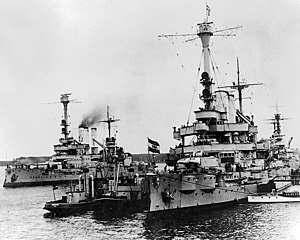 Armadillos Schlesien and Schleswig-Holstein , right in the background is the battleship of Hesse , photography circa 1930 | |
| Service | |
 Germany Germany Weimar Republic Weimar Republic Germany Germany | |
| Named after | |
| Class and type of vessel | Deutschland Dreadnought |
| Manufacturer | Shihau, Danzig |
| Ordered to build | June 11, 1904 |
| Construction started | August 18, 1905 |
| Launched | May 28, 1906 |
| Commissioned | July 6, 1908 |
| Status | Flooded |
| Main characteristics | |
| Displacement | 13,200 t - normal; 14,218 t - full |
| Length | 127.6 m |
| Width | 22.2 m |
| Height | 7.7 m |
| Reservation | 230 mm sheets of armor belt 280 mm tower defense 76 mm deck |
| Power | 19 330 l. with. |
| Mover | 3 screws |
| Speed | 17 knots |
| Sailing range | 5000 nautical miles at 10 knots |
| Crew | 743 people |
| Armament | |
| Artillery | At the time of construction
As of 1939:
|
| Flak | As of 1939: 4 × 37 mm guns (2 × 2) 22 × 20 mm |
| Mine torpedo armament | 6 × 450 mm torpedo tubes (at the time of construction) |
Content
Creation History
Armadillos of the Deutschland type were the logical conclusion to a series of German armadillos of the early 20th century: the Kaiser type, the Wittelsbach type and the Braunschweig type.
The battleship (later reclassified to battleship) “Schlesien” (after the name of the land of Silesia ) was laid down at the Danzig shipyard “Schihau” in July 1905 . The ship was launched on May 28, 1906 and entered service in 1908 .
Design
The battleship had a displacement of 13,208 tons, a hull length of 127.7 m, a width of 22.2 m, a draft of 7.7 m. A belt with a thickness of 100 to 240 mm ran along the entire length of the waterline. The thickness of the deck armor is 40–75 mm, the armor of the main caliber towers is 250–280 mm, the casemates of the auxiliary caliber guns are 170 mm, and the conning tower is 140–300 mm.
Three triple expansion steam engines with 12 Schulz-Tornicroft boilers had a total capacity of 23,500 liters. with. Full speed did not exceed 19 knots, cruising range of 10-knot course - 5500 miles. The crew is 743 people.
The armament of the battleship was two two-gun 280-mm turrets of the main caliber, fourteen casemate 170-mm guns, twenty 88-mm guns and six torpedo tubes.
Service
After the defeat of Germany in the First World War, the Weimar Republic was allowed to leave the fleet with only 15 thousand sailors and 8 obsolete battleships.
The Schlesien, Schleswig-Holstein, Hessen, Lorringen, Braunschweig, Alsace, Preussen and Hanover remained in service. But as the "pocket battleships" (formally suited to the Versailles restrictions) became operational, it was necessary to get rid of the "old men", and in 1931 the last 5 of the listed battleships were removed from the fleet lists and scrapped.
The Schlesien in 1926 underwent a significant modernization together with the Schleswig-Holstein of the same type, after which both battleships were transferred to the class of training ships.
During the modernization, the two pipes closest to the nose were combined into one, the boilers were partially transferred to oil heating, and the 170-millimeters were replaced with a 150-mm caliber. At the same time, the number of "anti-mine" artillery was steadily declining: two guns were removed shortly after modernization, two more by 1937, and by 1939 armadillos completely lost 150 mm cannons. But accordingly, their anti-aircraft power increased, consisting first of 88-mm anti-aircraft guns, to which six 105-mm guns were added, and several dozen 20-mm and 40-mm machine guns were added to the war.
Combat use
On August 25, 1939, the German training battleship Schleswig-Holstein entered the Gdansk Bay on a “friendly visit”. The official reason for the arrival of the battleship was the 25th anniversary of the death of one of the German ships in the First World War. In fact, the battleship was a floating battery to attack the Polish coast.
At 4:30 on September 1, the Schleswig-Holstein was put on alert with a single shot from a pistol. And at 4:45 began the shelling of Westerplatte - this marked the beginning of the Second World War.
The debut of Schleswig-Holstein at Westerplatte predetermined the role of these obsolete ships throughout the war. They were used only for shelling the coast, but quite intensively: the "Slesien" fought until the spring of 1945 .
March 15-23, 1945 the battleship "Schlesien" took part in the hostilities in the area of Danzig Bay.
The Schlesien was the last major German artillery ship operating against coastal targets and advancing Soviet troops. On May 2, the battleship moved to Greifswald to shell the railway bridge over the Piin River in the Volgast area from the bay. However, on May 3, 1945, at 2.30 a.m., while in the Swineemunde area, the battleship was blown up on an English aviation bottom magnetic mine. Two people died in the explosion, the battleship lost speed and was hardly towed to the shore by the destroyer Z-39.
Here, on the roadstead of the Pomeranian (Pomeranian) bay of Svinemuende, the ship was stranded to avoid flooding. By that time, the battleship had significant trim on the nose. The Germans set the old ship in such a way that it could shell approaches to the city from the stern tower of the main caliber (two 280-mm guns).
Drowning "Slesien"
May 3, 1945 "Schlesien" at the transition to a new parking spot was discovered by air intelligence KBF . On the morning of May 4, the disposition of the stationary ship was clarified.
By 7 o’clock in the morning the first information arrived: in addition to the battleship, there were 3 destroyers, 12 patrol ships, 2 minesweepers and 8 transports on the roadstead. No enemy aircraft were found in the Swineemunde area.
47 airplanes were allocated for the raid: the strike group of the 51st mine-torpedo regiment of 10 Bostons (2 torpedo bombers A-20G and 8 A-20D troop-carriers ). Captain F.N. Makarikhin was appointed commander of the squadron. Also involved were 24 Il-2 attack aircraft (moderated by Lieutenant Garkush) and 12 Yak-9 fighter cover units of Major Usychenko. Komesk captain Makarihin was on a special Boston without bombs. He guided the strike group on the target and coordinated the actions of all tactical groups. Hero of the Soviet Union Alexander Bogachev participated in the raid.
The first raid began at 11.30 a.m. and lasted about 8 minutes. Haze visibility was limited. IL-2 attack aircraft attacked the guard ships, diverting their fire on themselves, and torpedo bombers and top-gunmen attacked the battleship.
During this attack, a bomb dropped from the plane of Junior Lieutenant N. Linnik fell into the Slesien and a fire broke out on it. However, when passing over the ship, the plane was destroyed by fire from the battleship.
The second raid on the “Schlesien” took place at about 4:00 pm on May 4: a guidance plane, one torpedo bomber, five ground attack aircraft, 16 attack aircraft and 8 fighters took off. During their attack, a powerful underwater explosion was recorded at the very side of the battleship, there was a direct hit of bombs in the vehicle, which immediately sank. The destroyer, the auxiliary cruiser Orion, and one more transport were badly damaged. But the fact that the Schlesien is aground has not yet been established.
In the period between the second and third raids, according to German data, a charge was destroyed on the ship that destroyed the mast, and kingstones were discovered. The rest of the team was evacuated ashore.
The third raid was carried out at 8 p.m. on May 4, 1945 by five top-troopers, 16 attack aircraft under cover of 8 fighter jets, as a result of which five hits of aerial bombs in the "Schlesien" were recorded.
In total, 4 torpedoes and 41 aerial bombs were dropped on the battleship and ships in a day. During three air raids, the Orion auxiliary cruiser (7021 tons) was sunk. In addition, six transports with a total displacement of 29,000 tons, two destroyers, two minesweepers and a patrol ship were recorded in the KBF aviation report. Severely damaged: three destroyers, a patrol ship, and transport with a displacement of 3,000 tons.
A special commission of the KBF, which included a representative from 51 ITAF, examined the circumstances of the attack on Schlesien and found that there were several direct hits of large-caliber bombs in the battleship and there was a hole that could have been a consequence of the explosion of a 1000-kg aircraft bomb or torpedo in shallow water near board the ship.
Criticism of the aftermath of a KBF Air Force attack on the battleship Schlesien on May 4, 1945
The results of three aircraft attacks of the 51st mine-torpedo air regiment of the KBF Air Force cause controversy in view of its ambiguity.
A certain part of the researchers believes that the destruction of the battleship "Slesien", as a combat unit, cannot be credited to the Soviet Navy. This is supported by the following facts:
- The battleship suffered significant damage precisely from the explosion of an English ground mine on the night of May 3, 1945.
- Half an hour before the first raid, the commander of Schlesien, captain tsursee Hans-Eberhardt Bush with 20 wounded sailors went aboard the destroyer T-36, which indicates a decision to flood the ship even before the KBF air force attacks [1] .
- The actions of the KBF aviation did not cause significant damage to the ship, and did not even lead to casualties [1] .
- The Soviet command itself recognized the actions of aviation on the battleship "Slesien" unsatisfactory [2] .
On the other hand [by whom? ] the following counterarguments are given:
- After the explosion of the bottom mine, the Schlesien was towed in Svineemünde (that is, kept afloat), its artillery was capable of firing at sea and coastal targets, as well as providing air defense for the area: the ship did not lose combat significance.
- During the evacuation of Svinemuende, some German ships went in tow (for example, the destroyer "Z 34"): without attacks by the Air Force, the Schlesien Design Bureau could leave the port in the same way.
- The non-combat situation when the commander of the "Slesien" aboard another ship, while the "Slesien" crew members remained in combat posts (the same calculations of anti-aircraft guns, for example) cannot be considered evidence of the crew leaving the ship before its self-destruction.
- The report of the commission that examined the Schlesien after Swinemünde’s occupation mentions a major hole in the board from being hit, or from a close explosion of a large-caliber bomb, or a torpedo: which indicates the presence of damage from external explosions, and not only from internal ones, as during self-explosion.
- Significant destruction of the ship's superstructure also testifies in favor of the effectiveness of air bombs.
- The fact that the ship was blown up and the kingstons opened by the team does not diminish the significance of the Soviet aviation attacks on the Schlesien - just like the fact that the Bismarck crew opened the kingstones does not diminish the victory of the ships of the English Royal Navy.
- The Soviet command recognized as unsatisfactory the actions of not all of the aircraft involved in the raid, namely torpedo-bearing [2] .
Advanced
- In 1932-1933, the commander of the battleship "Slesien" was Captain 1st Rank Canaris , future head of military intelligence Abwehr .
- The Soviet command was aware of the depths in the area of operation (10-12 meters), which did not allow the use of conventional aircraft torpedoes, which when dropped from an aircraft dived 15-20 meters. To attack the battleship, experimental torpedoes 45-36-AN were used.
- The largest enemy warship was destroyed precisely by the Baltic Fleet. The largest warship Kriegsmarine destroyed by surface ships of the RKKF was the destroyer T-31 (displacement of 1754 tons, commander - captain-lieutenant Peter Pirkham), sunk by torpedo boats TK-37 of senior lieutenant Toronenko and TK-60 of lieutenant Bushuyev (both type boats D-3 ) at exactly midnight from the 19th to the 20th of June 1944 near the Finnish island of Narvi .
- For his attack on the "Schlesien" pilot M. Borisov received 10,000 rubles.
Notes
- ↑ 1 2 M. Morozov. Blow to the "Schlesien". Magazine "Flotomaster" № 2, 2006
- ↑ 1 2 "Collection of materials on the experience of military operations of the Air Force of the Navy" No. 13 (M., 1946)