Preobrazhenskoye is a former funny (palace) village east of Moscow , on the banks of the Yauza River , a summer estate and the residence of Tsar Alexei Mikhailovich , incorporated into Moscow in 1864 (in 1864, the administrative border between the lands of the city of Moscow and the Moscow district was recognized Kollezhsky Val , the territory between it and the Garden Ring was transferred to the city government [1] ).
| The settlement that became part of Moscow | |
| Transfiguration | |
|---|---|
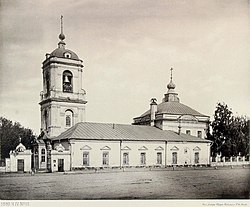 Church of the Transfiguration in Transfiguration (1882) Church of the Transfiguration in Transfiguration (1882) | |
| Story | |
| First mention | 1661 |
| In the composition of Moscow with | 1864 |
| Status at the time of inclusion | suburb |
| Other names | Old Transfiguration, Transfiguration of the Soldiers' Settlement ( XVIII century ) |
| Location | |
| Counties | HLW |
| Areas | Transfiguration |
| Metro stations | Transfiguration Square |
| Coordinates | |
The name of the former village is retained in the name of the modern Preobrazhenskoye district in the Eastern Administrative District of Moscow.
Content
History
It was founded by Tsar Alexei Mikhailovich on the right bank of the Yauza River (in the area of modern Kolodeznaya Street and the Lane), who built a summer palace here and created an estate with gardens, ponds and groves. The estate was named after one of the palace churches. The first surviving mention is contained in the expenditure documents of the Order of the Grand Palace, dated June 1661 and reported on the decoration of the royal wooden palace erected here [2] . In 1672, a court theater was built in Preobrazhensky near the palace (“comedy horomina” [3] ); Theater performances were held from 1672 to 1676 and continued at the beginning of the XVIII century. After the death of Alexei Mikhailovich, Tsarina Natalya Kirillovna lived in Preobrazhenskoye with her son Peter . Here Peter in 1683 started his amusing regiments [4] , one of which was named Preobrazhensky , and built, in 1684, a “funny town” - the “Presburg” fortress [5] ( Preschburg ), was not preserved. Near the "amusement town" there appeared the "Amusement Settlement " and an orderly hut was established.
Around 1687, in front of the palace, across the Yauza River (on its left bank), was the Preobrazhenskaya Soldier Sloboda, which was inhabited by soldiers and officers of the Preobrazhensky Regiment . In the center of the soldiers' settlement there was an orderly hut built (see Preobrazhensky order ). At the beginning of the 1690s, at the direction of Peter I, the Novo-Transfiguration Palace was built at the southern tip of Preobrazhenskaya Soldiers' Settlement (also called “Nagorny” by location on the mountain, not preserved). In the right bank of Preobrazhenskoye, the buildings of the “Plavlavnaya Mill” and the shipyard (for the manufacture of wooden parts of ships for the Azov campaign , was founded in 1695; the Hamovniy yard, where the canvas was made) and the Secret Office (in 1718) were later located. In the 1780s, the empty structures of the Khamovny Dvor in Preobrazhensky were given to the Novo-Ekaterininskaya almshouse, in which in 1789 they transferred the property of the palace church of the Old Transfiguration Palace. [6] Currently, MGUPI is located on the site of the Khamovnogo Dvor. In the courtyard of MGUPI there is a preserved building of the chapel of the Novo-Ekaterininskaya almshouse, used from Soviet times as a warehouse of household equipment.
By the end of the first third of the 18th century, the Transfiguration of the Soldiers' Settlement lost its “military” structure. Among its inhabitants there were many peasant artisans (mainly weavers) and workers of the Khamovnogo yard. During the persecutions of the schismatics in the reign of Anna Ioannovna, they secretly gathered in Preobrazhensky for the administration of the service. Here in 1771 the Transfiguration Cemetery was founded and a large ensemble of Old Believer monasteries and churches was formed (Preobrazhensky Val, 17 and 25).
In the 19th century, Preobrazhenskoye was a well-known industrial outskirts of Moscow, a concentration of large factories, mainly textile (Guchkovs, Kotovs, etc.). It housed the weaving factory of brothers Efim and Ivan Fedorovich Guchkov (in General, now Elektrozavodskaya Street ), the largest among Moscow enterprises in the middle of the XIX century. The population of the area at that time was predominantly Old Believer .
Well-known figures of Russian science and culture lived and worked in Preobrazhensky at different times: court poet Simeon of Polotsk (teacher of Tsar Fedor Alekseevich), shipbuilder Feodosiy Sklyaev, historian Ivan Yegorovich Zabelin (he spent his youth in the orphanage house of Novo-Ekaterininsky, on the street in front of the building on the street in front of the building on the street. Vasily Ivanovich Surikov (in Preobrazhensky, he, among other things, wrote a sketch for Boyary Morozova ) and others.
After the installation of the Kamer-Kollezhsky shaft in 1742, the Transfiguration of the Soldiers' Sloboda was incorporated into the customs border of Moscow, and no later than 1782 — it came under the jurisdiction of the Moscow city police, although the administrative inclusion of this territory into the city took place only in 1864. Most of the monuments of Preobrazhensky that are widely known in Russian history (two royal palaces, the buildings of the Preobrazhensky order and the Secret Chancellery, the amusing fortress of Preschburg ) did not survive, being destroyed by the beginning of the 19th century.
Preobrazhenskaya Soldiers' Settlement has a regular layout with straight parallel streets and lanes connecting them. The general layout of the settlement has been preserved to our time. Until the 90s of the 20th century, the streets also preserved fragments of historic buildings — one-story and two-story wooden and stone houses [7] . In recent decades, new high-rise buildings have radically changed the overall scale of the settlement. The complex of Old Believer monasteries, churches, chapels and prayer houses along the Preobrazhensky shaft and at the Preobrazhensky cemetery has been preserved.
See also
- Preobrazhensky Treaty
Notes
- ↑ Moscow. Encyclopedia. - M. , 1980. - p. 292.
- ↑ Zabelin I. Ye. Home life of the Russian people. - M. , 1895. - T. I. - p. 640. Reproduction of these documents is given in the publication: Bugrov A. V. Yauzskaya Moscow. - M. , 2011. - P. 21-22.
- ↑ Artaxerxes action // Brockhaus and Efron Encyclopedic Dictionary : 86 tons (82 tons and 4 extras). - SPb. , 1890-1907.
- ↑ Preobrazhenskoye Selo // The Brockhaus and Efron Small Encyclopedic Dictionary : in 4 tons. - SPb. , 1907-1909.
- ↑ Preobrazhenskoye, a village near Moscow // Encyclopedic Dictionary of Brockhaus and Efron : 86 t. (82 t. And 4 extra). - SPb. , 1890-1907.
- ↑ Bugrov, A.V. Preobrazhenskoye and the environs: history essays. - M. , 2004. - p. 45-46. - 289 s. - ISBN 5-98554-009-X .
- ↑ Where to look for Transfiguration? Experience in historical and cartographic research
Literature
- Zabelin I.Ye. Preobrazhenskoye or Preobrazhensk, Moscow capital of glorious transformations of the first emperor Peter the Great. - M. , 1883.
- Sinitsyn P. Preobrazhenskoye and its surrounding places, their past and present / Fig. Artists M.V. Nesterova . - M., 1895. (Reprinted: - M., 1997. ISBN 5-85791-022-6 .)
- Transfiguration, a village near Moscow // Encyclopedic Dictionary of Brockhaus and Efron : 86 t. (82 t. And 4 extra.). - SPb. , 1890-1907.
- Artaxerxes action // Brockhaus and Efron Encyclopedic Dictionary : 86 t. (82 t. And 4 add.). - SPb. , 1890-1907.
- Preobrazhenskoye Selo // Brokhaus and Efron Small Encyclopedic Dictionary : 4 tons. - St. Petersburg. , 1907-1909.
- Monuments of architecture of Moscow. Volume 5. From the Earth to the Kamer-Kollezhsky shaft: - M., Art, 1998.
- Bugrov A.V. Preobrazhenskoye and environs: essays on history. - M., 2004.
- Bugrov A.V. Yauzskaya Moscow. - M., 2011.
Links
- "The origins of Preobrazhensky" on the official website of the Government of the Preobrazhensky district.
- "Hail the streets of Moscow ..." on gramota.ru.
- History of the Church of the Transfiguration
- Where to look for Transfiguration? Experience in historical and cartographic research