Joachim Murat ( French Joachim Murat ; the correct traditional pronunciation is Joashen Murat ; modern - Joaquim Murat ; March 25, 1767 , , Law , France - October 13, 1815 , Pizzo , Calabria , Kingdom of Naples ) - Napoleons Grand Duke of Berg in 1806-1808, king of the Kingdom of Naples in 1808-1815.
| Joachim Murat | |||||||||||||
|---|---|---|---|---|---|---|---|---|---|---|---|---|---|
| fr. Joachim murat | |||||||||||||
 Murat portrait Francois Gerard . OK. 1808 | |||||||||||||
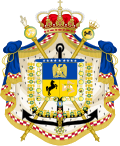 Coat of arms of Murat - King of Naples | |||||||||||||
| |||||||||||||
| Predecessor | title established | ||||||||||||
| Successor | Napoleon Louis Bonaparte | ||||||||||||
| |||||||||||||
| Predecessor | Joseph Bonaparte | ||||||||||||
| Successor | Ferdinand IV | ||||||||||||
| Birth | March 25, 1767 , Law , France | ||||||||||||
| Death | October 13, 1815 (48 years old) Pizzo , Calabria , Kingdom of Naples | ||||||||||||
| Burial place | |||||||||||||
| Kind | |||||||||||||
| Birth name | |||||||||||||
| Father | |||||||||||||
| Mother | |||||||||||||
| Spouse | |||||||||||||
| Children | , , and | ||||||||||||
| Religion | |||||||||||||
| Awards |
| ||||||||||||
| Military service | |||||||||||||
| Years of service | 1787-1813 | ||||||||||||
| Affiliation |  France France | ||||||||||||
| Type of army | cavalry | ||||||||||||
| Rank | Marshal of the Empire | ||||||||||||
| Commanded | reserve cavalry of the great army | ||||||||||||
| Battles | Donauwoerth (1805) Wertingen (1805) Austerlitz (1805) Jena (1806) Preisis Eilau (1807) Heilsberg (1807) Smolensk (1812) Borodino (1812) Dresden (1813) Leipzig (1813) | ||||||||||||


He was married to Napoleon's sister Carolina Bonaparte . For military successes and outstanding courage, Napoleon rewarded Murat in 1808 with a Neapolitan crown . In December 1812, Murat was appointed Napoleon commander of the French troops in Germany, but left the post without permission at the beginning of 1813. In the campaign of 1813, Murat took part in a number of battles as Marshal of Napoleon, after the defeat in the battle of Leipzig he returned to his kingdom in southern Italy, and then in January 1814 he sided with the opponents of Napoleon. During Napoleon's triumphant return to power in 1815, Murat wanted to return to Napoleon as an ally, but the emperor refused his services. This attempt cost Murat a crown. In the fall of 1815, according to investigators, he tried to regain the Kingdom of Naples by force, was arrested by the authorities of Naples and executed.
Napoleon of Murat: “There was no more resolute, fearless and brilliant cavalry chief ... [2] He was my right hand, but, left to his own devices, he lost all his energy. In view of the enemy, Murat excelled with courage in the whole world, in the field he was a real knight, in his office - a bouncer without mind and determination ” [3] .
Biography
The early years
Joachim Murat was born March 25, 1767 in the south of France in the village of Labastide-Fortuniere (now Labastide-Muir) near Toulouse in the family of the innkeeper Pierre Muir (1721-1799) [4] . He was the youngest child in a large family; mother Jeanne Lubier gave birth to him at the age of 45. Thanks to the patronage of the Talleyrands , which served as Pierre Murat, his son Joachim managed to get a good education.
Murat first studied theology in Toulouse, but by the age of twenty he fell in love with a local girl and began to live secretly with her. When his small savings were over, in February 1787 he enlisted in a horse-jaeger regiment, just passing through Toulouse [5] . Two years later, he was dismissed for violation of his subordination and returned to his father, worked in an inn. In 1791 he recovered in the army, the following year he received the first officer rank of sub-lieutenant (October 15, 1792), and a year later became captain (April 14, 1793). The great French revolution gave an impetus to his career.
Career start
At the end of 1794, the ardent republican captain Murat, who was removed from command of the squadron, went in search of good luck to Paris, where circumstances soon brought him to the young General Bonaparte.
In October 1795, a royalist rebellion took place in Paris (the uprising of 13 Vandemeier). In a critical situation, the revolutionary Directory appointed Napoleon for its defense. He did not have significant forces and decided to use artillery to disperse the rebels. Murat volunteered to deliver 40 guns from Sablon ( French Camp des Sablons ) to the center of Paris. Avoiding the meeting with the royalists, he successfully completed the task. On October 4, 1795, Napoleon gave the order to shoot the crowd of royalists with buckshot , and Murat the next year at the age of 29 became a brigadier general (May 10, 1796) for his courage in the Italian campaign . The words "Honor and Ladies" were engraved on the blade of his saber.
In the Egyptian expedition of 1798, Murat commanded the French cavalry. In the battle of Abukir on July 25, 1799, he personally led several squadrons into the attack. In the battle, he cut off the fingers of his hand to the commander of the Turks, Said Mustafa Pasha , who, in response, wounded Murat in the jaw with a pistol shot [6] . For a successful battle, Murat received the rank of division general (July 25, 1799).
Near Napoleon. 1799-1808
The role of the latter in the coup d'etat of the 18th Brumaire (November 9) of 1799 testifies to Napoleon's complete trust in Murat. It was Murat who commanded the grenadiers, who dispersed on November 10 the Council of the Five Hundred , the House of People's Representatives of the French Parliament. The historian E.V. Tarle described this event as follows:
There was a rumble of drums, and the grenadiers, led by Murat, entered the palace with a cursory step ... An unceasing drum battle drowned out everything, the deputies fled on a mass run. They ran through the doors, many opened or smashed the windows and jumped into the yard. The whole scene lasted from three to five minutes. It was not ordered either to kill the deputies or to arrest ... For a second, the thundering voice of Murat, drowning out the drums, ordered his grenadiers: “Throw this whole audience out to me!”, Sounded in their ears not only in these first minutes, but was not forgotten by many of them, as we know from memories, their whole life [7] .
Napoleon seized power in France as the first consul, while still retaining nominal co-rulers.
On January 20, 1800, Murat became related to Napoleon, taking his eighteen-year-old sister Caroline as his wife.
In 1804, he served as governor of Paris.
May 19, 1804 became the Marshal of France .
Since August 1805, the commander of the reserve cavalry of Napoleon - an operational unit in the Great Army , designed to deliver concentrated cavalry strikes.
In September 1805, Austria, in alliance with Russia, launched a campaign against Napoleon , in the first battles of which it suffered a series of defeats. Murat distinguished himself by the daring capture of the only whole bridge across the Danube in Vienna . He personally convinced the Austrian general guarding the bridge of the beginning of the ceasefire, then, with a sudden attack, prevented the Austrians from blowing up the bridge, thanks to which the French troops crossed the left bank of the Danube in mid-November 1805 and found themselves on the retreat line of the Kutuzov army. However, Murat himself fell for the trick of the Russian commander, who managed to assure the marshal of the conclusion of peace. While Murat was checking the Russian message, Kutuzov had only one day to withdraw his army from the trap. Later, the Russian army was defeated in the battle of Austerlitz . However, after this serious defeat, Russia refused to sign the peace.
On March 15, 1806, Napoleon awarded Murat the title of Grand Duke of the German Principality of Berg and Cleve , located on the border with the Netherlands.
In October 1806, Napoleon began a new war with Prussia and Russia .
In the battle of Preisis-Eilau on February 8, 1807, Murat proved himself to be a brave massive attack on Russian positions led by 8 thousand horsemen (“attack of 80 squadrons”), however, the battle was the first in which Napoleon did not win a decisive victory.
After the conclusion of the Tilsit Peace in July 1807, Murat returned to Paris, and not to his duchy, which he clearly neglected. Then in order to consolidate the peace, he was awarded by Alexander I the highest Russian order of St. Andrew the First-Called .
In the spring of 1808, Murat, at the head of an 80,000th army, was sent to Spain. On March 23, he occupied Madrid , in which a rebellion broke out on May 2 against the French occupation forces , and up to 700 Frenchmen died. Murat resolutely suppressed an uprising in the capital, dispersing the insurgents with buckshot and cavalry. He established a military tribunal under the supervision of General Pear . By the evening of May 2, 120 captured Spaniards were shot, after which Murat stopped the execution of sentences [8] . A week later, Napoleon castled: his brother Joseph Bonaparte resigned the title of Neapolitan king for the crown of Spain, and Murat took the place of Joseph.
King of Naples. 1808-1812
On August 1, 1808, Napoleon honored his loyal marshal and relative with the crown of Naples, a kingdom in southern Italy . Joachim Napoleon, as Murat has since called himself, solemnly drove into Naples and began with an amnesty of political criminals.
In October 1808, he recaptured the island of Capri from the British and in subsequent years ensured the security of the southern flank of Napoleon's empire.
In September 1810, Murat with the Neapolitan forces tried to capture the island of Sicily , but was recaptured by the British.
Since 1810, Murat’s attitude towards France and Napoleon has changed. Considering his own army strong enough for the needs of the state and dissatisfied with the behavior of the French generals, whom he accused of failure of the expedition to Sicily, Murat asked Napoleon to recall the French auxiliary corps, but received a decisive refusal. Murat then ordered French officials to accept Naples citizenship; Napoleon in response to this announced that the Kingdom of Naples is part of a great empire, and the subjects of the French Empire are rightfully at the same time subjects of the Kingdom of Naples. This manifesto made Murat's position rather difficult; he already had to wage a difficult struggle against the royalists, robber gangs, financial difficulties, systematically plotting. He began to surround himself with spies and began to gradually abolish the liberal reforms that he himself had introduced.
1812 Russian Campaign
During a campaign in Russia in 1812, Murat commanded the reserve cavalry of the Great Army - three corps, numbering more than 30 thousand horsemen at the beginning of the campaign. The first half of the campaign, he acted in the forefront, attacking the retreating Russian army as soon as possible. He personally led the cavalry regiment in the battle near Ostrovno , unsuccessfully tried to delay the withdrawal of the Neverovsky division in the battle for Smolensk , and unsuccessfully tried to bring down the Russian barriers near Valutino . Extremely proud, the king of Naples quarreled so much with Marshal Davout at the end of August near Vyazma that he was about to find out his saber relationship, but his close associates managed to dissuade him [9] .
In the battle of Borodino, Murat proved himself to be the best. He carried cavalry with his personal courage, was surrounded by redoubts and fought off the Russians with a saber, until the attack of the French infantry helped him out. While most of the time in the center of the battle under fire, Murat happily survived the battle, in which the French army lost more than 40 generals killed and wounded.
Murat then commanded the vanguard, closely following the retreating Russian army. Kutuzov managed to knock Murat off the trail, drag him in a false direction to Ryazan, and meanwhile deploy troops and take a flanking position south of Moscow. There was a lull in the fighting, the advanced posts of the Russians and the French entered into conversation. In his memoirs, General Ermolov describes these remarkable encounters as follows:
More than once, General Miloradovich had a meeting with Murat, the king of Neapolitan ... Murat was now dressed in Gishpan, now in a fictitious, stupid outfit, with a sable cap, in the eye-drawers. Miloradovich - on a Cossack horse, with a whip, with three shawls of bright colors, inconsistent with each other, which, wrapped around the neck with their ends, fluttered in full length according to the will of the wind. There was no third such thing in the armies! [ten]
The special attitude of the Cossacks to Murat is indicated by Arman de Colencourt and Philippe Paul de Segur . From the memoirs of Segur:
Murat happily appeared in front of enemy outposts. He enjoyed the fact that he attracted all his eyes. His appearance, his courage, his rank drew general attention to him. The Russian bosses did not at all show disgust for him; on the contrary, they showered him with signs of attention that supported his illusion ... For a moment Murat was even ready to think that they would not fight against him!
He went so far that Napoleon, reading his letter, once exclaimed: “Murat, king of the Cossacks? What nonsense! People who have achieved everything can come up with all kinds of ideas! ” [11]
In the Tarutino battle , which marked the beginning of Napoleon’s retreat, the French avant-garde under the command of Murat was defeated by a surprise attack by Russian divisions. From complete destruction he was saved by the energy and courage of Murat, who managed to organize resistance and calm panic. After this, the king of Naples did not play a noticeable role in subsequent battles, the French cavalry because of the death of horses turned into infantry and could not effectively fight against the Russians.
Napoleon, leaving the army on December 6, 1812, transferred the main command to Murat. According to the testimonies of his comrades-in-arms, Napoleon did not consider Murat as a commander, but hoped that he would be able to captivate the soldier with his energy and determination. The king of Naples was tasked with gaining a foothold in Vilna and stopping the advance of the Russian troops, while the French emperor was gathering fresh armies. In the unanimous opinion of the French side, Murat did not cope with the duties assigned to him. The remnants of the French army in Russia lost all control, everyone escaped as best he could. Napoleon, according to Kolenkur, sharply spoke about Murat:
What would save a hundred brave people died under the nose of tens of thousands of brave men through the fault of Murat. The captain of the Voltigeurs would be better in command of the army than he ... There are no more courageous people on the battlefield than Murat and Ney , and there are no less determined people than them when you need to make some decision in your office [12] .
A month later (January 16, 1813) Murat arbitrarily surrendered the command of the army to Eugene de Beauharnais , and he went to save his kingdom, from which he received disturbing news. The change of command was officially announced in connection with Murat’s disease. Napoleon regarded his act as desertion, but soon forgave the pet.
King of Naples. 1813-1815
Murat returned to Napoleon's army in June 1813, at the beginning of the most active phase of the campaign. He successfully commanded the cavalry in the battle of Dresden , but after losing the Battle of the Nations on October 24 left Napoleon. Extremely annoyed by the insults that Napoleon showered on him, Murat decided to change him and entered into a secret treaty with Austria on January 8, 1814, under which he pledged to move a 35,000-strong corps against the troops of the kingdom of Italy led by Beauharnais.
A proclamation to the troops, Murat announced that the interests of the state require the separation of the Naples case from the case of Napoleon and the accession of the Neapolitan troops to the Allied forces. Murat moved his troops against a former ally in the Great Army - Beauharnais, on January 19, took Rome, then Florence and Tuscany . Murat avoided active hostilities, hesitated, did not find the previous energy and, in general, did nothing directly on the battlefield. He entered into secret negotiations with Napoleon, demanding all of Italy south of the Po River . In a letter dated February 18, 1814, Napoleon reprimanded his favorite:
Take advantage, since it happened, of the advantage of treason, which I attribute solely to fear, in order to provide me with valuable information. I am counting on you ... You have done me as much harm as you could, starting from your return from Vilna; but we will not touch this anymore. The title of king tore your head. If you want to keep it, put yourself right and keep your word [13] .
Napoleon's abdication violated Murat’s plans. In May 1814, he sent troops to the Kingdom of Naples.
Murat’s representatives were not allowed for peace talks in Vienna. The Allied powers were in no hurry to recognize his legitimacy, tending to return the throne to the former King of Both Sicilies Ferdinand IV (at whose disposal remained Sicily). 150,000 Austrian troops were concentrated in northern Italy to displace Murat [14] , but the events took an unexpected turn.
On March 1, 1815, Napoleon left Elba and landed in France, marking the beginning of a triumphant return to power . Murat immediately took advantage of this and declared war on Austria on March 18. He addressed the to all Italians as a single nation, for the first time designating a movement for the unification of feudally fragmented Italy. In a proclamation, he called on the people to fight for the liberation of Italy from foreign (that is, Austrian) troops: “80 thousand soldiers from Naples, led by their king [Murat], vowed not to stop until they liberated Italy. We call on Italians from every province to help implement this great plan. ” [15] Murat actually had 42 thousand soldiers with whom Rome occupied, then Bologna and a number of other cities, until he reached the Po River, where he was defeated. The Austrian corps of Bianchi and Nugent went on the counterattack.
The decisive battle took place on May 2, 1815 . On the first day, Murat managed to disperse the Austrian vanguards, but the next day, Bianchi strengthened with reinforcements and attacked Murat. Murat, personally leading the battalions, with a successful counterattack threw the Austrians back to their original fortified position. However, at another section of the battle, the Austrians overthrew the Neapolitan division, and Murat had no choice but to retreat in front of superior forces (40 thousand Austrians versus 27 thousand Neapolitan army). At this moment, a notice came of the passage of the 12,000th Austrian corps of Nugent to the rear of the Neapolitan army. Moreover, a rebellion broke out in southern Italy in favor of the former king of Naples, Ferdinand. Having left the army to his general Charaskoz, Murat rushed to save his family in Naples, whose inhabitants took to the streets against Joachim Napoleon.
On May 19, Murat departed on a ship to France, disguised as a sailor; his family was evacuated to Austria on an English ship. Napoleon, who had not even had time to speak out against the Allies, did not want to see the fugitive Marshal and ordered him to wait for further orders in Toulon in southern France, so that Murat did not take part in the Battle of Waterloo .
Fate was predetermined for Murat to fall. I could take him to Waterloo, but the French army was so patriotic, so honest that it is doubtful that it would overcome the disgust and the horror that it felt for the traitors. I do not think that I had so much power to support him, and yet he could bring us victory. We really missed him at some moments of that day. Break through three or four English squares - Murat was created for this; there was no more determined, fearless, and brilliant cavalry chief.
- Napoleon about Murat in a conversation of February 8, 1816 [16]
Death. 1815
After the second restoration, Murat left France on August 23 and took refuge from the persecution of royalists in Corsica [17] , where he gathered 250 armed supporters. Austria issued a passport to Murat with the condition of renunciation of the title of king and submission to Austrian laws, granted the title of count and residence in Bohemia. The enthusiastic reception shown in Corsica inspired Murat to a daring adventure. He drew up a landing plan in Naples, in the hope that all the people would rise under his banner. September 28, 1815 his flotilla of six ships left Corsica.
The winds strongly delayed the advance, then the storm scattered the flotilla, some of the ships returned. Murat, left with two ships, under the persuasion of his associates decided to go to Trieste with the Austrians, abandoning the adventure. The captain convinced him to land to replenish provisions. Murat, prone to theatrical effects, ordered to go ashore in full uniform.
Murat landed on October 8 ashore in Calabria near the town of Pizzo with 28 soldiers. Local residents, including the garrison, accepted his appearance with restraint, without enthusiasm and without hostility. From Pizzo Murat moved to the district center of Monte Leone, but here his team was fired by gendarmes. Murat retreated to the landing site, but his ship had already left. The gendarmes threw the former king into prison, where he was treated with respect, awaiting instructions from the government of Naples.
During the first interrogations, Murat behaved evasively, trying to prove that he landed on the shore without the intention of launching an uprising carried by the storm. The evidence was a found proclamation calling for rebellion, which they forgot to destroy before the landing. On October 13, 1815, a military court sentenced Murat to execution with immediate enforcement of the sentence. He wrote a farewell letter to the family, in which he expressed regret only that he was dying away from children. Standing in front of the soldiers, Murat kissed a medallion with a portrait of his wife and ordered: “Save your face, aim in your heart!” [18] , after which he was shot in a volley of 12 guns.
Military ranks
- Horse Ranger (February 23, 1787)
- Junior Lieutenant (May 30, 1791)
- Lieutenant (October 31, 1792)
- Squadron Commander (May 1, 1793)
- Colonel (February 2, 1796)
- Brigadier General (May 10, 1796)
- Division General (July 25, 1799)
- Marshal of the Empire (May 19, 1804)
Titles
- Prince of the French ( French: Prince français ; February 1, 1805)
- Grand Admiral of the Empire ( French Grand amiral de l'Empire ; February 1, 1805)
- Grand Duke Berg and Cleve ( French: Grand-duc de Berg et de Clèves ; from March 15, 1806 to August 1, 1808)
- King of Naples ( French: Roi de Naples ; from August 1, 1808 to May 3, 1815)
Rewards
- Legionnaire of the Legion of Honor (December 11, 1803)
- Grand Officer of the Legion of Honor (June 14, 1804)
- Badge of the Great Eagle of the Legion of Honor (February 2, 1805)
- Large chain of the Legion of Honor (February 5, 1805)
- Cavalier of the Order of the Black Eagle ( Kingdom of Prussia , May 18, 1805)
- Grand Cross of the Military Order of Maximilian Joseph ( Kingdom of Bavaria , 1805)
- High dignitary of the Order of the Iron Crown ( Kingdom of Italy , February 20, 1806)
- Cavalier of the Order of St. Apostle Andrew the First-Called (Russia, July 3 [15] 1807)
- Cavalier of the Order of St. Alexander Nevsky (Russia, June 27 [July 9] 1807)
- Cavalier of the Order of the Route Crown ( Kingdom of Saxony , July 12, 1807)
- Grand Cross of the Order of St. Joseph ( Grand Duchy of Wurzburg , 1808)
- Grand Master of the Royal Order of the Two Sicilies ( Kingdom of Naples , August 1, 1808)
- Grand Commander of the Order of the Westphalian Crown ( Kingdom of Westphalia )
- ( Dutch Kingdom )
- Cavalier of the Order of the Golden Fleece (Spain)
Murat in reviews of contemporaries
Kolenkur about Murat:
His ill-fated passion for magnificent costumes led to the fact that this brave of kings, this king of brave men had the appearance of a king from the boulevard stage. The emperor found him funny, told him this and repeated it publicly, but did not get angry at this quirk that the soldiers liked, especially since it attracted the attention of the enemy to the king and, therefore, exposed him to greater dangers than them [12] .
Segur left such a review of Murat during the attack on Moscow:
Murat, this theatrical king in the sophistication of his outfit and a true monarch in his extraordinary courage and ebullient activity, was bold as a retaliating attack, and always had the appearance of superiority and menacing courage, which was the most dangerous weapon of the offensive [19] .
Murat Family
Murat and Carolina Bonaparte had four children:
- Napoleon-Achille Murat (Napoléon Achille Murat, 1801-1847) - the eldest son, in 1821 he moved to the United States; during the Belgian revolution he joined the Belgian army, but then returned to America.
- Maria Letizia Josephine Murat (1802-1859)
- Lucien Charles Joseph Napoleon Murat , Prince of Ponte Corvo (Napoleon Lucien Charles Murat, 1803-1878) - the second son, also lived in America, then returned to France; in 1849-1850 he was plenipotentiary minister of France in Turin . In 1853, Napoleon III appointed him senator. In the second half of the 1850s, he sought to obtain the throne of Both Sicilies as heir, but Napoleon III did not support the applicant, and his hopes were not realized.
- Louise Julia Carolina Murat (1805–1889)
Movies
- " Napoleon " (mini-series, 2002), in the role of Murat Claudio Amendola.
- “Fire in My Heart” (Italy, 2006, director Lamberto Lambertini).
See also
- Murat
- Bonaparte
- Capodimonte Observatory
Notes
- ↑ https://www.tombes-sepultures.com/crbst_1554.html
- ↑ Corsican. Diary of Napoleon's life in his own words. - By: Johnston RM The Corsican. A Diary of Napoleon's Life in His Own Words. - 1910.
- ↑ V. V – v. Murat, Joachim // Brockhaus and Efron Encyclopedic Dictionary : in 86 volumes (82 volumes and 4 additional). - SPb. , 1890-1907.
- ↑ The text of the birth certificate of Murat from the archive of the city of Bastide-Fortuniere (now Bastide-Murat). “On March 25, 1767, Joachim Murat-Jordi, the legitimate son of the inhabitants of this parish, Pierre Murat-Jordi and Jeanne Labujer, was born in this parish, and was baptized in the church of this parish on March 26.” 1st volume of correspondence of Marshal Murat, published by A. Lumbroso in Paris in 1908, p. 2 [1] Archived copy of November 14, 2007 on the Wayback Machine
- ↑ Murat // The Court and Camp of Bonaparte . - N. Y .: Harper & bros., 1842. - S. 332.
- ↑ Napoleon I Bonaparte. Campaigns in Egypt and Syria (1798-1799) = Mémoires pour servir à l'histoire de Napoléon, Capagnes d'Egypte et de Syrie, 1798-1799. - St. Petersburg, 1994.
- ↑ Tarle E.V. IV. Eighteenth Brumaire 1799 // Napoleon.
- ↑ Baines E. Hystory of the wars of the French revolution. - L. , pub. in 1818. - Vol. 2, bk. 4, ch. 5, p. 67.
- ↑ De Segur F.-P. Campaign in Russia: Notes of the adjutant of Emperor Napoleon I. - Ch. 2. - Smolensk: Rusich, 2003.
- ↑ Notes by General Ermolov, Chief of the General Staff of the 1st Western Army, in the Patriotic War of 1812. Note 69
- ↑ De Segur F.-P. Campaign in Russia: Notes of the adjutant of Emperor Napoleon I. - Ch. 4. - Smolensk: Rusich, 2003.
- ↑ 1 2 Kolenkur, A. Napoleon's campaign in Russia. - Ch. 9.
- ↑ The Court and Camp of Bonaparte. Murat. Compilation published in 1842, NY, p. 335
- ↑ Archibald Alison, “Lives of Lord Castlereagh and Sir Charles Stewart”, vol. II, pub. in 1861, p. 591
- ↑ Marshal Murat's Proclamation to the Italians. Rimini, March 30, 1815.
- ↑ Corsican. Diary of Napoleon's life in his own words.
- ↑ Corsica was formally under the rule of the French Bourbons, but in fact there was anarchy in transition.
- ↑ The Court and Camp of Bonaparte. Compilation published in 1842, NY, pp. 341–348: the story of Murat’s landing and death in Calabria
- ↑ De Segur F.-P. Campaign in Russia: Notes of the adjutant of Emperor Napoleon I. - Ch. 3. - Smolensk: Rusich, 2003.
Literature
- Tular J. Murat, or Awakening of the Nation / trans. with fr. - M .: Terra, 1993 .-- 382 p.
- Dumas, Alexandre. Crimes célèbres. - Éditions Phébus, 2002 .-- T. 2.
- Dupont, Marcel. Murat, Cavalier, Maréchal de France, Prince et Roi. - Éditions Copernic, 1980. - ISBN 2-85984-050-8 .
- Gallois, Léonard. Histoire de Joachim Murat. - Paris: Schubart, 1828.
- Hulot, Frédéric. Murat. La chevauchée fantastique. Présenté par Son Altesse le Prince Murat. - Paris: Ed. Pygmalion, Gérard Watelet, 1998 .-- ISBN 2-85704-536-0 .
- Prieur, Jean. Murat et Caroline. - Paris: Éditions Fernand Lanore, 1985 .-- ISBN 2-85157-011-0 .
- Schmidt, Charles. Das Großherzogtum Berg 1806-1813 (Le Grand-Duché de Berg): Eine Studie zur französischen Vorherrschaft in Deutschland unter Napoleon I. Aus dem Französischen übersetzt von Lothar Kellermann und mit Beiträgen von Burkhard Dietz hchrggrötsch Jrgrs . von Burchardt Dietz und Jörg Engelbrecht. - Bergische Forschungen, B. XXVII. - Neustadt / Aisch, 1999 .-- ISBN 3-87707-535-5 .
- Schmidt, Gerold. Zum 50jährigen Bestehen des Landes Nordrhein-Westfalens: Der historische Beitrag des Rheinlandes zur Entstehung Nordrhein-Westfalens // Rheinische Heimatpflege. - Köln 33. Jahrgang 1996. - P. 268-273.
- Tulard, Jean. Murat. Fayard 1999. ISBN 2-213-60372-3 .
- Dictionnaire Napoléon / Jean Tulard (dir.). - Fayard, 1999.
- Mémoires du général Griois 1792-1822. - Éditions du Grenadier, 2003.
Links
- Murat, Joachim Napoleon // Mine officer class - Nyssa. - SPb. ; [ M. ]: Type. t-va I. D. Sytin , 1914. - S. 500-502. - ( Military Encyclopedia : [in 18 vol.] / Edited by K. I. Velichko [and others ]; 1911-1915, v. 16).
- Zakharov, Sergey. Marshal Murat . BUT! (October 26, 2011). Date of treatment March 27, 2015.