Abdullah I ibn Hussein [3] ( Arabic. عبد الله الأول بن الحسين ; 1882 , Mecca - July 20, 1951 , Jerusalem ) - the first king of Jordan ( 1946 - 1951 ) and founder of the Hashemite dynasty of Jordan. Since 1921, the emir of Transjordan .
| Abdullah I ibn Hussein | ||||||||||||
|---|---|---|---|---|---|---|---|---|---|---|---|---|
| Arab. عبد الله الأول بن الحسين | ||||||||||||
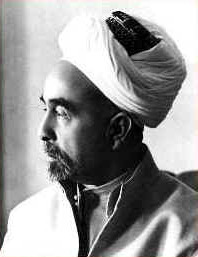 Abdullah ibn Hussein | ||||||||||||
| ||||||||||||
| Coronation | May 25, 1946 | |||||||||||
| Predecessor | himself as Emir of Transjordan | |||||||||||
| Successor | Talal ibn Abdullah | |||||||||||
| ||||||||||||
| Predecessor | title established | |||||||||||
| Successor | himself like a king | |||||||||||
| Birth | 1882 Mecca , Hijaz | |||||||||||
| Death | July 20, 1951 Jerusalem , Jordan | |||||||||||
| Burial place | Royal cemetery, Amman | |||||||||||
| Kind | Hashimites | |||||||||||
| Father | Hussein ibn Ali al-Hashimi | |||||||||||
| Spouse | ||||||||||||
| Children | Talal ibn Abdullah | |||||||||||
| Religion | Islam | |||||||||||
| Awards |
| |||||||||||
| Rank | ||||||||||||


Born in Mecca in the family of her sheriff - Hussein bin Ali . In 1896, together with his brother, he was sent to Istanbul to the court of the Ottoman Sultan to study and as hostages from the Hashemite family. In 1909 - 1916 he was a deputy of the Turkish parliament and its vice-chairman. He was associated with the English authorities in Egypt . In 1916 - 1918 he led the Arab units besieging the Turkish garrisons in Hijaz . He was the Minister of Foreign Affairs of the state of Hijaz. In 1920 he was proclaimed king of Iraq , but a year later he was removed in favor of his younger brother Faisal , expelled from Syria. In 1921, with the help of England, he became the emir of Transjordan , [4] and after the declaration of independence from May 25, 1946 , he became king. He concluded a number of agreements with England, which turned the country into an English bridgehead in the Middle East and granted it unlimited control over the country's finances. In the 1930s conducted a series of punitive expeditions against the Bedouins. In 1936 , during the Arab uprising in Palestine, he offered his services as a mediator, and although the Arabs met his offer more than coolly, this step seriously strengthened his position and allowed him to put forward a plan for the creation of the Arab Federation.

In 1946, Abdullah ibn Hussein was declared king of the proclaimed independent kingdom of Transjordan . In April 1948, the League of Arab States placed Abdullah at the head of the army [ specify ] [ which one? ] , which was supposed to impede the implementation of the partition plan of Palestine and the creation of the state of Israel there after the abolition of the British mandate and the withdrawal of British troops. As a result of the Arab-Israeli war of 1948-1949, Transjordan occupied the West Bank , in whose territory, in particular, the Partition Plan provided for the creation of an Arab state. After the annexation of the West Bank that followed in 1950. Jordan The name of the Kingdom of Transjordan has been changed to the Kingdom of Jordan .
Shot on July 20, 1951, by a member of a Palestinian terrorist organization on the threshold of the Al-Aqsa Mosque in East Jerusalem , annexed by Transjordan in 1950. After his death, the throne was succeeded by his eldest son, Prince Talal , who was declared legally incompetent due to mental illness, who soon renounced the throne in favor of his son Hussein .
Content
- 1 Children
- 1.1 Sons
- 1.2 Daughters
- 2 Military ranks
- 3 Awards
- 4 notes
Children
Sons
- Talal ibn Abdullah
- Naif ibn Abdullah (1914-1983)
Daughters
- Haya Bint Abdullah (1907-1990)
- Munira Bandage Abdullah (1915-1987)
- Mukbula bandage Abdullah (1921-2001)
- Naifen Bandage Abdullah (1950-2000)
Military ranks
- Field Marshal of the Jordanian Arab Army (Field Marshal Jordan Arab Army, 1948)
- Field Marshal of the Egyptian Army (Field Marshal Egyptian Army, 1949, honorary title)
- British Air Force Commodore (Commodore RAF, October 30, 1940, honorary title)
Rewards
- Knight of the Great Cross of the Order of the British Empire (GBE), 1920 [5]
- The Great Ribbon of the Order of Mesopotamia (Iraq), 1922
- Knight Commander of the Order of St. Michael and St. George , 1927
- The Great Order of the Hashemites (Iraq), 1932
- Order of Faisal I Class 1 (Iraq), 1932
- Knight of the Great Cross of the Order of St. Michael and St. George , 1935
- The Silver Jubilee Medal of King George V , 1935
- Coronation Medal of King George VI , 1937
- Chain of the Order of Muhammad Ali ( Egypt ), 1948
- Chain of the Order of Pahlavi (Iran), 1949
- Grand Cross of the Order of Military Merit in White ( Spain ), 1949
- Grand Ribbon of the Umayyad Order (Syria), 1950
Notes
- ↑ Kamal S. Salibi. The Modern History of Jordan . - IBTauris, December 15, 1998. - P. 93. - ISBN 978-1-86064-331-6 .
- ↑ Hashemite Monarchs of Jordan , "The Emirate of Transjordan was founded on April 11, 1921, and became the Hashemite Kingdom of Jordan upon formal independence from Britain in 1946"
- ↑ It is also possible to spell the name of Abdullah and Abdullah
- ↑ The bodyguard of Emir Abdullah on a camel with a banner of red, green and white in the background on the left . World Digital Library (April 1921). Date of treatment July 14, 2013. Archived July 15, 2013.
- ↑ The Royal Ark