
Half-format camera - a camera with a frame size of 18 × 24 mm, designed for shooting on a 35 mm type-135 perforated film or the same film [1] [2] . Such a frame is called half-format, because its width and area are half of the most common small-format frame 24 × 36 mm.
Small Format Differences
Cameras for 35 mm film were initially used in cinema as a tool for test shooting, which allows saving film [3] . The frame size of the first such cameras naturally corresponded to the size of the “ silent ” movie frame - 18 × 24 mm before the appearance of sound cinema [4] [5] [* 1] . For the purpose of photography itself, a double frame format was proposed - 24 × 36 mm. It was he who soon began to be considered standard for small-format cameras , and the 18 × 24 mm frame was “half” [6] . The focal lengths of lenses for half-format equipment are shorter than for small-format ones due to the small diagonal of the frame. Lenses of 30 mm are considered normal , allowing you to make cameras more compact and get a greater depth of field . Due to the latter circumstance, many half-format cameras have scale focusing or continuous focusing at hyperfocal distance [7] .

Mirrored
" Olympus Pen F T",
Japan, 1966
Two-format
Konica Autoreflex P
Japan, 1965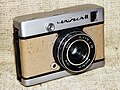
Seagull 2
USSR, 1967
" Zenith surprise MT-1 "

Pentacon Penti


At the same time, the small area of the half-format negative does not allow for photo printing to enlarge the image to large sizes available for small format. On half-format prints, grain, film defects, and blurred outlines due to aberrations of the shooting lens are much more noticeable. The image quality of half-format cameras is not enough for professional photography, so they have become widespread among amateur photographers and in some application areas where the capacity of cassettes and compact compactness are priority. Some models are designed instead of standard Type-135 cassettes for more convenient charging with Rapid cassettes with a capacity of 24 half-format frames [8] .
Distribution
In addition to small-format and half-format cameras, cameras were also produced with other reduced formats - 17 × 24, 18 × 23, 24 × 24, 24 × 30, 24 × 32 mm - which made it possible to save film, but which were not widely used. Cameras with a frame of 18 × 24 mm have been produced at least since 1914, but have been widely used since the late 1950s with the advent of new photographs with improved resolution [9] . In the USSR, the first semi-format camera in 1965 was the " Seagull " [7] . Their main advantages - a twice reduced film consumption, small size and weight - attracted many amateur photographers, and the latest film varieties made it possible to obtain prints of a fairly high quality from a half frame. Mostly scale cameras (“ Canon Demi ” [10] , “ Pentacon Penti ”, “The Seagull ”, “ FED-Mikron ”, “ Agat-18 ”) were produced, but rangefinders (“ Robot Royal 18” [11] are also known , “Ducati Sogno” [12] , “ Nikon S3M” [13] ), and single-lens reflex lenses with interchangeable lenses (the Olympus Pen F family [14] [15] , Zenit-Surprise ).
Half-format cameras have found application in medical and scientific equipment, forensics and in other areas of technical photography. For these purposes, even half-length versions of “full-frame” devices were produced ( Zenit-MT , Zenit-MT-1 [16] , Praktica L2 [11] , Praktica VLC2 [17] , Exa Ib [ 18] , Pentax MF , Nikon FM2 [19] ). The proximity of the sizes of the half-format frame to the filmstrip frame made it possible to independently create films on a reversible film , suitable for demonstration by a filmoscope .
Also known are cameras with a switch that allows you to select one of two formats - 24 × 36 or 18 × 24 mm (“Konica Autoreflex”, “Konica Half Pro FT-1” [20] )
See also
- Small format camera
- " Fir-tree " - a camera of a special design for creating a microfilm .
Notes
- ↑ In 1932, the “classic” 16 × 22 mm movie frame was standardized, and the 18 × 24 frame is used in the modern Super-35 movie format
Sources
- ↑ General Photography Course, 1987 , p. 43.
- ↑ Cameras, 1984 , p. 29.
- ↑ Small-format photography, 1959 , p. eight.
- ↑ Handbook of the cameraman, 1979 , p. 9.
- ↑ Fundamentals of Film Engineering, 1965 , p. 376.
- ↑ Stephen Gandy. Historic 1st Production 24x36 Full Frame 35mm Camera . 1914 Simplex . CameraQuest (October 20, 2013). Date of treatment November 24, 2014.
- ↑ 1 2 Soviet photo, 1967 , p. 38.
- ↑ Soviet photo, 1967 , p. 39.
- ↑ Cameras, 1984 , p. 28.
- ↑ Canon Camera Museum. Demi
- ↑ 1 2 Half Format CAMERAS 135, from 1914 to ours days
- ↑ Stephen Gandy's CameraQuest. Ducati: Great Italian Half-frame Mini "Leica"
- ↑ Stephen Gandy's CameraQuest. Nikon S3M Half-frame & Motordrive
- ↑ Olympus History: Pen Series
- ↑ Stephen Gandy. Largest Half-frame System . Stephen Gandy's CameraQuest (November 26, 2003). Date of treatment February 3, 2019.
- ↑ Medical cameras of the Krasnogorsk Mechanical Plant
- ↑ Mike´s Praktica Collection. Praktica VLC 2 half format
- ↑ The Exakta and Exa pages. Halbformat exa
- ↑ Stephen Gandy. Nikon FM2 Half Frame CameraQuest Date of treatment January 22, 2013. Archived on February 5, 2013.
- ↑ Half Format CAMERAS 135, from 1914 to ours days
Literature
- A.N. Vedenov. Small-format photography / I.V. Barkovsky. - L .: Lenizdat, 1959. - S. 45-48. - 675 s. - 200,000 copies.
- E.M. Goldovsky . Fundamentals of film technology / L.O. Eisymont. - M.,: “Art”, 1965. - 636 p.
- Gordiychuk, I. B. Directory of the cameraman / I. B. Gordiychuk, V. G. Pell. - M.,: Art , 1979. - 440 p. - 30,000 copies.
- Fomin A.V. § 6. Classification of cameras // General course of photography / T. P. Buldakova. - 3rd. - M .: "Legprombytizdat", 1987. - S. 43-48. - 256 s. - 50,000 copies.
- M. I. Shulman. Cameras / T. G. Filatova. - L .: "Engineering", 1984. - 142 p. - 10,000 copies.
- M. Shtykan. About half-format cameras (Russian) // " Soviet Photo ": magazine. - 1967. - No. 2 . - S. 38-39 . - ISSN 0371-4284 .