

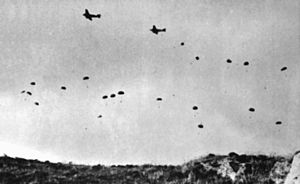
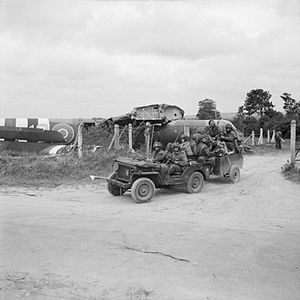

Airborne landing (from French descente [1] - landing , descent ) - holding a landing with the delivery of specially prepared formations , units and subunits to the enemy rear rear with aircraft ( military transport aircraft , army helicopters, gliders ) to perform combat ( special ) tasks.
Content
Combat missions
As a rule, tactical airborne assault forces are distinguished from the composition of combined-arms associations, formations and units, which are landed behind enemy lines from helicopters to assist troops advancing from the front in breaking through the enemy's defensive positions, destroying tactical nuclear weapons, command posts, capturing and holding bridges , ferries and other tasks.
The basis of the operational-strategic and operational airborne assault forces are the formations and units of the airborne troops, air assault and airmobile forces, sometimes mechanized troops can be added to their composition. They carry out landing in the rear of the enemy for the seizure of important military-economic areas, disorganization of state and military administration, the destruction of nuclear weapons and major military installations. By means of landing, airborne assault forces are divided into parachute , landing and combined (parachute landing).
When conducting a parachute landing, all personnel, military equipment, materiel are parachuted and cargo multi-domed parachute systems. The landing party can be landed anywhere, at any time of the day or night, directly on the object, near the target (at a distance of 3 km) and at some distance from the object (more than 3 km). Landing troops land from planes, helicopters or gliders, using the capture of airfields and landing sites behind enemy lines.
When conducting combined landing, personnel and light weapons are parachuted, and heavy military equipment and its crew (clearance) land from aircraft at airdromes and platforms captured by paratroopers.
The airborne units , units and formations, as a rule, are airborne and operate independently, the air assault and airmobile units , the units and formations, as a rule, are airborne and operate together with them, but they are all being prepared for combat and combat operations. , air assault, raid, anti-terrorist and peacekeeping operations and can be parachuted, landing and combined by helicopters and airplanes, depending on the assigned combat missions and conditions about adjustments.
Views
By the number of troops involved in the nature of the tasks that are being performed, the depth of landing (ejection) of the landing can be:
- operational-strategic;
- operational;
- operational-tactical;
- tactical;
- special purpose.
By management : [2]
- strategic;
- operational;
- tactical.
By tasks :
- intelligence;
- diversionary;
- reconnaissance and sabotage;
- constraining;
- distracting.
On Wednesdays :
- airborne landing;
- aircraft landing;
- glider landing;
- helicopter landing;
Landing Technique
- for airborne assault, BMD ( airborne assault vehicle or airborne assault vehicle) are used - combat tracked floating vehicles , airborne parachute , parachute-reactive or landing.
- Air assault helicopter
Known Operations
- Troopers at Fort Eben-Emael (1940)
- Cretan operation (1941)
- Operation Market Garden (1944)
- Vyazemsky airborne operation (1942)
See also
- The Airborne Troops (VDV) is a highly mobile military branch designed to cover the enemy in the air and conduct combat and sabotage operations in its rear .
- Air Assault
- Airborne troops
Notes
- ↑ Landing in dictionaries.
- ↑ Great Soviet Encyclopedia (TSB), Third Edition, issued by the Soviet Encyclopedia Publishing House in 1969 - 1978 in 30 volumes
Literature
- Ford, John A .; Elton, Robert M. The Airborne: A General Purpose Force . // Infantry . - March-April 1975. - Vol. 65 - No. 2.