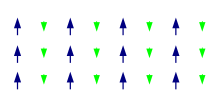
Ferrimagnets are materials in which the magnetic moments of atoms of different sublattices are oriented antiparallel, as in antiferromagnets , but the moments of different sublattices are not equal, and, therefore, the resulting moment is not equal to zero. Ferrimagnets are characterized by spontaneous magnetization. Different sublattices in them consist of different atoms or ions, for example, they can be different iron ions, Fe 2+ and Fe 3+ . The properties of ferrimagnets are possessed by some ordered metal alloys, but mainly various oxide compounds, among which ferrites are of the greatest practical interest.
Ferrimagnets have a domain structure consisting of two or more sublattices connected antiferromagnetically (antiparallel). Since the sublattices are formed by atoms (ions) of various chemical elements or their unequal number, they have different magnetic moments directed antiparallel. As a result, a nonzero difference in the magnetic moments of the sublattices appears, leading to spontaneous magnetization of the crystal. Thus, ferrimagnets can be considered as uncompensated antiferromagnets (their magnetic moments of atoms are not compensated). These materials got their name from ferrites - the first uncompensated antiferromagnets, and the magnetism of ferrites was called ferrimagnetism. In ferrites, the domain structure, as in ferromagnets, is formed at temperatures below the Curie point . Ferrites are applicable to all magnetic characteristics introduced for ferromagnets. Unlike ferromagnets, they have a high resistivity, a lower saturation induction, and a more complex temperature dependence of induction. Ferromagnetism in metals is explained by the presence of an exchange interaction, which is formed between adjacent atoms, as well as by the mutual orientation of spin magnetic moments. In ferrimagnets, the magnetic moments of the ions are antiparallel oriented, and the exchange interaction does not occur directly, but through the oxygen ion O 2− . This exchange interaction is called indirect exchange or superexchange. It intensifies as the intermediate angle approaches from 0 ° to 180 °.
Literature
See also
- Paramagnets
- Diamagnetics
- Antiferromagnets
- Ferromagnets
- Spermagnets
- Asperomagnets
- Helimagnets
- Spin Glass
- Micomagnets
- Sperimagnets
- Aromatics [1]