Palace pier - the main descent to the Big Neva in St. Petersburg , designed by architect Carl Rossi in the first quarter of the 19th century and decorated with lion statues.
| Marina | |
| Marina with lions | |
|---|---|
| Palace marina | |
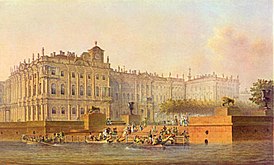 Freshly built marina in the picture of Vasily Sadovnikov . 1840 lithograph | |
| A country |  Russia Russia |
| City | St. Petersburg , Admiralty Embankment , on the axis of the eastern pavilion of the Main Admiralty |
| Project Author | Karl Rossi |
| Builder | A. D. Gotman |
| First mention | 1820 |
| Construction | 1820 - 1824 |
| Key dates | |
| Set bronze lions and porphyry vases - 1832 Vases transferred to Petrovsky descent - 1873 - 1874 Dock moved to the east axis pavilion of the Main Admiralty - 1914 - 1916 Restoration of lions - 1914 - 1916 , 1950s , 2006 , 2007 | |
| Status |  An object of cultural heritage of the peoples of the Russian Federation of federal significance. Reg. No. 781710803800026 ( EGROKN ). (Wikigid database) An object of cultural heritage of the peoples of the Russian Federation of federal significance. Reg. No. 781710803800026 ( EGROKN ). (Wikigid database) |
| condition | Used for its intended purpose |
It is located in close proximity to the Admiralty , the Palace Bridge and the Winter Palace . Used as a pier for pleasure craft.
Content
- 1 Description
- 1.1 Unofficial names
- 2 Construction History
- 2.1 Coney Marley
- 2.2 Statues of Dioscuros
- 2.3 Final selection
- 3 Realignments
- 4 sculpture
- 4.1 Lions
- 4.2 Vases
- 5 Pier in art
- 6 notes
Description
As of 2008, the pier was used as a pier for pleasure boats, in 2004 it was used as a stop for a water bus [1] . Since the beginning of the 20th century, a floating restaurant has been moored to the marina, and this entertainment complex near architectural monuments has its opponents [2] .
The marina is a wide granite staircase descent to the Big Neva . It consists of two marches of eight steps, marches are divided among themselves by a small granite platform. This platform at the edges has two ledges overlooking the river. Behind these protrusions from the coast are granite pedestals of lions. The monotony of the vertical parallelepiped of the pedestal is divided by narrow protrusions. The staircase descent from the sides is limited by the parapet of the embankments.
| ||||||||||||||

Lions stand on cast-iron pedestals, turning heavy foreheads to each other. The formidable faces of animals are peculiar and expressive - lions are depicted with a half-open bared mouth and terrible fangs. The strength and dexterity of the predator are indicated by the wide chest, powerful paws and a slender muscular body with a tucked up stomach speak. Lions rest on a ball with their front paw with curved claws released.
The lion is called the "King of the beasts." The traditional symbol of power, embodying the power of the sun and fire.
In Egyptian mythology - a symbol of divine power and royal dignity, among the Assyrians and Greeks, lions were considered companions of goddesses, in early Christian art the lion alternately symbolized St. Mark, St. Jerome, and even Christ himself - as "a lion from the tribe of Judah."
Unofficial Names
At the beginning of the XXI century , various names of the pier are used. This is partly due to the fact that the marina is separated from the Winter Palace by traffic flowing through the Palace Bridge . Unofficial names of the object often repeat the names of other marinas, and to them add a clarifying “on the Admiralty Embankment”. The marina is called “ Palace Descent ” [3] , “ Marina with Lions ” [4] [5] or “ Descent with Lions ” [6] [ 7] , “ Admiralteyskaya Marina ” [1] , Admiralteysky Descent [8] .
Construction History
Historically, between the wings of the Admiralty before the construction of the embankment was the Admiralty Marina [9] .
The first ideas for arranging the descent to the Neva at the Winter Palace during the Palace Drive to the Neva before the backfill of the Admiralty Moat ( 1817 ). The first surviving reading of the marina was the work of architect L. Ruska , created before the backfill of the Admiralteysky Moat as part of the design of the embankment between the Admiralty building and the Winter Palace . It was a beautiful marina-staircase, which was decorated with four sculptural compositions. They were allegorical female figures on round pedestals, with lying stone lions facing the palace [10] .
Another project was preserved in the prints department of the M.E.Saltykov -Shchedrin State Public Library . It is a drawing by an unknown artist, depicting a marina with two pairs of lying lions [10] .
| Guillaume Cousteau | ||
| Coney Marley 1745 year | ||
| Marble | ||
| Paris , at the entrance to the Champs Elysees | ||
Coney Marley
The following proposal came from the famous sculptor V.I. Demut-Malinovsky . He created the Horsemen model, which was not approved and was rejected. But on its basis a new idea arose - to decorate the marina with horse groups like the sculpture group “ Coney Marley ”, which is located in Paris at the entrance to the Champs Elysees . The sculptural compositions depicted gigantic frantic horses, with a fierce look and grin of teeth and a waving mane. Horses involve waterworms, which seem small compared to animals. Sculptural groups were created in 1745 by the sculptor Guillaume Cousteau [10] .
On behalf of the St. Petersburg Academy of Arts , a request was sent about the possibility of obtaining small models of Marley horses. There was no reaction to the first request, and in 1827 a second request was sent to France . In response, K.P. Bryullov sent a small drawing of one of the equestrian groups from Paris to the Academy of Arts in February 1828 . In early March, small bronze copies of both groups arrived in St. Petersburg , and on October 5 alabaster arrived to create large models from them [10] .
The commission, requesting the cost of casting the compositions in metal, estimated the cost of 32 thousand rubles per group prohibitively expensive. Models of Marley horses were not made, the search for a more affordable option began [10] .
| ||||||||||||||
Dinosaur statues
In the design of the marina, the architect wanted to establish the lower tier of the statue of lions and the upper tier of the statue of the work of P.K. Klodt .
The sculptor received a government order to carry out two sculptural groups to decorate the marinas of the Admiralty Embankment in late 1832 - early 1833 . In the summer of 1833, the sculptor made models for the project, and in August of the same year, the models were approved by the emperor and delivered to the Academy of Arts for discussion. Members of the academic council expressed full satisfaction with the work of the sculptor and it was decided to complete both first groups in full size [11] .
After this success in the work on this project, a forced pause occurred due to the fact that Klodt completed work on the sculptural composition of the Narva Gate . This break ended in the mid-1830s, and work on the project was continued. Emperor Nicholas I , who oversaw the design of the marina, did not approve of the combination of lions and horses. Instead of Dioscurovs, vases were installed on the pier, and dioscuros were installed on Anichkov bridge [11] [12] .
Final Choice
The palace pier was built in 1820 - 1824 . She was at the exit of the Palace Drive to the Neva. Now at this place is the entrance to the Palace Bridge [13] .
The marina was built according to the drawings of the architect Carl Rossi as part of a project to improve the territory of the Winter Palace after the construction of the arch of the General Staff Building. Emperor Nicholas I himself oversaw the work. Engineer A.D. Gotman built the pier. Simultaneously with these works, Petrovsky descent was built at the western pavilion of the Main Admiralty [12] [13] .
| Marble Florentine Lions | ||
| Marble | ||
| Italy , Florence , Signoria Square | ||
The proposed lion statues of Rossi are an exact copy of the Florentine lions . Casting models were plaster casts from the original, which are stored at the Academy of Arts . The same lions were installed by Karl Rossi at the Mikhailovsky Palace [14] .
After all the details of the marina were approved, there was a pause in the construction of the marina, which has not yet been explained by historians. From 1828 to 1832, there was no progress in the construction of the marina, and from the end of 1832 the events took place one after another. In early May 1832, Nicholas I made his choice: he ordered two porphyry vases sent as a gift by the Swedish king in 1830 to be placed on the lower descent to Bolshaya Neva , and marble statues of Hercules and Flora from the Tauride Palace placed on top of high pedestals [10] .
At the end of the month, the autocrat changes his mind and further work is carried out according to the Rossi project, on May 31, 1832 all details of the project are given the highest attention. On June 5, 1832, work on lion figures and pedestals was launched at the Aleksandrovsky Iron Foundry. In September 1832, lion statues were erected on the Palace Marina at the same time as porphyry vases. At the end of 1832 and the beginning of 1833 P.K. Klodt was entrusted with the work on the dioscurus , but they did not remove either the lions or the vase from the pedestal. And the statues of Hercules and Flora in 1862 were installed in the Alexander Garden [10] [11] .
| A.K. Beggov | ||
| View of the Neva from the Winter Palace . 1881 year | ||
Perestroika
On the pier in 1832, copper lions and porphyry vases were installed. In this form, the pier was until the third quarter of the XIX century: in 1873 - 1874 the vases were transferred to Petrovsky descent. In 1875, a wide boulevard was arranged on the embankment. The embankment has been called Admiralteyskaya since 1874, and in 1879 traffic was opened along the embankment [15] [13] .
Judging by the picture of A. K. Beggrova, the embankment was very different from the current state: it was already and passed much to the left of the current position of the highway. The marina was the dominant coastline, towering on the banks of the Great Neva .
In 1914 - 1916, the pier with lions was moved to the axis of the eastern pavilion of the Main Admiralty due to the construction of the Palace Bridge . Work on the transfer of the pier was carried out by engineer A. P. Pshenitsky [13] .
After the transfer, the appearance of the embankment changed, the marina was compositionally and functionally combined with the left coastal support of the bridge. Lions are below the level of the railings and now the marina is not the dominant coastline.
Sculpture
The ceremonial river gates of the palace were elegantly decorated. It must be remembered that this marina, before the industrial development of aircraft, received most of the guests of the imperial house , as well as all religious rites that took place on the river in the presence of the highest persons, were solemnly carried out from this marina.
Lions
The idea of installing lions on the pier appeared in the first project of Luigi Ruska and went through the red thread through all the design options. In the fall of 1828, an attempt was made to clarify the issue of decorative statues of lions for the marina. All historical documents indicate that the installation of an exact copy of Florentine lions was considered [10] .
As a result, the lions were installed on the Palace pier as a decoration in 1832 [16] . Now the lion pier is located at the eastern pavilion of the Admiralty (next to the Palace Bridge ). According to local historians and bloggers, these lions are the most famous lions of St. Petersburg [10] .
thin Khadzhibaronov S.P. , 1986
Lions are made by minting from sheet copper; figures were made in 1832 at the Alexandrovsky Iron Foundry in St. Petersburg. They were made by the master I. Prang according to the model of the sculptor I. P. Prokofiev. Cast-iron pedestals for lions were cast at the same factory according to the design of architect L. Charlemagne .
Vases
Installed on the pier with lions as a decoration in 1832 . [16] .
Two vases are made of polished porphyry at the Elfdalen lapidary factory in Sweden . Cast-iron pedestals were cast at the same factory and according to the same design as for the lions: at the Aleksandrovsky Iron Foundry according to the design of architect L. Charlemagne . Prior to installation at this site, vases were stored in the Tauride Palace [13]
Vases in 1873-1874 were moved to Petrovsky descent at the western pavilion of the Admiralty (next to the Bronze Horseman ).
Everything can happen at the end of May -
The window languishes with expectation.
How nice to be silent, understanding everything,
When time is at one with us.
The words have not been spoken by you
They didn’t touch the heart depth -
On the pier with the lions, over the Neva
I listen to the recognition of the wave.
Baltic wind cools palms
But I’ll burn my fingers about your temple.
In my soul it’s as if the violin is groaning.
And the city is sleeping, transparent and high ...
Today the sky is strangely green
And for some reason - not a single star.
The white night is getting paler
When you look in your eyes for so long.
We are joyful together and unaware
That everything passes in this living life,
But look how forever alone
Alexandrian angel carrying a cross.
Leningrad poetess [17]
Pier in Art
The very location of the main pier, from the Admiralty , facing the Neva and not far from the Winter Palace , led to the attention of artists from it. She was depicted on her canvases by such masters of fine art as Vasily Sadovnikov ("Palace Pier", 1840 ) and A. K. Beggov ("View of the Neva from the Winter Palace", 1881 ).
The Leningrad poetess I. N. Vazhinskaya also mentioned him in her poem together with the White Nights [17] .
Notes
- ↑ 1 2 Petrovsky Courier. By bus along the Neva (Newspaper article) (inaccessible link - history ) . We were there . Petrovsky Courier (8-01-2004). Date of treatment December 1, 2008.
- ↑ Alexander Bogatyrev. Ice Skating Rink (Russian Line Orthodox News Agency) (December 25, 2007). Date of treatment December 2, 2008. Archived March 21, 2012.
- ↑ Julia Nadezhdina. The day before the subbotnik (Newspaper article). The city . Nevsky time (04/22/2003). Date of treatment November 25, 2008.
- ↑ Water transport (Help site) (unavailable link) . City transport . Date of treatment November 25, 2008. Archived December 30, 2005.
- ↑ On further improvement of the protection of cultural monuments in the RSFSR (as amended on July 10, 2001) . The document . Date of treatment November 25, 2008. Archived March 21, 2012.
- ↑ Санкт-Петербург (Справочный сайт). Рестораны и кафе . Вкусный.ру . Дата обращения 25 ноября 2008. Архивировано 21 марта 2012 года.
- ↑ Каталог ресторанов и кафе (Санкт-Петербург) (Справочный сайт). Рестораны и кафе . Вкусности.ру . Дата обращения 25 ноября 2008. Архивировано 21 марта 2012 года.
- ↑ Пятый канал. На Адмиралтейскую набережную Петербурга вернулся медный лев (Лента новостей). Культура . Сайт пятого канала . Дата обращения 25 ноября 2008. Архивировано 7 июня 2012 года.
- ↑ Б. К. фон Миних. Диспозиция и церемониал торжественного въезда императрицы Анны Ивановны в С.-Петербург 16 генваря 1732 года . — Вып. 2. — СПб: Русский архив, 1867.
- ↑ 1 2 3 4 5 6 7 8 9 Нестеров В. В. Львы стерегут город . — Л. : Художник РСФСР, 1971.
- ↑ 1 2 3 Петров В. Н. Петр Карлович Клодт, 1805—1867. — Л. , 1985.
- ↑ 1 2 Александр Викторович. Дворцовая набережная (недоступная ссылка) . Главная → История Санкт-петербурга → Улицы . walkspb.ru . Дата обращения 19 ноября 2008. Архивировано 19 декабря 2008 года.
- ↑ 1 2 3 4 5 Ю. М. Пирютко. Пристани . Городское хозяйство → Транспорт → Морской транспорт . Энциклопедия Санкт-Петербурга. Дата обращения 24 ноября 2008.
- ↑ Надежда Скворцова. Хрупкие стражи (Львы на Адмиралтейской набережной) (недоступная ссылка — история ) . Рядом с Сергеем Мироновым . Сайт сторонников Сергея Миронова в Санкт-Петербурге и Ленинградской области . Дата обращения 19 ноября 2008.
- ↑ Статья «Адмиралтейская набережная» на сайте Информационный портал Санкт-Петербурга
- ↑ 1 2 За 80 лет до начала строительства Дворцового моста
- ↑ 1 2 И. Н. Важинская . Стихи . Новые поступления . Журнал «Нева» 2006, № 3 . Дата обращения 19 ноября 2008. Архивировано 21 марта 2012 года.