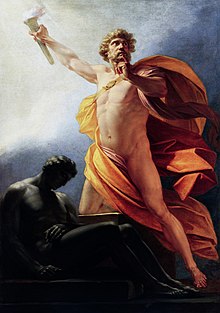
The Olympic flame is one of the symbols of the Olympic Games . This fire is lit in the city of the Games at the time of their opening, and it burns continuously until they end.
The revival of the tradition based on ancient Greek rituals took place during the 1928 Olympic Games in Amsterdam at the Olympic Stadium , for the project of which the Dutch architect Jan Wils was awarded a gold medal in an art competition . Fire burned at the Games Stadium in Los Angeles in 1932.
During the 1936 Olympic Games in Berlin , the Olympic torch relay was held for the first time (according to the propaganda idea of Karl Dima [1] , dating back to the Greek ritual of lampadrome ). More than 3,000 runners participated in the delivery of the torch from Olympia to Berlin . At the Winter Olympics, the fire started in 1936 and in 1948 , but the relay was first held in 1952 before the Winter Olympics in Oslo , and it took off not in Olympia, but in Morgedal .
Typically, a fire is trusted by a famous person, most often an athlete, although there are exceptions. Being elected to host this ceremony is considered a great honor.
Content
Relay
Currently, the Olympic flame is lit in Olympia ( Greece ), a few months before the opening of the games. Eleven women, mostly actresses depicting priestesses , hold a ceremony during which one of them lights the fire with a parabolic mirror that focuses the rays of the sun . This fire is then delivered to the city hosting the Olympic Games . Usually use a torch, which runners carry, passing it to each other on the relay, but at different times other transportation methods were used. In addition to the main torch, special lamps are also lit from the Olympic flame, designed to store fire in case the main torch (or even the fire on the games themselves) goes out for one reason or another. There are several cases when the fire was extinguished: during the games ( Montreal , 1976, during a rainstorm ), in London in 2012 20 days before the games, as well as in Moscow and Blagoveshchensk [2] in 2013.
In 1928, a special tower for the Olympic flame was built in Amsterdam .
For the Games in Berlin, the fire was lit from the sun on July 20, 1936, 15 maidens took part in the ceremony, and the high priestess passed on the torch to the Greek runner Cyril Condilis, who started the baton [3] .
During the Olympics in London (1948) - the first Olympic Games after World War II - the first torchbearer was the corporal of the Greek army, who, before the start of the Olympic torch relay, took off his military uniform and weapon as a sign of the sacred truce.
Surprises began in 1952 . The organizers of the winter games decided to abandon the traditional idea of lighting the Olympic flame. The source of the fire was a fireplace in the house-museum of the pioneer of Norwegian skiing Sondre Norheim in Morgedal . The entire relay race was done on skis.
In the same year, the fire of the Summer Olympics in Helsinki flew part of the way (from Greece to Switzerland ) by plane. In addition, in Finland , it was mixed with flame ignited by the non-setting polar Sun.
In 1956, for the winter games in Cortina d'Ampezzo, the fire was lit in the temple of Jupiter in Rome, and for the winter games of 1960 - again in Morgedale. In 1994, for the winter games in Lillehammer in Morgedal, a second fire was lit, unofficial compared to the fire lit at Olympia, which greatly upset the Greeks [4] .
In 1964, the Olympic torch relay was very short. Fire was delivered by plane from Athens to Vienna , and from there to Innsbruck .
The Olympic torch relay in the Olympic Games in Mexico City has largely repeated the journey of Christopher Columbus .
In 1976, in order to move from Europe to America , part of the flame energy was captured by a sensor, converted into a radio signal, which was sent via satellite to Ottawa [5] [6] , where it initiated the ignition of a torch using a laser beam, and the relay continued [7] [8] .
In 1992, the fire was lit by a burning arrow fired from a bow by a Paralympic Antonio Reboglio .
Since 1996, the organization and sponsorship of the Olympic torch relay has been carried out by Coca-Cola . Using its public programs, the company is actively involved in the selection of torchbearers.
In 2000, in Sydney, the Olympic flame even managed to stay under water for about three minutes.
The first round of the Olympic torch relay took place before the opening of the 2004 Olympics in Athens . The trip lasted 78 days, during which a distance of 78,000 kilometers was covered and 11300 torchbearers were involved.
Criticism and protests
Karl Dim [1] developed the idea of the Olympic torch relay for the 1936 Summer Olympics in Berlin , which were organized by the Nazis under the patronage of Joseph Goebbels [9] . Karl Dima’s reputation was destroyed after his performance at the Olympic Stadium in Berlin in March 1945 became known to members of the Hitler Youth , in which he called adolescents in the Hitler Youth (whose membership was considered mandatory for Aryans from 1936) to defend the capital until death, as did the Spartans of antiquity. As a result of the storming of Berlin, most of the children and adolescents who defended it from the Hitler Youth - about two thousand - died [10] .
The Olympic relay race has repeatedly been the target of an attack in order to draw attention to various problems, including those not related to the Olympic movement [11] [12] .
The International Olympic Committee has decided to stop the international stages of the Olympic torch relay, and limit it only to the territory of the country hosting the Olympics [13] .
Olympic flame lighting ceremony
The relay race ends at the central stadium of the capital of the games, at the end of the opening ceremony. The last participant in the relay lights a fire in a bowl installed in the stadium, where it continues to burn until the end of the games.
Game organizers are trying to come up with an original way to light a fire in the Olympic bowl and make this event memorable. Details of the ceremony are kept secret until the very last moment. To whom it will be entrusted to light the fire, usually, also is not informed in advance. As a rule, this is entrusted to a famous athlete of the host country of the Olympics.
Personnel entitled to light the Olympic flame
Summer Olympics
| Games | City | Torchbearer | Specialization |
|---|---|---|---|
| 1936 | Berlin | Fritz Schilgen | Athletics |
| 1948 | London | John Mark | Athletics |
| 1952 | Helsinki | Paavo Nurmi | Athletics |
| 1956 | Melbourne Stockholm | Ron clarke Hans Vikne | Athletics (Clark) Horse Riding (Vikne) |
| 1960 | Rome | Giancarlo Paris | Athletics |
| 1964 | Tokyo | Yoshinori Sakai | Student born August 6, 1945 on the day of the atomic bombing of Hiroshima |
| 1968 | Mexico city | Norma Enriquette Basilio de Sotelo | Athletics |
| 1972 | Munich | Gunter Zahn | Athletics |
| 1976 | Montreal | Stefan Prefonten , Sandra Henderson | Young athletes representatives of French and English speaking Canada |
| 1980 | Moscow | Sergey Belov | Basketball |
| 1984 | Los Angeles | Rafer johnson | Athletics |
| 1988 | Seoul | Jung Sung Man , Kim Won Thak , Song Mi Chun | Athletics |
| 1992 | Barcelona | Antonio Rebollo | Archery (Paralympic) |
| 1996 | Atlanta | Mohammed Ali | Boxing |
| 2000 | Sydney | Katie Freeman | Athletics |
| 2004 | Athens | Nikos Kaklamanakis | Sailing |
| 2008 | Beijing | Li Ning | Gymnastics |
| 2012 | London | Callam Airlie, Jordan Dakitt, Henri, Katie Kirk, Cameron Makritchi, Aidan Reynolds, Adel Tracy [14] | Seven young athletes aged 16 to 19, nominated by famous British athletes [15] |
| 2016 | Rio de Janeiro | Wanderlei di lima | Athletics |
| 2020 | Tokyo |
Winter Olympics
| Games | City | Torchbearer | Specialization |
|---|---|---|---|
| 1952 | Oslo | Aigil Nansen | Grandson of Fridtjof Nansen |
| 1956 | Cortina d'Ampezzo | Guido Caroli | Skating |
| 1960 | Squaw Valley | Kenneth Henry | Skating |
| 1964 | Innsbruck | Joseph Reeder | Skiing |
| 1968 | Grenoble | Alain Kalma | Figure skating |
| 1972 | Sapporo | Hideki Takada | Schoolboy |
| 1976 | Innsbruck | Joseph Feistmantl , Crystal Haas | Luge |
| 1980 | Lake Placid | Charles Morgan Kerr | Doctor of Psychology |
| 1984 | Sarajevo | Sandra Dubravchich | Figure skating |
| 1988 | Calgary | Robin Perry | Schoolgirl |
| 1992 | Albertville | Michel Platini , Francois-Cyrille Grange | Soccer player and schoolboy from Savoy |
| 1994 | Lillehammer | Haakon | Kronprinz of Norway |
| 1998 | Nagano | Midori Ito | Figure skating |
| 2002 | Salt Lake City | 1980 US Olympic Hockey Team | Hockey |
| 2006 | Turin | Stephanie Belmondo | Ski race |
| 2010 | Vancouver | Wayne Gretzky , Ekaterin Lemay-Doan , Steve Nash , Nancy Green , Rick Hansen | Ice hockey , speed skating , basketball , alpine skiing , paralympic |
| 2014 | Sochi | Irina Rodnina , Vladislav Tretyak | Figure skating , ice hockey |
| 2018 | Pyeongchang | Kim Yong A | Figure skating |
| 2022 | Beijing |
Ways of transporting the Olympic flame
| Type of transport | Year | City of the Games |
| Skiing | 1952 | Oslo (ZOI) |
| Aircraft | 1952 | Helsinki (LOI) |
| Horses | 1956 | Stockholm (LOI) |
| Ship, boat, water ski | 1968 | Mexico City (LOI) |
| Motorcycle | 1972 | Munich (LOI) |
| Laser ray | 1976 | Montreal (LOI) |
| Helicopter | 1984 | Los Angeles (LOI) |
| Snowmobile | 1988 | Calgary (ZOI) |
| Supersonic aircraft Concorde | 1992 | Albertville (ZOI) |
| Frigate Cataluna | 1992 | Barcelona (LOI) |
| Reindeer harness, parachute, disabled carriage | 1994 | Lillehammer (ZOI) |
| Canoe, Pony Express, Steamer, Train | 1996 | Atlanta (LOI) |
| Dog team, snowmobile, horse-drawn sleigh | 2002 | Salt Lake City (ZOI) |
| Formula 1 race car of the Ferrari team, venetian gondola | 2006 | Turin (ZOI) |
| Dragon (traditional Chinese boat) | 2008 | Beijing (LOI) |
| Traditional English boat, racehorses, steam locomotive , bungee , speed boat | 2012 | London (LOI) |
See also
- Live fire
- Eternal flame
- Olympic symbols
- Olympic Torch Relay 2014 Winter Olympics
- 2012 Olympic torch relay
- Olympic Torch Relay 2008 Summer Olympics
- Olympic torch relay of the 2004 Summer Olympics
Notes
- ↑ 1 2 Mallon B. & Heijmans J. Historical Dictionary of the Olympic Movement. 4th ed. The Scarecrow Press, 2011. P. LII, 99
- ↑ The icy wind extinguished the Olympic flame in Blagoveshchensk
- ↑ Mallon B. & Heijmans J. Historical Dictionary of the Olympic Movement. 4th ed. The Scarecrow Press, 2011. P. LII
- ↑ Mallon B. & Heijmans J. Historical Dictionary of the Olympic Movement. 4th ed. The Scarecrow Press, 2011. P. 271
- ↑ From the history of olympiads. The "modest" high cost of Montreal
- ↑ Fire relay race - records, facts, oddities
- ↑ Relay of different years
- ↑ The Incredible Adventures of the Olympic Flame
- ↑ Taylor, Paul, Jews and the Olympic Games , Sussex Academy Press
- ↑ Guy Walters From Berlin to Beijing // Standpoint Online , 2008
- ↑ Turpin, Adrian . Olympics Special: The Lost Olympians (Page 1) , Find Articles, originally The Independent on Sunday (August 8, 2004). Archived on April 13, 2008. Date of treatment April 6, 2008.
- ↑ Lews, Paul , Kelso, Paul. Thousands protest as Olympic flame carried through London , The Guardian (April 7, 2008). Date of treatment May 18, 2011.
- ↑ The Olympic torch relay will no longer be held . Siberian News Agency (03/28/2009). Date of treatment November 2, 2013.
- ↑ Seven teenagers light Games' cauldron
- ↑ Steve Redgrave delivered the torch directly to the stadium.
Links
2008 Google Maps KMZ Olympic torch relay ( KMZ tag file for Google Earth )