Light cruisers of the Caroline type are a type of light cruisers of the Royal Royal Navy of Great Britain during the First World War . In total, 6 units were built: Caroline ( Caroline ), Carisfort ( Carysfort ), Cleopatra ( Cleopatra ), Komus ( Camus ), Conquest ( Conquest ), Cordelia ( Cordelia ). The development of light cruisers of the Arethusa type, the ancestors of the C -class cruisers.
| Caroline Light Cruisers | |
|---|---|
| Caroline-class light cruisers | |
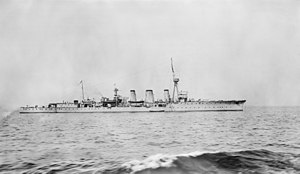 Light cruiser Caroline | |
| Project | |
| A country |
|
| Preceding type | type "Arethusa" |
| Subsequent type | type of "Calliope" |
| Main characteristics | |
| Displacement | Normal - 4219 t , full - 4733 |
| Length | 135.9 m |
| Width | 12.6 m |
| Draft | 4.6 m |
| Reservation | Belt - 75 mm; deck - 25 mm |
| Engines | 4 TZ Parsons Carisfort 2 PT Brown-Curtis 8 steam tube boilers |
| Power | 40 000 liters from. |
| Mover | the screws |
| Speed | 28.5 knots |
| Sailing range | 5,000 miles with 16 knots (Carysfort, which did not have cruising turbines, is 3,200 miles). |
| Crew | 301 people |
| Armament | |
| Artillery | 2 × 1 - 152 mm / 45, 8 × 1 - 102 mm / 45 |
| Flak | 1 × 1 - 76 mm 4 × 1 - 47 mm |
| Mine torpedo armament | Two twin-tube 533 mm torpedo tubes [1] |

A further development of the series was the Kalliope type cruiser.
Content
- 1 Design
- 1.1 Powerplant
- 1.2 Booking
- 1.3 Armament
- 2 Service
- 3 notes
- 4 References
- 5 Literature
Design
Powerplant
8 Yarrow water tube boilers with a working pressure of 16.5 atmospheres. The fuel supply is 916 tons of oil.
Booking
On-board armor was made of steel grade NT (High Tensile Steel), and was used as a structural element to ensure the longitudinal strength of the hull. Reservation deck was 25.4 mm and was made from the same material.
Armament
They were armed with two linearly elevated 152-mm guns located in the stern “Mk. XII ”with a barrel length of 45 calibers, 8 × 102-mm Mk.V guns of 45 calibers located in pairs in the nose and on both sides of the cruisers and 2 × 2,533 mm torpedo tubes. Artillery fire control was carried out from two rangefinder posts located on the bow superstructure and aft bridge. Each post was equipped with a Barr & Stroud open-standing rangefinder with a nine-foot base (2.74 m).
Service
“ Caroline ” - laid down on January 28, 1914, launched on September 29, 1914, went into operation in December 1914
“ Carisfort ” - laid down February 25, 1914, launched November 14, 1914, went into operation in June 1915
" Cleopatra " - laid down on February 26, 1914, launched on January 14, 1915, went into operation in June 1915
" Komus " - laid down on November 3, 1913, launched on December 16, 1914, went into operation in January 1915.
" Conquest " - laid down on March 3, 1914, launched on January 20, 1915, went into operation in June 1915.
“ Cordelia ” - laid down on July 21, 1913, launched on February 23, 1914, went into operation in January 1915
Notes
- ↑ All data is given at the time of entry into operation.
Links
Literature
- Donets A. Cruiser alphabetical types. Part 1 // Direct descendants of the Scouts: Cruisers type C. - Moscow: Military Book LLC, 2005. - 134 p. - (Cruisers of Britain). - 250 copies. - ISBN 5-902863-06-6 .
- Nenakhov Yu. Yu. Encyclopedia of the Cruisers 1910-2005. - Minsk, Harvest, 2007.
- Conway's All the World's Fighting Ships, 1922-1946.- Annapolis, Maryland, USA: Naval Institute Press, 1996.
- Conway's All the World's Fighting Ships, 1906-1921. - London: Conway Maritime Press, 1986. - ISBN 0-85177-245-5 .